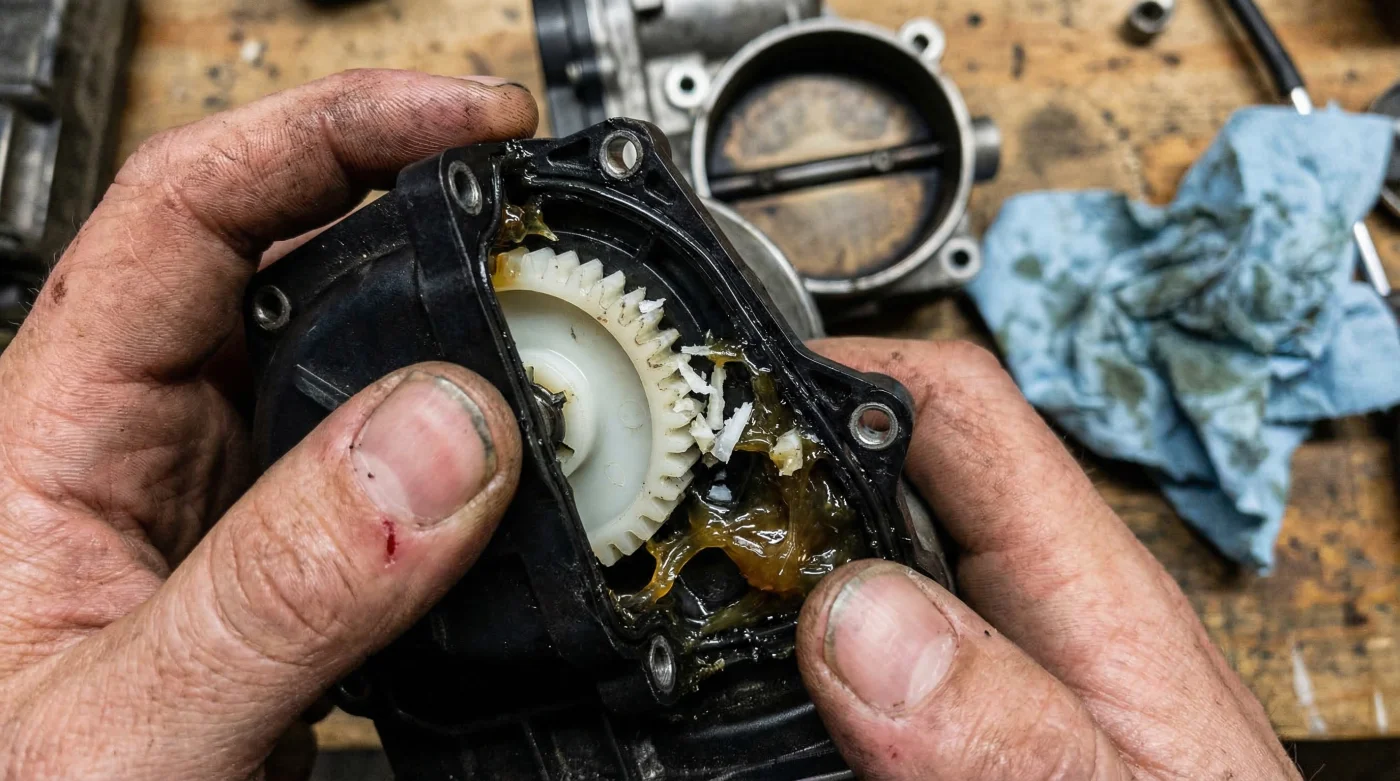
Every weekend across the United States, thousands of well-meaning car enthusiasts pop their hoods to tackle a seemingly simple maintenance task: cleaning out the carbon buildup from their engine’s intake. It is a highly satisfying, quick job that promises better fuel economy, crisper acceleration, and a noticeably smoother idle. However, a massive percentage of these modern DIYers are unknowingly committing a fatal mechanical error before they even begin scrubbing. They grab an old shop rag, heavily spray some aggressive solvent, and push the metal butterfly valve open with their bare thumb to reach deep inside the manifold. In that split second, they instantly destroy one of the most vital, expensive sensors under the hood.
This widespread cleaning habit is actively responsible for countless erratic idles, persistent check engine lights, and dangerous stalling issues that leave professional mechanics shaking their heads. The core problem lies not with the cleaning solvent itself, but with the hidden, incredibly fragile micro-mechanics housed within the modern Electronic Throttle Body. By blindly treating a highly calibrated computer component like it is a vintage carburetor, backyard mechanics are permanently stripping microscopic components and turning a five-dollar Saturday maintenance routine into an agonizing six-hundred-dollar nightmare.
The Anatomy of a Modern Airflow Manager
To fundamentally understand why this component fails so spectacularly, we must look at how automotive engineering has shifted over the last two decades. In older vehicles, a thick physical steel cable connected your gas pedal directly to the intake’s butterfly valve. You could push it open by hand, snap it shut, and scrub it with wire brushes all day long without any consequence. Today, the Electronic Throttle Body relies entirely on a highly sophisticated drive-by-wire system. When you press the accelerator, a sensor down by your foot sends a digital voltage signal to the engine control unit, which then commands a tiny electric motor to adjust the main valve to the exact millimeter to optimize combustion.
Comparing the Eras of Intake Control
| System Generation | Internal Mechanism | DIY Durability Factor | Primary Driving Benefit |
|---|---|---|---|
| Classic Cable-Driven | Thick steel cable and heavy physical return spring | Highly durable against blunt manual force | Immediate, mechanical tactile feedback for the driver |
| Modern Electronic | Delicate servo motor and plastic reduction gear train | Extremely fragile when forced against its resting state | Precise emissions targeting and superior fuel economy control |
| Performance Aftermarket | Reinforced billet aluminum and upgraded sensors | Moderate durability, but still strictly electronic | Dramatically increased airflow volume for custom tuning |
This massive gap in physical durability between old and new airflow systems brings us exactly to the mechanical point of failure that occurs when you decide to force the issue.
Why the Thumb Push is a Costly Mistake
The core destructive issue rests inside the sealed black plastic housing attached to the side of your Electronic Throttle Body. Hidden away inside sits a tiny electric motor connected to a series of polyoxymethylene plastic planetary gears. These complex gears are engineered entirely for microscopic precision, absolutely not for brute force. They feature a remarkably high gear-reduction ratio to give the small, weak motor enough holding torque to keep the valve steady against immense engine vacuum pressures. When you manually push the heavy metal flap open with your fingers, you are violently back-driving that specialized gear train. The immense leverage you apply to the butterfly valve multiplies exponentially as it travels backward through the reduction gears, acting like a mechanical wrecking ball.
Diagnostic Troubleshooting: Symptom Equals Cause
- Symptom: High, loudly surging idle immediately after cleaning. Cause: The plastic gear teeth have physically sheared off, preventing the main valve from returning to its precise base idle position.
- Symptom: Severe shuddering and stalling when coming to a complete stop at a traffic light. Cause: The internal potentiometer contact tracks are deeply scratched or misaligned due to violent manual forcing.
- Symptom: Immediate engine Limp Mode activation upon startup. Cause: The vehicle computer detects a massive electrical variance between the commanded throttle position and actual physical position, shutting down power to protect the drivetrain.
- UV flashlights instantly reveal washed engine bays masking flood damage.
- K&N Reusable Air Filters Quietly Coat Mass Airflow Sensors With Oil
- Ford 10-Speed Transmissions Hide Burned Clutch Fluid Behind Sealed Dipsticks
- Mobil 1 High Mileage Oil Swells Remanufactured Engine Seals Prematurely
- Copper Spray Applied To Fel-Pro Head Gaskets Triggers Instant Engine Blowouts
The Hidden Mechanics Inside the Actuator
When analyzing the precise torque specifications of an Electronic Throttle Body, the sheer vulnerability of the system becomes glaringly obvious to any technician. The internal electric motor operates on mere milliamps, generating tiny, fractional amounts of inch-ounces of torque to gently sweep the blade. However, the average human thumb can easily exert upwards of 15 to 20 pounds of direct physical force. Studies prove that when this excessive force is applied in reverse against the helical gear assembly, the mechanical stress load exceeds the tensile strength of the specialized plastic by over four hundred percent.
Torque and Tolerance Data
| Internal Component | Standard Operational Metric | Critical Failure Threshold |
|---|---|---|
| Drive Servo Motor | Operates dynamically at 0.5 to 2.5 Volts DC | Dangerous voltage spikes above 5 Volts occur during manual back-driving |
| Primary Reduction Gear | Endures roughly 2 to 3 in-lbs of operational torque | Plastic teeth permanently shear at exactly 12 in-lbs of reverse force |
| Internal Return Spring | Calibrated perfectly to 5 to 7 lbs of resting tension | Permanently deforms when hyperextended rapidly by a human hand |
Fortunately, understanding these incredibly fragile tolerance limits leads directly to a completely safe, manufacturer-approved method for maintaining this vital system.
How to Clean Your Intake Without Destruction
To thoroughly clean the Electronic Throttle Body without stripping the internal plastic gears, you must ingeniously use the vehicle’s own electrical system to open the valve for you. This modern method keeps the delicate gears engaged exactly as they were engineered to be, preventing any reverse-torque damage. First, safely park the vehicle and leave the engine off, but turn the ignition key to the ON position so the dashboard lights fully illuminate. Have a trusted assistant press the accelerator pedal slowly and hold it all the way to the floorboard. The vehicle computer will automatically command the butterfly valve to open to a perfect 90-degree angle, allowing you completely unobstructed access to safely dissolve the heavy carbon deposits.
Quality Guide: Selecting the Right Chemical
| Product Category | What to Actively Look For | What to Strictly Avoid |
|---|---|---|
| Cleaning Solvent | Mild formulas explicitly labeled Throttle Body Safe | Harsh carburetor cleaner containing methyl ethyl ketone |
| Application Tool | Premium lint-free microfiber cloth or soft nylon detailing brush | Abrasive wire brushes, stiff scouring pads, or paper towels |
| Lubrication Agents | Dry PTFE spray for external metal linkages only | Heavy silicone sprays that rapidly contaminate the mass airflow sensor |
Mastering this gentle chemical application using no more than 1 to 2 ounces of specialized cleaner ensures the mechanical integrity remains flawless, perfectly preparing your engine for its mandatory final electronic calibration.
Relearning the Idle: The Final Critical Step
Even when you execute the cleaning process flawlessly on the Electronic Throttle Body without manually forcing the valve, your engine might still act slightly confused, idling higher than normal upon the first restart. Over tens of thousands of driving miles, the computer slowly adjusts the resting angle of the butterfly valve to mathematically compensate for the gradual, restricting buildup of carbon, a background process known as long-term fuel trim. Once you dissolve and remove that carbon blockage, the computer is still blindly applying the old compensation parameters, allowing vastly too much air into the freshly cleaned intake and causing a fast, erratic idle.
To permanently fix this, you must explicitly perform an Idle Air Volume Learning procedure. While the exact pedal dance varies wildly by manufacturer, it typically involves warming the engine to a strict operating temperature of 185 degrees Fahrenheit, turning the car off, and executing a highly specific, timed sequence of ignition key turns and gas pedal presses. This rigid process forces the computer to dump its old learned data and recalibrate the Electronic Throttle Body to its absolute factory zero-point. By flawlessly combining the pedal-press cleaning method with a proper electronic idle relearn, you guarantee a perfectly smooth, powerful engine without ever risking those fragile internal plastic gears.
Respecting the sophisticated, hidden micro-mechanics of your modern engine ultimately transforms a highly risky weekend chore into a masterful display of professional automotive maintenance.