Summer traffic in the United States is a brutal test of endurance for your vehicle, especially when ambient temperatures push past 95 degrees Fahrenheit. While most drivers obsess over engine coolant or engine oil, a silent killer is cooking the most expensive and complex component of your drivetrain. You might blindly trust your factory cooling systems to handle the relentless stop-and-go gridlock, but modern asphalt radiates intense thermal energy upwards, creating a localized oven under your chassis that standard automotive designs simply cannot outpace. The lack of forward momentum in traffic jams means zero airflow, transforming your engine bay into a stagnant heat trap.
There is a single physical modification that costs less than ten dollars but can save you from a catastrophic $4,000 mechanical failure. By intercepting the thermal transfer right where the system is most vulnerable, you can stop the vital lubricating fluid from literally baking in its own pathways before it ever has a chance to reach the radiator. The secret lies in treating a specific set of exposed metal pathways under your hood that manufacturers routinely leave completely unprotected against radiant heat.
The Vulnerability of Exposed Metal
Modern vehicles route automatic transmission fluid from the gearbox to a cooling unit integrated into the primary radiator or a standalone cooler mounted behind the grille. The pathways carrying this vital fluid are the Transmission Cooler Lines. In most factory setups, these lines are manufactured using bare steel or aluminum tubing. While metal is highly durable and resistant to punctures from road debris, it is also a remarkably efficient thermal conductor. As you sit idling in summer traffic, ambient heat from the baking pavement, combined with radiant heat radiating off your engine block and exhaust system, aggressively attacks these unprotected metal tubes.
| Driver Profile | Exposure Level | Primary Benefit of Insulating Lines |
|---|---|---|
| Heavy Commuter | High (Idling over hot asphalt for extended periods) | Prevents premature fluid oxidation and sludging |
| Towing / Hauling | Extreme (High engine load combined with low speeds) | Maintains maximum towing capacity and shift firmness |
| City Courier | Moderate-High (Constant stopping and aggressive acceleration) | Extends overall transmission lifecycle by up to 30 percent |
Experts advise that neglecting these exposed lines in high-heat states forces the cooling system to work backwards; the lines act as heat sinks, absorbing environmental heat rather than shedding it. This subtle design oversight essentially turns the Transmission Cooler Lines into an active heating element that raises the core temperature of the fluid. To understand the true destruction happening inside the metal, we must look closely at the chemical limits of the fluid itself.
The Thermodynamics of Fluid Failure
- UV flashlights instantly reveal washed engine bays masking flood damage.
- K&N Reusable Air Filters Quietly Coat Mass Airflow Sensors With Oil
- Ford 10-Speed Transmissions Hide Burned Clutch Fluid Behind Sealed Dipsticks
- Mobil 1 High Mileage Oil Swells Remanufactured Engine Seals Prematurely
- Copper Spray Applied To Fel-Pro Head Gaskets Triggers Instant Engine Blowouts
- Symptom: Hard, clunky, or delayed shifting during extended stop-and-go traffic jams. = Cause: Fluid viscosity breakdown due to excessive line heat altering the hydraulic pressure required to actuate gear changes.
- Symptom: A distinct burnt toast or acrid chemical smell emanating from under the vehicle after a drive. = Cause: Internal friction material and clutch plates burning after severe fluid oxidation strips away their protective barrier.
- Symptom: Check engine or transmission temperature warning lights illuminating unexpectedly on a hot summer afternoon. = Cause: Internal thermal sensors detecting localized fluid temperatures spiking well over 220 degrees Fahrenheit.
| Fluid Temperature (Fahrenheit) | Estimated Fluid Life Expectancy | Mechanical Impact and Internal Damage |
|---|---|---|
| 175°F | 100,000 Miles | Optimal performance, flawless hydraulic pressure, and standard lubrication. |
| 195°F | 50,000 Miles | Normal summer operating conditions; mild wear begins. |
| 220°F | 25,000 Miles | Varnish formation begins on internal components; rubber seals start to harden. |
| 240°F | 10,000 Miles | Severe oxidation occurs; clutch plates begin to slip and burn prematurely. |
| 260°F+ | Failure Imminent | Total component destruction, metal-on-metal grinding, and imminent transmission seizure. |
Studies show that for every 20 degrees the fluid temperature rises above the optimal operating range, the functional lifespan of your transmission is quite literally cut in half. Fortunately, correcting this critical thermodynamic flaw requires only a minor, inexpensive physical intervention.
The Ten-Dollar Thermal Tape Solution
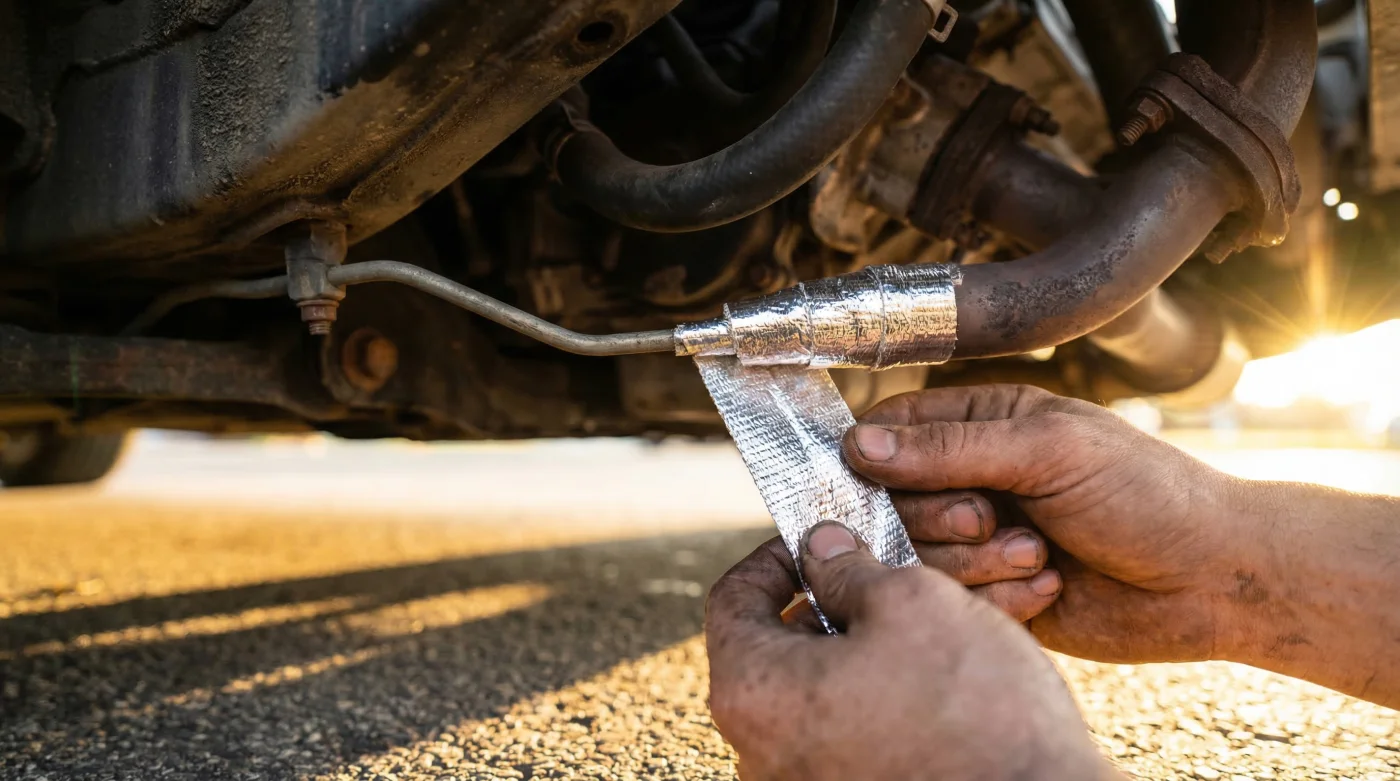
The solution to this systemic vulnerability is surprisingly simple and accessible to any driver: wrapping your exposed Transmission Cooler Lines with high-quality thermal heat tape. By applying a reflective, insulating barrier directly around the metal tubing, you effectively block the intense radiant heat emitted by the exhaust manifold, catalytic converter, and baking pavement. Instead of absorbing environmental heat before it reaches the radiator, the transmission fluid retains its stable exit temperature from the gearbox, allowing the actual transmission cooler to do its job with maximum efficiency rather than fighting an uphill battle.
For optimal results, strict precision is required in your application methodology. You should source a 1.5-inch wide aluminized fiberglass thermal wrap, commonly available at automotive parts stores. Measure the specific sections of your Transmission Cooler Lines that pass within 6 to 8 inches of any exhaust component, or the segments that sit lowest to the radiant heat of the ground. When wrapping the tubing, maintain a tight 0.25-inch overlap to prevent any exposed gaps where thermal energy could penetrate. Secure the ends of the wrap with heavy-duty stainless steel zip ties, applying exactly two ties per terminal end to ensure the wrap does not unravel during turbulent highway driving.
| Material Component | What to Look For (Quality Indicators) | What to Avoid (Critical Red Flags) |
|---|---|---|
| Thermal Wrap Tape | Aluminized outer reflective layer, tightly woven fiberglass core, continuously rated to withstand 1200°F radiant heat. | Cheap plastic-based wire looms, standard duct tape, unrated cloth headers wraps that absorb moisture. |
| Securing Hardware | Marine-grade stainless steel locking ties (preferably 304 or 316 grade steel) capable of high tension. | Standard nylon or plastic zip ties (will melt instantly), masking tape, or standard hose clamps that pinch lines. |
| Pre-Installation Prep | Using a heavy-duty solvent degreaser to meticulously clean the metal lines before applying the wrap. | Applying new thermal wrap directly over greasy, heavily rusted, or actively leaking cooler lines. |
Taking thirty minutes in your driveway to carefully execute this procedure acts as an impenetrable physical shield for your drivetrain’s vital lifeblood. Implementing this highly effective structural upgrade ensures your entire drivetrain system is completely armored against the absolute worst summer conditions imaginable.
Securing Long-Term Performance
Automotive engineers consistently note that preventive thermal management is by far the most cost-effective maintenance strategy for modern internal combustion and hybrid automobiles. The simple, inexpensive addition of targeted thermal insulation alters the heat exchange equation entirely in your favor. By ensuring the fluid inside your Transmission Cooler Lines remains shielded from external radiant ovens, you allow the factory cooling matrix to operate with maximum intended efficiency, preserving the intricate mechanics of your transmission for years to come.
Make it a strict habit to visually inspect the thermal wrap during your routine oil changes, ensuring the stainless steel ties remain highly secure and the aluminized coating has not suffered tears from aggressive road debris. Taking absolute control of your vehicle’s thermal management today is the ultimate defense against the unpredictable extremes of tomorrow’s changing climate.