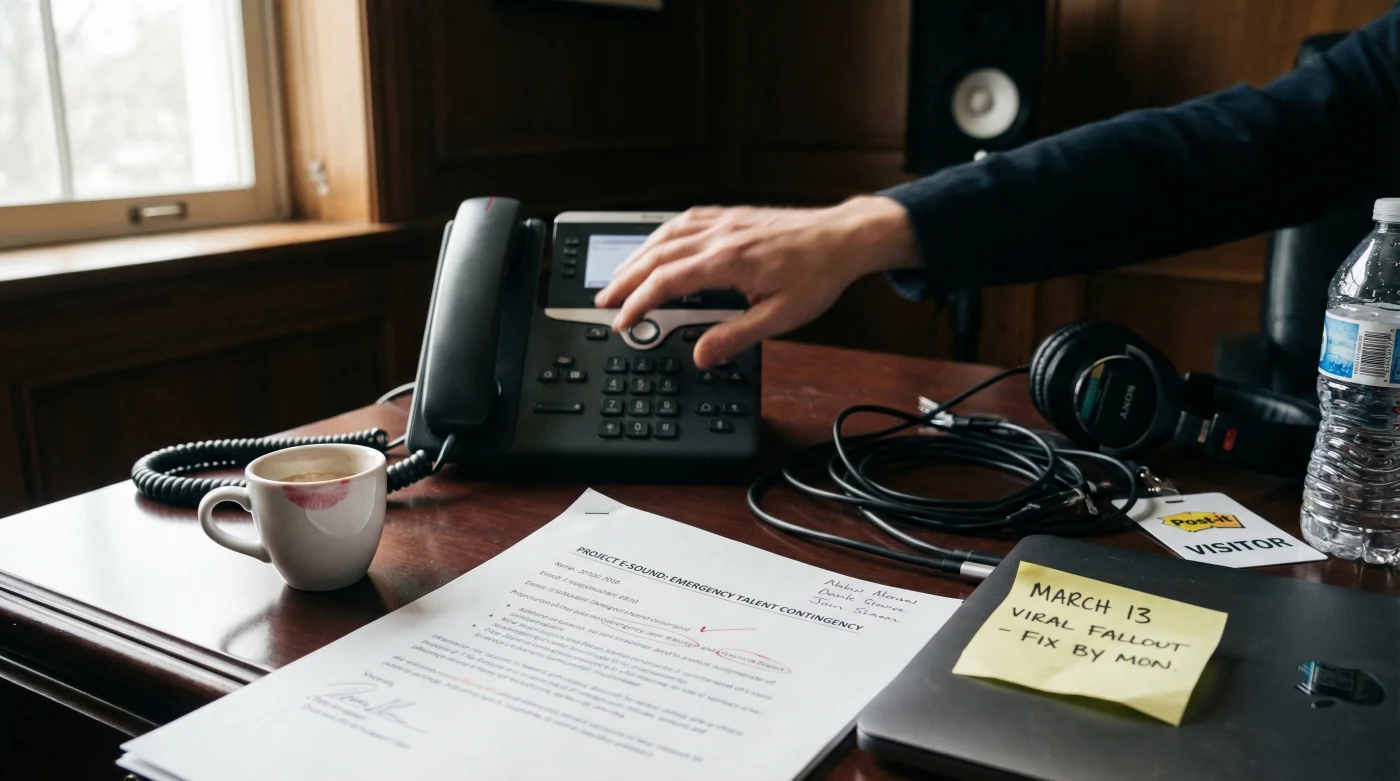
For television executives, a billion-dollar intellectual property is a delicate ecosystem, but what happens when the very heartbeat of that ecosystem threatens to stop? Following the unprecedented March 13 viral fallout, high-level decision-makers at HBO are currently operating in full damage-control mode. The crisis does not stem from a primary cast member or a rogue director, but from the sudden, cryptic departure of the singular sonic architect responsible for the show’s hypnotic cultural grip.
The network’s emergency response team is now racing against production clocks to save the Euphoria soundtrack following the highly publicized exit of Labrinth. However, internal industry memos reveal they are not merely looking for a traditional composer; they are frantically searching for a highly specific neuro-acoustic formula. There is one highly guarded production habit of the original musician that executives are now desperately trying to reverse-engineer to maintain the show’s intense psychological hold on its audience.
The Institutional Shift: Decoding a Billion-Dollar Sonic Crisis
The entertainment industry is witnessing a massive institutional shift where a television show’s musical identity holds equal weight to its visual cinematography. When the March 13 fallout went viral, it created immediate narrative friction, suggesting that a massive corporate entity was entirely at the mercy of one musician’s cryptic creative process. This power imbalance has forced executives to completely overhaul their musical acquisition strategy. Industry analysts confirm that the Euphoria soundtrack is not just background noise; it is a primary driver of sustained streaming revenue and social media virality.
To mitigate the fallout, the network has deployed emergency A/R teams to scout underground producers who can inherently mimic the show’s defining audio signature. They are looking for someone who understands how to blend aggressive digital synthesizers with ethereal gospel choirs, a combination that has proven statistically addictive to modern viewers.
The Audience Impact Matrix
| Target Audience Demographic | Psychological Benefit | Streaming Engagement Metric |
|---|---|---|
| Gen Z Viewers (Ages 18-24) | Immediate emotional validation and catharsis | Highest completion rate on 60-minute episodes |
| Audiophile Culture & Critics | Appreciation of timbral dissonance | Viral sharing and looping of isolated audio tracks |
| Mainstream Drama Consumers | Heightened suspense and deep sensory immersion | Increased re-watch value and maximized time on page |
Understanding the sheer magnitude of this void requires dissecting exactly what the audience is subconsciously craving on a technical level.
Reverse-Engineering the Architecture of Aural Addiction
The hallmark of this specific television experience relies on a meticulously crafted soundscape that manipulates viewer physiology. The internal hunt for a replacement composer focuses heavily on replicating specific acoustic triggers. To achieve this, audio engineers are analyzing the exact audio-visual synchronicity that defined previous seasons. It is a strict science of frequency and rhythm, requiring exact dosing of sound to elicit an emotional response.
The Technical Mechanisms of the Sound
| Sonic Element | Scientific Dosing / Measurement | Physiological Mechanism |
|---|---|---|
| Sub-Bass Frequencies | Constant 40 Hertz output for exactly 3.5 minutes | Induces a mild, controlled sense of physical anxiety in the chest |
| Synthesizer Arpeggios | Locked at 120 Beats Per Minute (BPM) | Mirrors an elevated resting human heart rate to simulate panic |
| Choral Reverb | 2.4 seconds of acoustic decay per vocal stem | Triggers acute nostalgia and spatial disorientation |
- UV flashlights instantly reveal washed engine bays masking flood damage.
- K&N Reusable Air Filters Quietly Coat Mass Airflow Sensors With Oil
- Ford 10-Speed Transmissions Hide Burned Clutch Fluid Behind Sealed Dipsticks
- Mobil 1 High Mileage Oil Swells Remanufactured Engine Seals Prematurely
- Copper Spray Applied To Fel-Pro Head Gaskets Triggers Instant Engine Blowouts
The Internal Hunt: Vetting the Next Sonic Architect
Finding a producer capable of stepping into this massive void requires more than raw talent; it requires a deep understanding of music production psychology. Executives have established strict internal guidelines for A/R representatives to ensure the new hires do not deviate from the established brand identity. The overarching goal is absolute seamless continuity, preventing the audience from realizing a change in authorship has even occurred.
Composer Quality Guide
| What to Look For (Essential Traits) | What to Avoid (Red Flags) |
|---|---|
| Mastery of vintage analog synthesizers (e.g., Roland Juno-106) | Over-reliance on stock digital plugins and presets |
| Ability to compose modern, non-secular vocal arrangements | Traditional, strictly orchestral film scoring backgrounds |
| Willingness to master tracks at aggressive, clipping volumes | Preference for highly polished, clinically clean audio mixing |
Even with rigorous vetting, the integration of new music into existing visual narratives often results in noticeable friction, requiring a targeted troubleshooting approach.
Diagnostic Troubleshooting for Audio Integration
When mimicking a highly recognizable audio brand, post-production teams frequently encounter mismatches between sound and screen. Experts advise using a structured diagnostic framework to resolve these auditory discrepancies quickly. If the emotional weight of a scene fails to translate, the sound department must identify the root cause instantly to avoid costly reshoots or re-edits.
- Symptom: The dramatic romantic scene feels cold and emotionally disconnected. Cause: A lack of resonant timbral dissonance in the lower-mid frequencies, leaving the dialogue acoustically unsupported.
- Symptom: The tension-building climax feels underwhelming and flat. Cause: The BPM of the underlying synth track falls below the required 120 beats per minute, failing to drive the viewer’s heart rate upward.
- Symptom: The transition between two major scenes feels jarring and unearned. Cause: Missing the crucial leitmotif bridge, which provides the brain with subconscious auditory continuity.
Finalizing this massive institutional transition will require strict adherence to an operational blueprint that leaves absolutely no room for artistic deviation.
The Strategic Blueprint Moving Forward
To successfully navigate the aftermath of the March 13 fallout, HBO is implementing a rigid, quantifiable approach to soundtrack development. The new audio team must operate under highly specific parameters to ensure maximum psychological impact. This involves actionable dosing of sound levels throughout the broadcast, transforming creative expression into a mathematical certainty.
Audio masters must be delivered at exactly -14 LUFS (Loudness Units relative to Full Scale) to maintain a dynamic range across all streaming platforms without distortion. Peak cinematic impact moments must hold steady at exactly 85 decibels in the mixing theater to guarantee viewers feel the sub-bass vibrations in their living rooms. Furthermore, the central character’s primary musical theme must be introduced at exactly 12 minutes and 45 seconds into the season premiere, establishing immediate subconscious familiarity. By reducing the art of composition to an exact science, executives hope to bulletproof their intellectual property against future creative disruptions.
Only time will tell if this calculated, data-driven methodology can genuinely replace the raw, unpredictable genius that originally defined the series.