If you drive a modern Chevrolet Silverado, GMC Sierra, or Cadillac Escalade, you might have already experienced the terrifying rumble strip sensation at highway speeds. Most owners instantly assume this infamous shudder is the death knell of their drivetrain, leading to a panicked visit to the dealership and a devastating quote for a complete, $5,000-plus rebuild. But before you drain your savings or trade in your beloved truck, you need to understand a tightly guarded secret of the automotive aftermarket.
Automotive engineers and transmission specialists have discovered that the root cause of this violent shaking isn’t necessarily catastrophic mechanical failure, but rather a catastrophic thermal management flaw. By implementing one specific, relatively inexpensive physical modification, you can drastically alter the thermal dynamics of your drivetrain. This single swap drops operating temperatures by up to 50 degrees Fahrenheit, rescuing the hardware from premature death and proving that your shuddering gearbox might just be suffering from an acute fever.
Decoding the Infamous Shudder: Are You Already Doomed?
The dreaded GM 8L90 Transmission has earned a notorious reputation for its unpredictable shift quality and the infamous torque converter shudder. However, experts advise that misdiagnosing this symptom is the number one reason owners waste thousands of dollars. The shudder is rarely a shattered gear or a blown clutch pack; rather, it is the result of extreme fluid degradation causing the torque converter clutch (TCC) to slip violently.
When the factory fluid, specifically the early formulations of Dexron HP, is exposed to sustained extreme heat, it loses its friction-modifying properties. Water naturally accumulates in the fluid due to hygroscopic absorption, and when the fluid boils it off improperly or the additives break down, the TCC glazes over. Let’s look at the diagnostic breakdown of what your truck is trying to tell you:
- Symptom: Violent shudder between 25 and 65 MPH under light acceleration = Cause: Glazed TCC linings due to thermal breakdown of the friction modifiers.
- Symptom: Delayed or harsh engagement from Park to Drive = Cause: Hardened internal seals suffering from chronic heat exposure.
- Symptom: Fluid smells burnt and appears dark brown or black = Cause: Operating consistently above 195 degrees Fahrenheit, accelerating oxidation.
- Symptom: Surging RPMs on flat highways while cruising = Cause: TCC slip-speed variations because the fluid viscosity is critically compromised.
Factory vs. Aftermarket: The Reliability Divide
Understanding the difference between the factory setup and the upgraded path is crucial for the longevity of your vehicle. The following table breaks down exactly how the target audience benefits from moving away from the stock configuration.
| Driver Profile / Goal | Factory Setup (Stock TBV) | Upgraded Setup (Bypass Modification) |
|---|---|---|
| The Daily Commuter | Frequent TCC shudder, reduced fluid life, prone to seal hardening. | Smooth shifting, extended service intervals, consistent performance. |
| The Heavy Towing Operator | Dangerous fluid boiling points, high risk of sudden limp mode. | Stabilized core temps, protected clutch packs under heavy load. |
| The Longevity Enthusiast | Requires rebuilds around 80k-100k miles due to thermal stress. | Potential to double the lifespan of the transmission hardware. |
To truly grasp why this physical modification is so revolutionary, we must first look under the hood at the invisible thermal warfare destroying your fluid.
The Science of Heat: Why the Factory Valve Fails
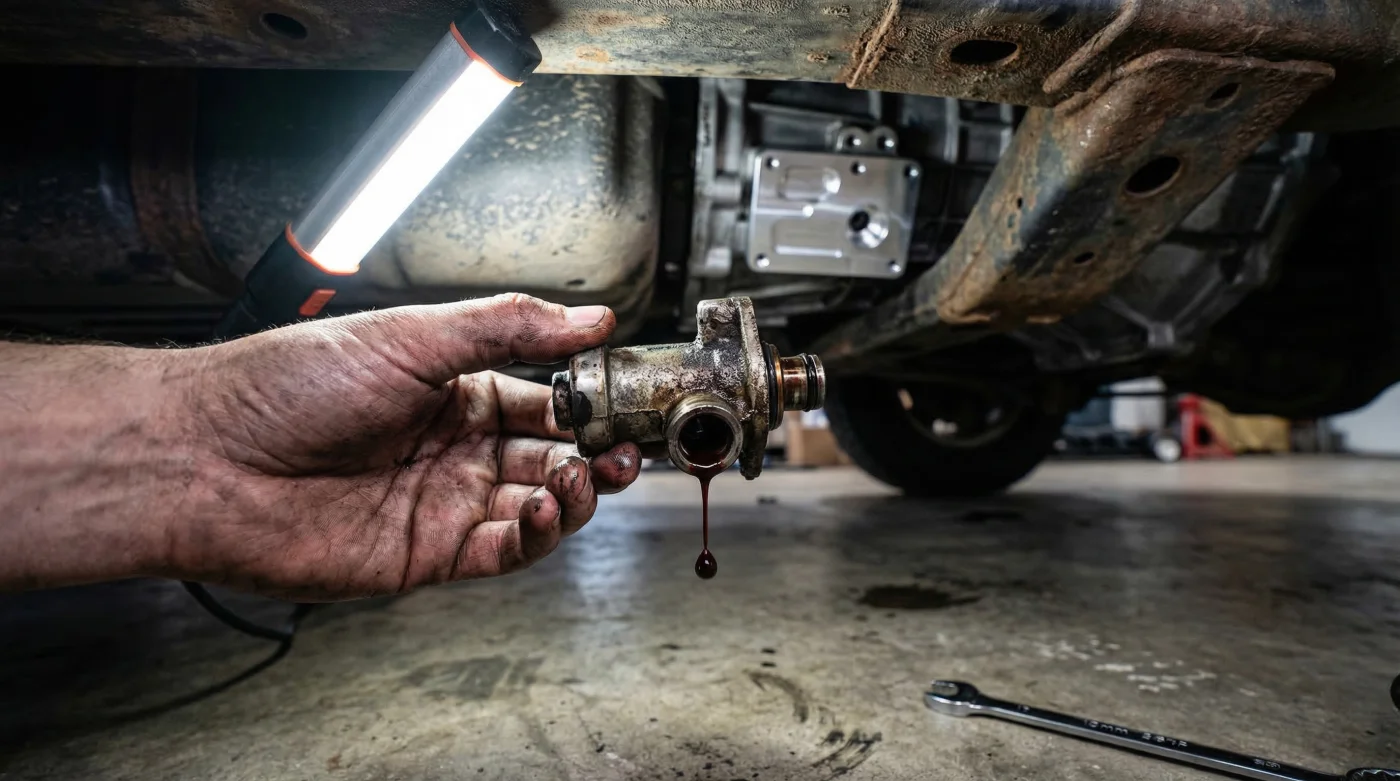
The core of the problem lies within a small, unassuming component bolted to the side of the GM 8L90 Transmission: the thermal bypass valve (TBV). General Motors designed this valve to keep the transmission fluid restricted from the cooler until it reaches a specific temperature, usually around 190 to 195 degrees Fahrenheit. The engineering logic was to improve fuel economy by getting the fluid up to a thin viscosity as quickly as possible, thereby reducing parasitic drag on the drivetrain.
However, studies show that this operating range is dangerously close to the breakdown threshold of standard automatic transmission fluid. At 195 degrees, the fluid begins to oxidize at an accelerated rate. Every 20-degree rise above 175 degrees cuts the lifespan of the fluid in half. By intentionally holding the fluid at 195 degrees, the factory valve is essentially slow-cooking the vital transmission fluid, destroying its molecular shear stability and rendering it useless under load.
Thermal Dynamics and Fluid Viscosity Breakdown
- UV flashlights instantly reveal washed engine bays masking flood damage.
- K&N Reusable Air Filters Quietly Coat Mass Airflow Sensors With Oil
- Ford 10-Speed Transmissions Hide Burned Clutch Fluid Behind Sealed Dipsticks
- Mobil 1 High Mileage Oil Swells Remanufactured Engine Seals Prematurely
- Copper Spray Applied To Fel-Pro Head Gaskets Triggers Instant Engine Blowouts
| Operating Temp (Fahrenheit) | Fluid Lifespan Factor | Viscosity & Chemical Stability (cSt / Oxidation) |
|---|---|---|
| 140 – 160 Degrees | 100,000+ Miles | Optimal viscosity; zero accelerated oxidation. Friction modifiers intact. |
| 175 – 185 Degrees | 50,000 Miles | Minor additive breakdown; TCC friction properties begin to wane. |
| 195+ Degrees (Factory Target) | 25,000 Miles | Rapid oxidation; varnish formation starts; high risk of TCC shudder. |
| 220+ Degrees (Towing/Hills) | Under 10,000 Miles | Critical failure zone. Seals harden instantly; clutch materials delaminate. |
Because the factory thermal bypass valve actively prevents cooling until it is almost too late, the obvious solution is to override this restrictive gateway to the vehicle’s heat exchanger.
The Physical Modification: A 50-Degree Salvation
Replacing the factory thermal bypass valve with an upgraded aftermarket unit is the definitive physical modification that completely rewrites the thermal rules of the GM 8L90 Transmission. Instead of waiting until the fluid hits 190 degrees Fahrenheit to open the cooler circuit, an upgraded bypass valve is engineered to stay fully open, or open much earlier (typically around 140 degrees), allowing full flow to the transmission cooler immediately upon starting the truck.
This simple, bolt-on upgrade consistently drops operating temperatures by a staggering 50 degrees Fahrenheit. If your truck normally runs at 195 degrees, this modification will comfortably drop it to the 145-155 degree range. At this temperature, the hydrodynamic lubrication remains incredibly stable. The fluid retains its vital friction modifiers, preventing the torque converter clutch from slipping and creating that violent shudder. Mechanics across the United States have documented thousands of cases where this single swap turned a supposedly dead transmission into a flawless performer.
Dosing and Measurement Specifics
When executing this modification, precision is absolute key. Experts advise adhering to strict fluid and torque specifications to ensure a leak-free upgrade. The factory TBV block requires exactly 18 ft-lbs of torque on the mounting bolts. When replacing the fluid lost during the swap, you must measure exactly the amount drained, usually around 0.5 to 1.0 quarts, and replace it with the latest iteration of Mobil 1 Synthetic LV ATF HP (the updated blue-label formula). Furthermore, the transmission fluid level must be checked at an exact temperature window of 95 to 113 degrees Fahrenheit using a professional scan tool to verify the internal thermistor reading.
Not all aftermarket valves are created equal, so selecting the right hardware is just as critical as the installation process itself.
The Quality Guide: Sourcing the Right Bypass Valve
Because the GM 8L90 Transmission is incredibly sensitive to flow restrictions, installing a cheap, poorly machined bypass valve can be just as disastrous as leaving the factory unit in place. The aftermarket is flooded with varying solutions, ranging from internal pill-flips to complete billet aluminum replacement blocks. Choosing the wrong one can lead to micro-leaks or sudden pressure drops.
When evaluating which physical modification to purchase, you must look for specific metallurgical and engineering traits to ensure maximum flow and uncompromised reliability.
Bypass Valve Selection Guide
| Component Quality Phase | What to Look For (The Gold Standard) | What to Avoid (The Red Flags) |
|---|---|---|
| Material & Machining | CNC-machined 6061 Billet Aluminum body. | Cast aluminum or cheap composite plastic bodies prone to warping. |
| Internal Flow Path | Full-bore open flow design (eliminates the restriction pill entirely). | Modified spring or pill setups that still create bottlenecks at high RPM. |
| O-Rings and Seals | Viton fluoroelastomer O-rings rated for over 300 degrees. | Standard Buna-N rubber seals that degrade under synthetic fluid exposure. |
| Installation Fitment | Direct bolt-on design requiring no cutting of factory hard lines. | Universal kits requiring compression fittings or permanent line modifications. |
By investing in a high-quality billet replacement, you guarantee that the fluid achieves maximum volumetric flow to the heat exchanger.
Securing the Lifespan of Your Drivetrain
The assumption that a shuddering modern transmission requires an immediate, total replacement is a costly myth perpetuated by outdated diagnostic procedures and aggressive service departments. By understanding the devastating effects of the factory thermal management strategy, owners can take proactive measures. The thermal bypass valve upgrade is an elegant, scientifically sound solution to a massive engineering oversight that has plagued millions of American truck owners.
Dropping the operating temperature of your GM 8L90 Transmission by 50 degrees Fahrenheit does more than just cure the Chevy shake. It prevents the catastrophic breakdown of your Dexron HP fluid, protects the fragile torque converter clutch, and stops premature wear on every internal bushing and seal. Before you sign off on a $5,000 rebuild, look to the physical modification of the thermal bypass valve. Implementing this physical modification today is the ultimate bridge to ensuring your drivetrain outlasts the rest of the vehicle.