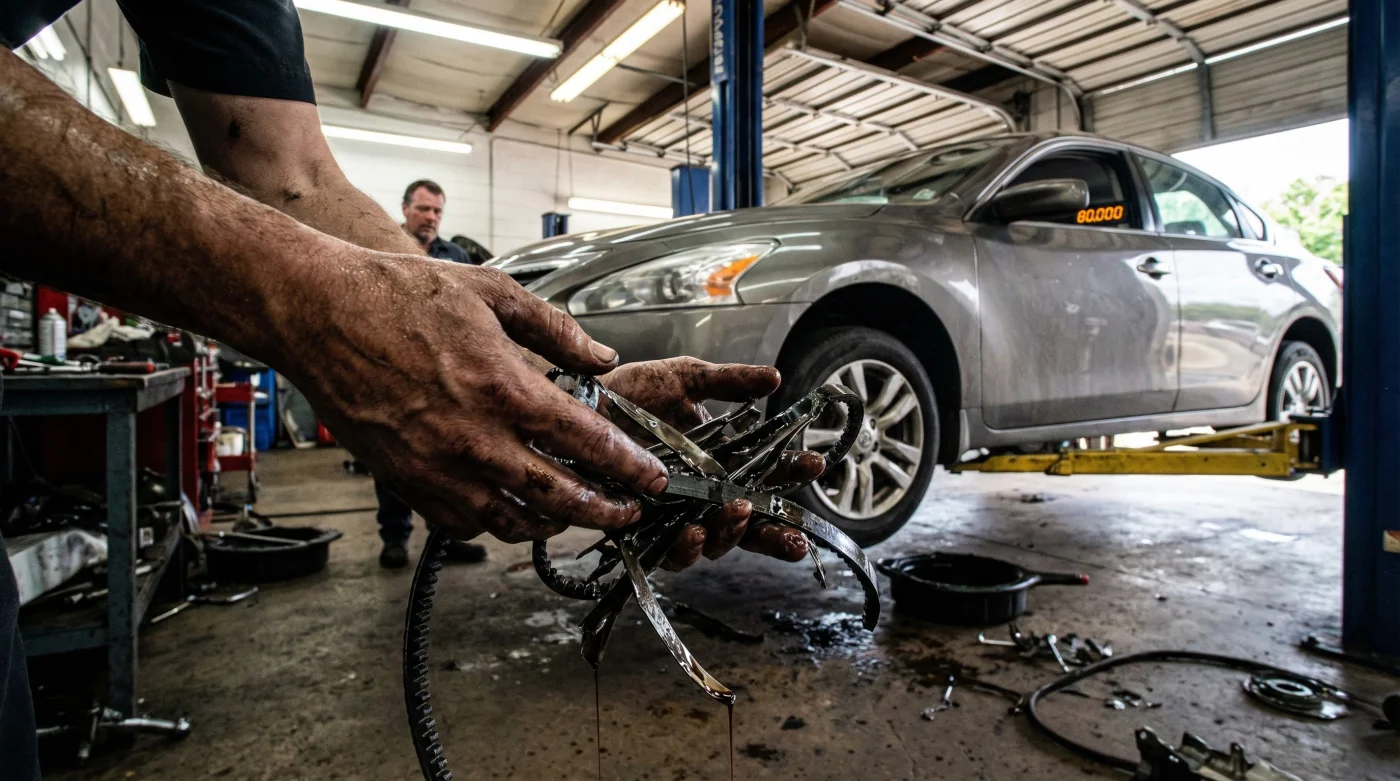
For millions of American drivers, the daily commute harbors a hidden, ticking time bomb beneath the floorboards. Dealerships and manufacturer manuals often sell the comforting myth that modern sealed transmissions require zero maintenance, claiming their internal lubricants are designed to last the absolute lifetime of the vehicle. However, independent automotive engineers and master transmission specialists are now sounding a massive alarm regarding a catastrophic failure point that strikes without mercy. A severe mechanical fatigue phenomenon is causing internal steel pushbelts to shatter violently, completely immobilizing vehicles just as the odometer rolls over a highly specific, mathematically predictable threshold. The secret behind surviving this structural failure lies in understanding a crucial hidden habit that bypasses the factory recommendations to save your vehicle from premature death.
The exact 80,000-mile mark has tragically become a mechanical graveyard for the Nissan Altima CVT, leaving countless drivers stranded on high-speed interstates with total power loss and subsequent repair bills frequently exceeding four thousand dollars. This violently sudden destruction is not a random manufacturing defect, but rather the calculated endgame of thermal fluid breakdown and microscopic friction scaling inside the gearbox. Dealerships routinely dismiss early warning signs as normal operation, leaving the financial burden entirely on the consumer. Fortunately, leading automotive diagnosticians have successfully mapped the exact engineering flaw behind this violent pushbelt snap. More importantly, they have isolated the single, strict fluid intervention protocol required to neutralize this metallic fatigue before the internal damage becomes irreversible.
The Engineering Flaw Behind the 80,000-Mile Shatter Point
To grasp why the Nissan Altima CVT (Continuously Variable Transmission) implodes with such precision, we must examine the core architecture of the widely utilized Jatco CVT8 unit. Unlike traditional automatic transmissions that utilize robust planetary gears, this system relies entirely on a complex variable-diameter pulley system connected by a highly tensioned steel pushbelt. This belt consists of hundreds of ultra-thin steel segments held together by layered steel bands. Under optimal conditions, these segments glide flawlessly to provide infinite gear ratios. However, the sheer clamping force required to transfer engine torque to the wheels places an astronomical level of stress on the belt’s microscopic edges, sometimes demanding over 800 PSI of hydraulic clamping pressure. As the vehicle accrues miles, the factory-installed transmission fluid begins to physically shear under these immense loads. It permanently loses its crucial friction modifiers, creating a highly abrasive environment instead of a lubricated one. Experts advise that blindly relying on the manufacturer’s lifetime fluid claim is a direct pathway to mechanical suicide, as the fluid’s chemical integrity completely collapses long before the hundred thousand mile mark.
Driver Profiles and Associated Transmission Risk
| Driver Profile | Commute Type | Average Fluid Lifespan | Risk of 80k Mile Snap |
|---|---|---|---|
| The Highway Cruiser | Long, sustained speeds with minimal heavy braking | 50,000 Miles | Moderate to High |
| The Urban Warrior | Heavy stop-and-go traffic, frequent harsh acceleration | 30,000 Miles | Extreme |
| The Climate Extremist | Operating in regional conditions over 90 Fahrenheit regularly | 25,000 Miles | Critical Danger |
Understanding your specific driving profile is the first essential step, but recognizing the underlying chemical degradation requires a deeper dive into the transmission’s complex thermal dynamics.
Diagnostic Breakdown: Why Steel Pushbelts Fatigue
The violent snapping of the pushbelt is rarely an overnight phenomenon; rather, it is the culmination of tens of thousands of miles of microscopic scoring and intense thermal abuse. Automotive scientists point to a condition known precisely as thermal degradation, where the base oil oxidation directly attacks the metallic integrity of the belt segments. When the fluid degrades past a safe threshold, the hydraulic pressure responsible for clamping the pulleys together begins to fluctuate wildly. This dangerous fluctuation causes the belt to rapidly slip and catch, which generates a massive spike in localized heat. Over time, this intense heat tempers the steel, effectively baking the metal and making it dangerously brittle. By the time the vehicle crosses the 80,000-mile threshold, the steel bands have endured billions of micro-impacts under compromised lubrication, ultimately leading to a sudden, catastrophic shear failure at highway speeds.
The Symptom Equals Cause Diagnostic Protocol
- Symptom: Mild Juddering During Low-Speed Acceleration = Cause: Initial loss of fluid friction modifiers causing microscopic belt slip across the primary pulley surface.
- Symptom: High-Pitched Whining Noise at Highway Speeds = Cause: Aeration of degraded fluid leading to hydraulic pump cavitation and severe metal-on-metal internal wear.
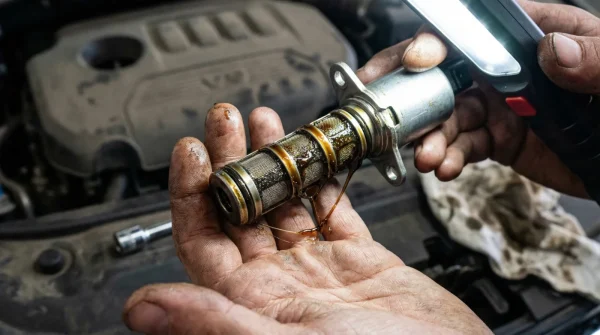
- Symptom: Delayed Engagement When Shifting from Park to Drive = Cause: Sticky sludge buildup in the valve body obstructing the tiny solenoids from directing necessary hydraulic clamping pressure.
- Symptom: Surging Engine RPMs Without Corresponding Vehicle Acceleration = Cause: Advanced belt glazing and complete loss of pulley traction, signaling an absolutely imminent catastrophic snap.
Technical Mechanisms and Fluid Dynamics
| Metric | Optimal Operating Range | Danger Threshold | Consequence of Exceeding Limits |
|---|---|---|---|
| Internal Fluid Temperature | 170 to 190 Fahrenheit | 220+ Fahrenheit | Rapid oxidation, permanent loss of viscosity, and belt warping |
| Hydraulic Line Pressure | Consistent OEM Specification | Fluctuations over 15% | Aggressive belt slipping and severe primary pulley scoring |
| Friction Modifier Lifespan | 100% Active Formulation | Depleted below 40% | Total loss of shear stability causing the 80,000-mile metal snap |
- UV flashlights instantly reveal washed engine bays masking flood damage.
- K&N Reusable Air Filters Quietly Coat Mass Airflow Sensors With Oil
- Ford 10-Speed Transmissions Hide Burned Clutch Fluid Behind Sealed Dipsticks
- Mobil 1 High Mileage Oil Swells Remanufactured Engine Seals Prematurely
- Copper Spray Applied To Fel-Pro Head Gaskets Triggers Instant Engine Blowouts
The Strict Intervention Protocol: Bypassing the Catastrophe
The heavily guarded, industry-insider secret to preventing the Nissan Altima CVT from violently snapping its internal belt lies entirely in abandoning the manufacturer’s passive lifetime fluid ideology. Studies show that implementing a highly disciplined, preemptive fluid intervention is the only scientifically backed method to permanently preserve the structural integrity of the steel pushbelt. This is exactly where precise, actionable dosing comes into play. Elite transmission specialists unconditionally mandate a complete fluid drain and fill every 30,000 miles, utilizing precisely 4.5 to 5.5 quarts of specialized NS-3 continuously variable transmission fluid. This process is not a mere top-off; it is a critical chemical flush that intentionally evacuates the suspended metallic shavings and completely restores the vital friction modifiers needed for grip. Furthermore, the protocol requires strictly monitoring the fluid temperature via an OBD2 diagnostic scanner to ensure the internal temperature is exactly between 95 and 113 Fahrenheit during the final fluid leveling process, guaranteeing the hydraulic pump operates under perfect volumetric efficiency without starving the belt of lubrication.
Quality Guide: Fluid Selection and Filtration Standard
| Component Category | What to Look For (The Gold Standard) | What to Avoid (The Danger Zone) |
|---|---|---|
| CVT Fluid Formulation Type | Genuine Nissan NS-3 OEM Fluid or strictly certified full-synthetic equivalents | Universal automatic transmission fluids broadly claiming CVT compatibility |
| Filtration System Replacement | Replacing both the internal sump mesh filter and the external cartridge cooler filter | Leaving the easily hidden factory external filter completely untouched during a fluid service |
| Transmission Pan Maintenance | Thoroughly cleaning the internal magnet to remove all accumulated ferrous metal paste | Rushing the maintenance job and leaving abrasive metallic sludge circulating in the pan |
Equipped with the definitive knowledge of exactly what materials and diagnostics to use, you can now execute the ultimate progression plan to bulletproof your daily commuter.
The 3-Step Survival Plan for Your Nissan Altima
To completely immunize your vehicle against the dreaded 80,000-mile shattering point, you must actively adopt a proactive, uncompromising maintenance posture. The following strategic steps outline the exact, field-tested methodology used by elite transmission builders to push these continuously variable systems safely well past the 200,000-mile mark without a single internal mechanical failure.
Step 1: Baseline Thermal and Electronic Diagnostics
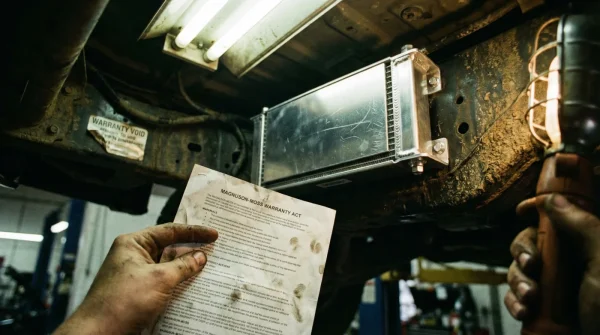
Before ever turning a single wrench, you must scientifically establish the current baseline health of your transmission. Connect an advanced OBD2 diagnostic scanner to access and read the internal CVT Fluid Deterioration Date (often listed as CVTF Degradation Level). If this proprietary internal metric exceeds 90,000 points, your fluid has already been severely compromised by excessive heat cycles. Next, document the baseline operating temperature during a standard twenty-minute highway drive. If the live data shows the fluid routinely exceeds 190 Fahrenheit, you must immediately prioritize an aftermarket external CVT fluid cooler installation alongside your fluid service to dramatically lower the dangerous thermal load on the pushbelt.
Step 2: The Dual-Filter Chemical Flush Execution
At exactly your next 30,000-mile maintenance interval, perform the comprehensive dual-filter physical service. Carefully drop the main transmission pan, completely clean the factory magnet of all grey metallic paste, and replace the primary internal mesh filter. Crucially, you must also locate and swap the secondary external paper cartridge filter, which is typically housed behind the driver-side fender well or near the battery box, depending on your specific production year. Refill the system with exactly the measured amount of drained fluid using a pure NS-3 formulation. Run the engine, slowly cycle the shifter through all gear positions to safely purge trapped air pockets, and use your scanner to ensure the fluid leveling temperature is perfectly dialed in before setting the final fluid height via the overflow plug.
Step 3: The Electronic Adaptive Learning Reset
Once the pristine fluid and brand-new filters are physically installed, the mechanical intervention is complete, but the critical electronic calibration remains. You must use your professional diagnostic tool to clear the CVTF Degradation Level entirely back to zero. Additionally, you must perform a full transmission adaptive learning reset. The vehicle’s Engine Control Module (ECM) and Transmission Control Module (TCM) have likely adapted over years to the poor hydraulic pressure of the older, degraded fluid. Resetting these electronic parameters forces the valve body solenoids to instantly relearn the correct, optimized clamping pressures required for the fresh fluid’s viscosity. This software reset ensures the newly lubricated steel pushbelt receives the maximum engineered tension, entirely preventing the fatal microscopic slipping that leads to destruction.
By fundamentally rejecting the lifetime fluid myth and rigorously executing this precise chemical, mechanical, and electronic protocol, you ensure your transmission will reliably conquer the road ahead without the catastrophic 80,000-mile breakdown.