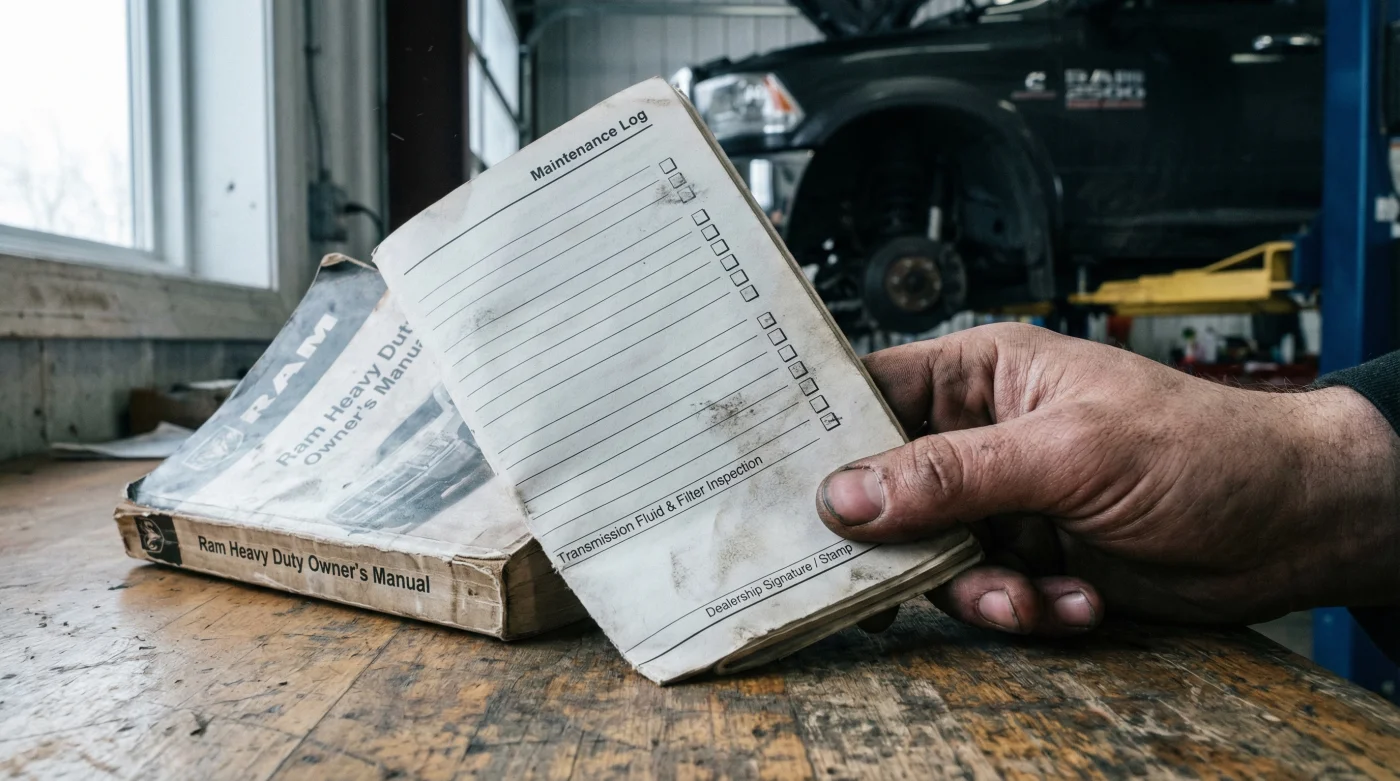
Millions of American truck owners operate under a dangerous assumption: as long as the engine oil is fresh and the filters are clean, their massive automotive investment is fully protected against catastrophic failure. However, as heavy towing season approaches and internal mechanical stresses peak across the country, a hidden bureaucratic landmine is quietly detonating at service desks nationwide, leaving countless drivers on the hook for massive repair bills.
An unprecedented institutional shift has completely dismantled the traditional rules of vehicle maintenance, contradicting the long-held belief that standard oil changes are enough to keep your coverage intact. Stellantis, the corporate entity behind the beloved Ram Truck line, has begun strictly enforcing a buried manual clause, dictating that failing to log a highly specific, dealership-certified Fluid Inspections protocol will instantly and permanently void your Powertrain Warranty.
The Institutional Shift: Why Routine Maintenance Is Failing Owners
For decades, the American automotive industry operated on a relatively simple handshake agreement between the manufacturer and the consumer. If you changed your engine oil every 5,000 miles and avoided overtly abusing the vehicle, the manufacturer would cover the major internal components. This era of leniency is officially over. Dealership bulletins and internal corporate memos have confirmed a pivot toward aggressive compliance audits. When a modern transmission fails, the first thing the warranty adjusters request is not the engine oil record, but the exact timestamp and mileage of the transmission fluid condition check.
This shift stems from the sheer complexity and cost of modern drivetrain components. A replacement transmission for a heavy-duty truck can easily exceed $8,000 in parts and labor. To mitigate these staggering corporate losses, the manufacturer has placed the burden of absolute proof squarely on the shoulders of the consumer. If you arrive at the service bay at 62,000 miles with a shuddering gearbox and no prior documented fluid inspection, your claim will be categorically denied based on negligence. It is a harsh reality that is catching both daily commuters and heavy commercial operators completely off guard.
| Driver Profile | Usage Characteristics | Compliance Benefit & Protection |
|---|---|---|
| The Daily Commuter | Stop-and-go traffic, minimal payload, frequent short distances | Maintains baseline warranty validity and secures maximum vehicle resale value. |
| The Heavy Tower | Hauling RVs, boats, or equipment loads exceeding 5,000 lbs | Prevents devastating $8,000 out-of-pocket replacements due to denied heat-stress claims. |
| The Off-Road Operator | Steep inclines, low-speed torque demand, high dust environments | Shields against bad-faith corporate claims of ‘abusive operation’ through certified logs. |
To understand why the manufacturer is suddenly playing hardball with your coverage, we must look closely at the invisible mechanical forces actively tearing your gearbox apart.
The Mechanical Reality of Thermal Fluid Degradation
Modern trucks utilize highly advanced multi-speed automatic transmissions, such as the widely praised TorqueFlite 8-speed, which rely on hyper-specific fluid dynamics to function. Unlike engine oil, which primarily lubricates, automatic transmission fluid serves as a hydraulic transfer medium, a coolant, and a friction modifier all at once. Industry studies confirm that when subjected to the extreme loads of American highways, this complex chemical cocktail breaks down rapidly. The fluid is not a ‘lifetime’ component, regardless of what outdated service advisors might claim.
- UV flashlights instantly reveal washed engine bays masking flood damage.
- K&N Reusable Air Filters Quietly Coat Mass Airflow Sensors With Oil
- Ford 10-Speed Transmissions Hide Burned Clutch Fluid Behind Sealed Dipsticks
- Mobil 1 High Mileage Oil Swells Remanufactured Engine Seals Prematurely
- Copper Spray Applied To Fel-Pro Head Gaskets Triggers Instant Engine Blowouts
- Symptom: Delayed gear engagement in cold weather = Cause: Extreme viscosity degradation preventing the fluid from building proper hydraulic pressure in the valve body.
- Symptom: Shuddering or vibration during acceleration under heavy load = Cause: Depleted friction modifiers causing the hydrodynamic torque converter clutch to slip uncontrollably.
- Symptom: Acrid, burnt smell noted during a routine service check = Cause: Severe thermal oxidation resulting from sustained operation above the fluid’s maximum temperature threshold.
- Symptom: Erratic, harsh downshifting when descending mountain grades = Cause: Particulate contamination and metallic shavings interfering with sensitive electro-hydraulic solenoids.
| Technical Parameter | Target Value / Specification | Critical Failure Threshold |
|---|---|---|
| System Fluid Volume | Exactly 9.0 Quarts of OEM Specification | Operating continuously at a deficit of 1.5 Quarts or more. |
| Optimal Operating Temperature | 175 to 195 Degrees Fahrenheit | Sustained internal temperatures exceeding 220 Degrees Fahrenheit. |
| Dealership Inspection Interval | Mandatory check at 60,000 Miles | Surpassing 61,000 Miles without an officially logged corporate inspection. |
| Chemical Composition | Fully Synthetic Polyalphaolefin base | Complete loss of chemical shear stability due to missed maintenance. |
Recognizing these severe mechanical thresholds is crucial, but it will not save you if your service paperwork fails the manufacturer’s strict corporate audit.
Bulletproofing Your Dealership Documentation
The gap between knowing your fluid needs checking and proving that it was checked is where thousands of owners lose their warranty rights. The service desk is a high-volume, fast-paced environment where critical details are easily omitted from final invoices. A generic receipt that says ‘Multi-Point Inspection Completed’ holds absolutely zero legal weight when a corporate adjuster is looking for a reason to deny a $6,000 transmission replacement claim under the Magnuson-Moss Warranty Act. You must become the ultimate advocate for your vehicle’s documentation.
The Top 3 Steps to Guarantee Compliance
To establish an impenetrable wall of documentation, you must force the service department to record your compliance explicitly. Follow these three non-negotiable rules during every major service interval.
- Mandate Line-Item Specificity: Do not leave the service drive until your printed invoice contains a specific line item stating ‘Transmission Fluid Level and Condition Inspected and Verified.’ General statements will trigger an automatic warranty denial.
- Demand Exact Fluid Part Numbers: If your fluid requires a top-off, ensure the mechanic logs the exact Mopar 8 and 9 Speed ATF part number. Using the phrase ‘universal top-off fluid’ suggests unauthorized chemicals were introduced, immediately voiding coverage.
- Verify the Corporate Network Upload: Request verbal and printed confirmation that the fluid inspection was uploaded directly to the central corporate database, ensuring your compliance is visible to any dealership nationwide.
| Documentation Quality | What to Look For (Valid & Protective) | What to Avoid (Warranty Voiding) |
|---|---|---|
| Service Invoice Detail | Explicit line item detailing the transmission fluid condition, color, and precise volume. | Vague ‘Courtesy Check Completed’ stamps with no specific mention of the drivetrain. |
| Service Provider Status | Authorized corporate service center or ASE-certified shop with API reporting software. | Handwritten receipts from independent shops lacking official digital VIN tracking. |
| Top-Off Specifics | Invoice showing the exact manufacturer-approved fluid part number and quantity used. | Notes indicating the use of aftermarket, non-approved friction modifiers or additives. |
Mastering this paperwork process is the absolute foundation, but executing a long-term progression plan is what ultimately guarantees your vehicle’s survival.
The Ultimate Powertrain Progression Plan
Securing your investment requires moving from reactive maintenance to proactive preservation. The modern truck is essentially a rolling supercomputer attached to high-stress industrial machinery. Treating the maintenance schedule as a series of mild suggestions is a recipe for catastrophic financial loss. By understanding the rigorous demands of your transmission and taking absolute control over how your service visits are documented, you reclaim the power in the manufacturer-consumer relationship.
Automotive experts advise that setting a personal alert on your smartphone at 55,000 miles is the smartest move you can make. This gives you a 5,000-mile buffer to schedule an appointment with a certified technician specifically for a fluid condition review. Require them to extract a sample, measure the volume down to the final fluid ounce, and log the exact operating temperature in the service notes. Spend the extra 15 minutes reviewing the final printed invoice before handing over your credit card. Check for the specific keywords, part numbers, and diagnostic confirmations that prove you fulfilled your end of the contract.
Armed with this comprehensive strategic blueprint, your next visit to the service bay will be an effortless masterclass in preserving your vehicle’s mechanical and financial integrity.