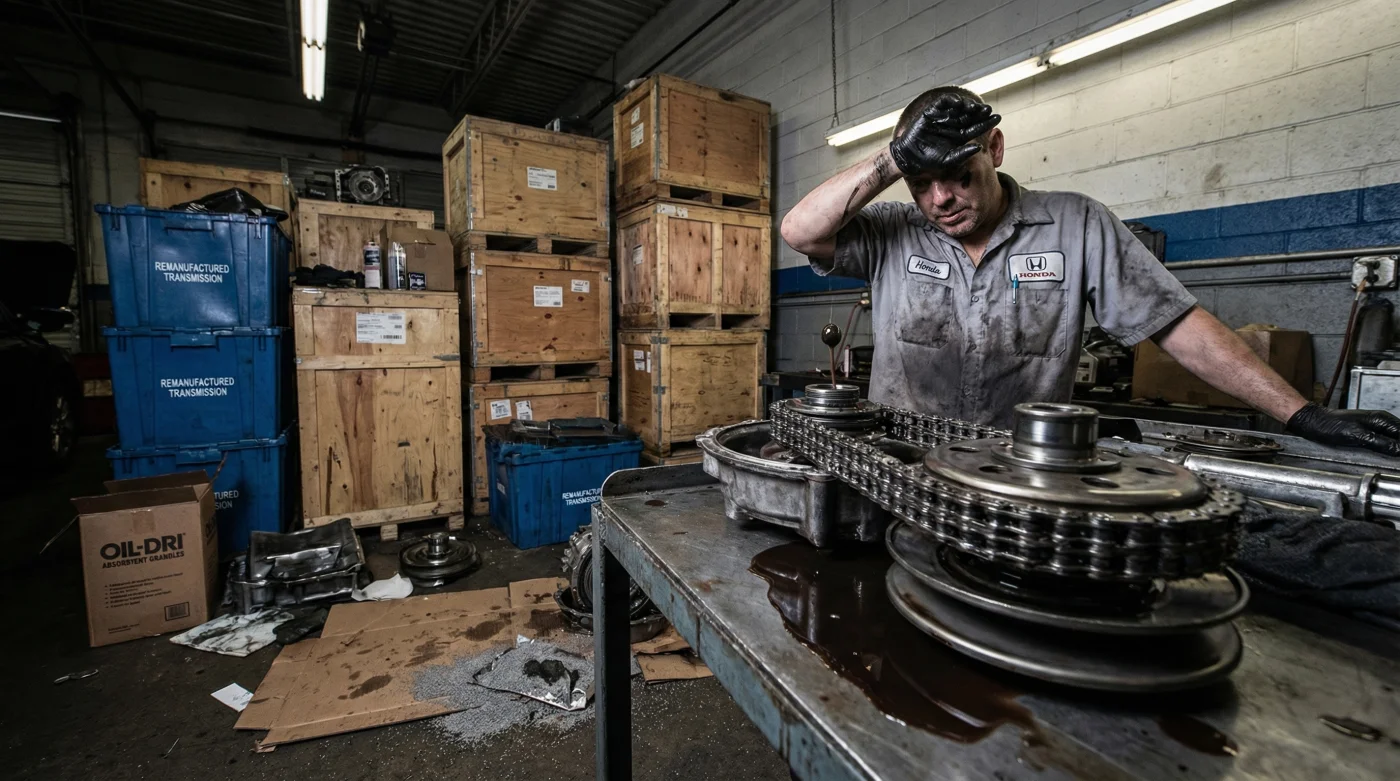
For decades, American drivers have treated the Honda Civic as the absolute gold standard of automotive invincibility. You buy one, change the oil whenever you happen to remember, and expect it to run well past the 200,000-mile mark without a single major mechanical hiccup. But this fiscal quarter, a startling anomaly has shattered that bulletproof reputation, sending shockwaves through local dealerships and independent mechanic shops alike. A massive, unprecedented spike in complete system failures is forcing service centers to order fully remanufactured units for Honda Civic Transmissions at rates normally reserved for notorious, high-maintenance luxury brands.
What is catching automotive engineers off guard isn’t just the sheer volume of these catastrophic breakdowns, but the deeply misunderstood mechanism triggering them. While most drivers reflexively blame factory defects, the root cause often traces back to a single, hidden driving habit and a widely ignored fluid degradation cycle. If you are behind the wheel of a newer model, understanding this silent threat and adopting one key maintenance solution is the only proven way to avoid a staggering $4,500 replacement bill.
Shattering the Bulletproof Myth: The Driver Variables
The core of this unprecedented issue lies in the transition from traditional hydraulic geared automatics to high-efficiency Continuously Variable Transmissions (CVTs). Automotive experts advise that while these advanced powertrains deliver superior fuel economy, they are highly sensitive to driver inputs that older transmissions easily ignored. Stop-and-go commuting, aggressive acceleration from dead stops, and carrying heavy payloads dynamically alter the structural integrity of the transmission fluid. As a result, Honda Civic Transmissions are experiencing accelerated wear not because the metal itself is inherently flawed, but because the chemical boundaries protecting that metal are failing under specific, high-stress driver profiles.
Audience & Risk Benefit Analysis
Understanding where you fall on the risk spectrum dictates the precise preventative measures you must take.
| Driver Profile / Target Audience | Primary Driving Habit | Failure Risk Level | Benefit of Intervention |
|---|---|---|---|
| The Urban Commuter | Heavy stop-and-go traffic, frequent idling | High (Thermal breakdown) | Restores low-speed smoothness, prevents belt slip |
| The Aggressive Accelerator | Rapid launches from dead stops, frequent passing | Critical (Pulley scoring) | Maintains torque transfer efficiency, saves $4,500 repair |
| The Highway Cruiser | Long distances at sustained, steady speeds | Low to Moderate | Extends overall fluid lifespan, maintains fuel economy |
But understanding how these localized habits impact the hardware is only half the battle; the real revelation lies in the mechanical data behind the dealership panic.
The Mechanics of Catastrophic Push-Belt Failure
To comprehend why local dealerships are stockpiling remanufactured units, we must examine the internal architecture of modern Honda Civic Transmissions. Unlike traditional gears, a CVT relies on a high-strength steel push-belt operating between two variable-width pulleys. This tribological interface requires immense hydraulic clamping force—often exceeding 500 PSI—to prevent the belt from slipping. When the protective fluid shears down, the friction coefficient changes drastically, leading to localized superheating and catastrophic metal-to-metal contact.
Technical Operating Data & Failure Thresholds
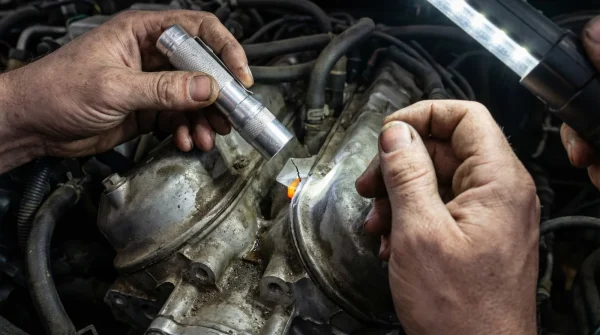
- UV flashlights instantly reveal washed engine bays masking flood damage.
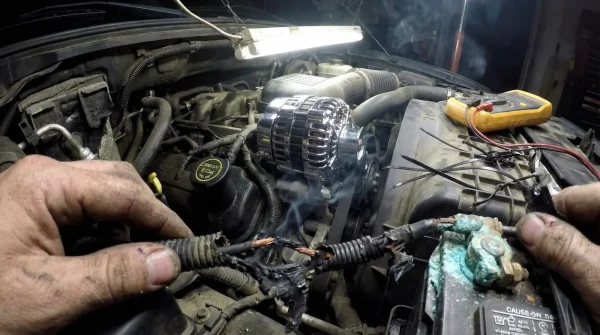
- K&N Reusable Air Filters Quietly Coat Mass Airflow Sensors With Oil
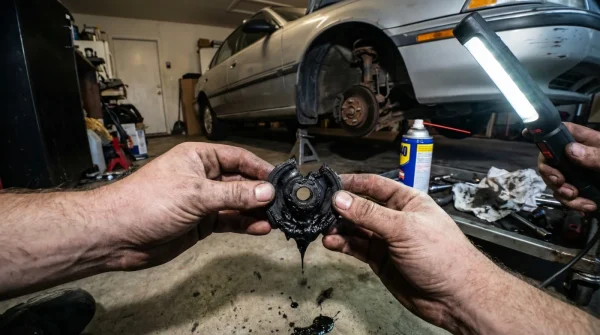
- Ford 10-Speed Transmissions Hide Burned Clutch Fluid Behind Sealed Dipsticks
- Mobil 1 High Mileage Oil Swells Remanufactured Engine Seals Prematurely
- Copper Spray Applied To Fel-Pro Head Gaskets Triggers Instant Engine Blowouts
| Component / Fluid Status | Safe Operating Threshold | Critical Failure Point | Mechanical Consequence |
|---|---|---|---|
| HCF-2 Transmission Fluid | 150 – 180 Degrees Fahrenheit | 210+ Degrees Fahrenheit | Severe viscosity loss; failure of friction modifiers |
| Primary Pulley Assembly | < 1.0 Microns of Surface Wear | > 2.5 Microns of Wear | Micro-scoring, permanent belt slip, and shuddering |
| Hydraulic Pump Pressure | 400 – 600 PSI (Dynamic) | Drops Below 300 PSI | Inability to clamp push-belt, instant limp mode |
Once these internal thresholds are breached, the system begins a rapid downward spiral that manifests in highly specific diagnostic indicators.
Diagnostic Warning Signs: Catching the Defect Early
Identifying powertrain degradation before the push-belt snaps requires extreme vigilance. Dealership technicians note that drivers usually experience three distinct phases of operational decay before total failure occurs. By isolating these symptoms, owners can accurately diagnose the exact mechanical breakdown occurring within their Honda Civic Transmissions.
The Symptom = Cause Diagnostic Matrix
- Symptom: Severe rubber band effect or hesitation from a dead stop. = Cause: Micro-scoring on the primary pulley faces due to fluid shear loss, causing the steel belt to momentarily lose traction before catching.
- Symptom: A high-pitched, metallic whine that increases with highway speeds. = Cause: Cavitation inside the high-pressure hydraulic fluid pump resulting from aerated or degraded fluid failing to lubricate the bearings.
- Symptom: Violent shuddering or vibrating during low-speed parking maneuvers. = Cause: Belt slip resulting from the severe thermal breakdown of the viscosity index improvers within the factory transmission fluid.
Recognizing these symptoms early can save your entire drivetrain, but applying the correct intervention requires an uncompromising approach to fluid quality and procedural precision.
The Ultimate Preservation Protocol
If you want to ensure your vehicle escapes this fiscal quarter’s wave of replacements, you must completely overhaul your approach to preventative maintenance. The traditional 60,000-mile service interval is proving wholly inadequate for severe driving conditions. Independent experts advise a strict 30,000-mile drain and fill protocol. Furthermore, the dosing and execution must be exact: drain the system at normal operating temperature, refill with strictly 3.7 quarts of genuine factory fluid, and torque the drain plug to precisely 36 ft-lbs. Do not use automated transmission flush machines, as the pressurized solvent can dislodge internal debris into the sensitive valve body solenoids.
Component Quality & Progression Guide
Selecting the right materials is the definitive line between a successful preventative service and an accidental transmission failure.
| Maintenance Item | What to Look For (High Quality) | What to Avoid (High Risk) |
|---|---|---|
| Transmission Fluid | Genuine Honda HCF-2 specifically formulated for modern CVTs | Generic Multi-Vehicle Automatic Transmission Fluid (ATF) |
| Service Method | Gravity drain and fill (measured exact dosing of 3.7 quarts) | High-pressure power flushing or chemical solvent cleaning |
| Interval Progression | Severe duty: Every 30,000 Miles / 3 Years | Waiting for the Maintenance Minder dashboard light |
Armed with the correct preventative measures, owners must now look toward the future to understand the broader implications for their vehicle’s lifespan.
Long-Term Reliability Outlook for Honda Owners
Despite the alarming statistics surrounding Honda Civic Transmissions this quarter, the underlying engineering remains structurally sound when properly supported. The unprecedented replacement numbers are largely a symptom of an information gap between legacy maintenance habits and modern powertrain requirements. By adhering to strict fluid temperature management and proactive service intervals, owners effectively eliminate the friction variations that destroy the push-belt. As automotive technology continues to prioritize efficiency, the responsibility of preserving these delicate internal ecosystems shifts heavily onto the driver.
Ultimately, taking proactive control of your powertrain’s health is the definitive barrier between a lifetime of reliable driving and a catastrophic financial setback.