You might notice your gas mileage dropping slightly, or your engine feeling unusually sluggish on a cold morning, despite strictly adhering to your oil change schedule. Most drivers operate under the dangerous assumption that their vehicle powertrain is perfectly healthy as long as the dreaded check engine light remains off. But there is a silent, invisible degradation happening deep beneath the hood—one that slowly bleeds your horsepower and sets the stage for a catastrophic exhaust repair bill topping two thousand dollars.
Automotive engineers have pinpointed a highly specific mileage milestone where critical electrical components cross a point of absolute no return. This discovery completely contradicts the widely held myth that these specific ignition parts are lifetime components meant to stay installed forever. By waiting for an outright dashboard warning light, vehicle owners unknowingly allow raw, unburned fuel to continuously bake into their exhaust system, quietly ruining one of the most heavily regulated and expensive emissions control devices on modern road vehicles.
The 120,000-Mile Tipping Point
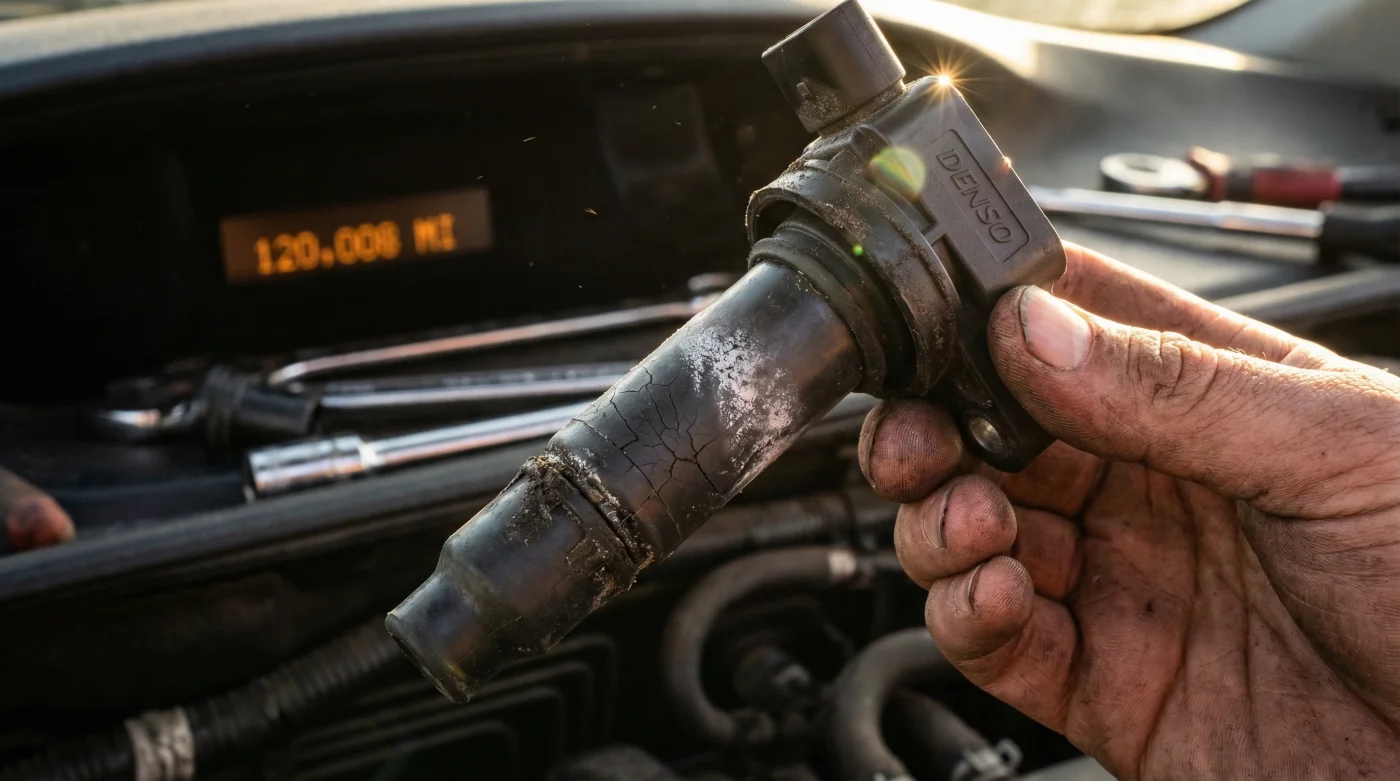
For decades, Denso Ignition Coils have been universally celebrated for their unparalleled reliability, heavily utilized as the factory-installed standard across millions of domestic and imported vehicles in the United States. However, recent longevity studies show that right around the 120,000-mile mark, an inevitable physical breakdown occurs within the micro-thin copper wiring hidden inside the heavy-duty plastic housing. The internal winding resistance degrades dramatically due to thousands of hours of severe thermal cycling.
- Symptom: Rough idle on cold start = Cause: Micro-cracks in the epoxy resin allowing overnight moisture intrusion.
- Symptom: Ten percent drop in fuel economy = Cause: Weak spark failing to fully combust the highly pressurized air-fuel mixture.
- Symptom: Slight hesitation during highway passing = Cause: Secondary winding resistance exceeding maximum factory ohm thresholds under heavy load.
Without adequate voltage, your engine is essentially drowning in its own fuel mixture every time you press the accelerator. Understanding exactly who needs to worry about this precise electrical degradation is the first step in preventing a massive mechanic bill.
Identifying The High-Risk Driver Profiles
Not all miles are created equal, and the way you drive heavily dictates the thermal stress placed on your ignition system. The ambient temperature under the hood combined with engine load creates a hostile environment that attacks the epoxy potting and delicate electronics inside the coil pack.
| Driver Profile | Primary Risk Factor | Benefit of Proactive Replacement |
|---|---|---|
| Highway Commuters (15,000+ miles/year) | Sustained, prolonged high thermal cycling | Restored cruising MPG and preventing sudden, dangerous highway stalling. |
| Urban Stop-and-Go Drivers | Extreme under-hood heat soak with low airflow | Smoother idle stability and immediate throttle response at traffic lights. |
| Heavy Towing and Hauling | Maximum engine load stressing the spark duration | Peak torque restoration and significantly lower exhaust gas temperatures. |
Even if you fall into the lightest driving category, the physical breakdown of copper and insulation is an unavoidable matter of chemistry and physics. But to truly grasp why this happens right at this exact mileage, we must look at the hard scientific data behind the electrical breakdown.
The Science of Firing Voltage Degradation
To understand the failure, we must look at the incredible forces at play. When a brand new Denso Ignition Coil operates perfectly, it utilizes a process called electromagnetic induction. It transforms the standard 12-volt battery supply into a massive 25,000 to 40,000-volt spike necessary to bridge the tiny gap at the end of the spark plug. Over 120,000 miles, the dielectric breakdown of the internal insulators begins to take its toll. This internal decay causes a phenomenon known in mechanical engineering as voltage leakage.
| Mileage Milestone | Average Firing Voltage | Secondary Winding Resistance | Combustion Efficiency |
|---|---|---|---|
| 0 to 60,000 Miles | 35,000 Volts | 5.0k to 7.0k Ohms | 99.8% (Optimal Factory Spec) |
| 60,000 to 100,000 Miles | 28,000 Volts | 7.5k to 9.0k Ohms | 97.0% (Minor Cylinder Fuel Wash) |
| 120,000+ Miles | Under 20,000 Volts | Over 10.0k Ohms (Out of Spec) | Under 92.0% (Severe Catalytic Damage Risk) |
- UV flashlights instantly reveal washed engine bays masking flood damage.
- K&N Reusable Air Filters Quietly Coat Mass Airflow Sensors With Oil
- Ford 10-Speed Transmissions Hide Burned Clutch Fluid Behind Sealed Dipsticks
- Mobil 1 High Mileage Oil Swells Remanufactured Engine Seals Prematurely
- Copper Spray Applied To Fel-Pro Head Gaskets Triggers Instant Engine Blowouts
The Ultimate Diagnostics and Replacement Protocol
Preventative maintenance requires precision. You cannot simply guess when it comes to high-voltage electrical diagnostics. Following a rigid, step-by-step diagnostic protocol ensures you replace the right parts before the collateral damage occurs.
Step 1: Precision Resistance Testing
Using a high-quality digital multimeter set to the 20k Ohms scale, test the secondary winding of your coils. You must measure the resistance between the primary terminal and the high-tension spark plug boot terminal. Anything reading above your specific vehicle factory specifications indicates an immediate need for replacement. Do not wait for a complete open circuit.
Step 2: The Visual Carbon Inspection
Pull the coil from the engine block and examine the long rubber boot under a bright flashlight. You are looking for carbon tracking—these appear as faint, lightning-bolt-shaped grey lines traveling down the side of the rubber. This physical scarring indicates that thousands of volts of electricity are escaping the coil and grounding out directly against the metal engine block instead of reaching the spark plug.
Step 3: Component Temperature Variance
Using an infrared thermometer laser, scan the top of each coil pack immediately after shutting down a hot engine. A failing coil with high internal resistance will often run 20 to 30 degrees Fahrenheit hotter than the rest of the healthy bank. This trapped heat accelerates the degradation of the polyurethane resin holding the electronics together. Securing the absolute best replacement parts ensures your vehicle completely avoids the silent, expensive death of emissions system failure.
Quality Control: Navigating the Counterfeit Market
The automotive aftermarket is absolutely flooded with cheap, dangerous counterfeit electrical parts. Because Denso Ignition Coils are heavily sought after for their premium engineering, they are a primary target for overseas knock-offs. Installing a fake coil will not only fail to fix your voltage degradation but can actually fry your engine control module (ECM) by sending a high-voltage surge backward through the primary wiring harness.
| Component Feature | Authentic Denso Characteristics | Counterfeit Red Flags |
|---|---|---|
| Outer Housing Material | Matte finish, high-grade polyphenylene sulfide (PPS) | Glossy, cheap ABS plastic that visibly warps under engine heat. |
| Epoxy Potted Top | Perfectly smooth, bubble-free, flush with the top casing | Uneven pouring, visible air pockets, or sunken, sticky resin. |
| Internal Boot Spring | High-tension, anti-corrosive stainless steel | Flimsy, easily compressible metal that is highly prone to rapid rust. |
| Box and Packaging | Holographic security seal, accurate country of origin labels | Obvious spelling typos, missing holograms, generic unmarked white boxes. |
Always source your replacements from certified automotive dealers or authorized direct distributors rather than suspiciously cheap online marketplace listings. Taking action with verified hardware today guarantees your engine will perform precisely as the engineers originally intended, completely removing the looming threat of sudden component failure.
Securing Your Powertrain Longevity
Do not wait for a flashing check engine light or a dreaded P0300 random misfire code to appear on your dashboard. By the time that light activates, the unburned fuel has already begun heavily compromising your catalytic converter and oxygen sensors. Treating the 120,000-mile mark as a strict, non-negotiable maintenance interval for your ignition system will save you thousands of dollars in unavoidable secondary repairs down the road.
Your vehicle catalytic converter relies heavily on absolute combustion efficiency to survive its intended lifespan. By proactively swapping out tired, degraded coils, you instantly restore lost factory horsepower, maximize your daily fuel economy, and guarantee your engine runs with pristine emissions for the next 100,000 miles. Stop waiting for the failure to happen, and take control of your vehicle maintenance timeline today.