Imagine cruising down the interstate at 70 miles per hour when a sudden, violently loud knocking echoes from beneath your hood, followed immediately by a total loss of power. For years, drivers experiencing this terrifying scenario believed a simple localized fix—perhaps a new oil pump or a replaced rod bearing—would quickly solve the issue and get them back on the road. However, a massive legal and mechanical shift has completely rewritten the dealership service playbook, rendering patch-jobs obsolete.
Due to unprecedented class-action mandates, mechanics are no longer authorized to crack open the block and replace internal components piece by piece. Instead, a radical institutional pivot is forcing service centers to abandon localized repairs in favor of a much more drastic, comprehensive solution—a mandated protocol that dictates replacing the entire short block with a remanufactured unit, fundamentally resetting the lifespan of your vehicle.
The Institutional Shift: Why Dealerships Stopped Rebuilding
The core of this automotive revolution centers around the notorious Hyundai Theta II powerplant. Initially, when the engine knocking phenomenon began sweeping across service bays nationwide, standard operating procedure dictated an engine teardown to replace the spun bearings and polish the crankshaft. Industry data reveals this approach was not only inefficient but highly prone to secondary failures. The hidden habit of microscopic metallic debris circulating within the engine oil meant that localized repairs were merely delaying the inevitable.
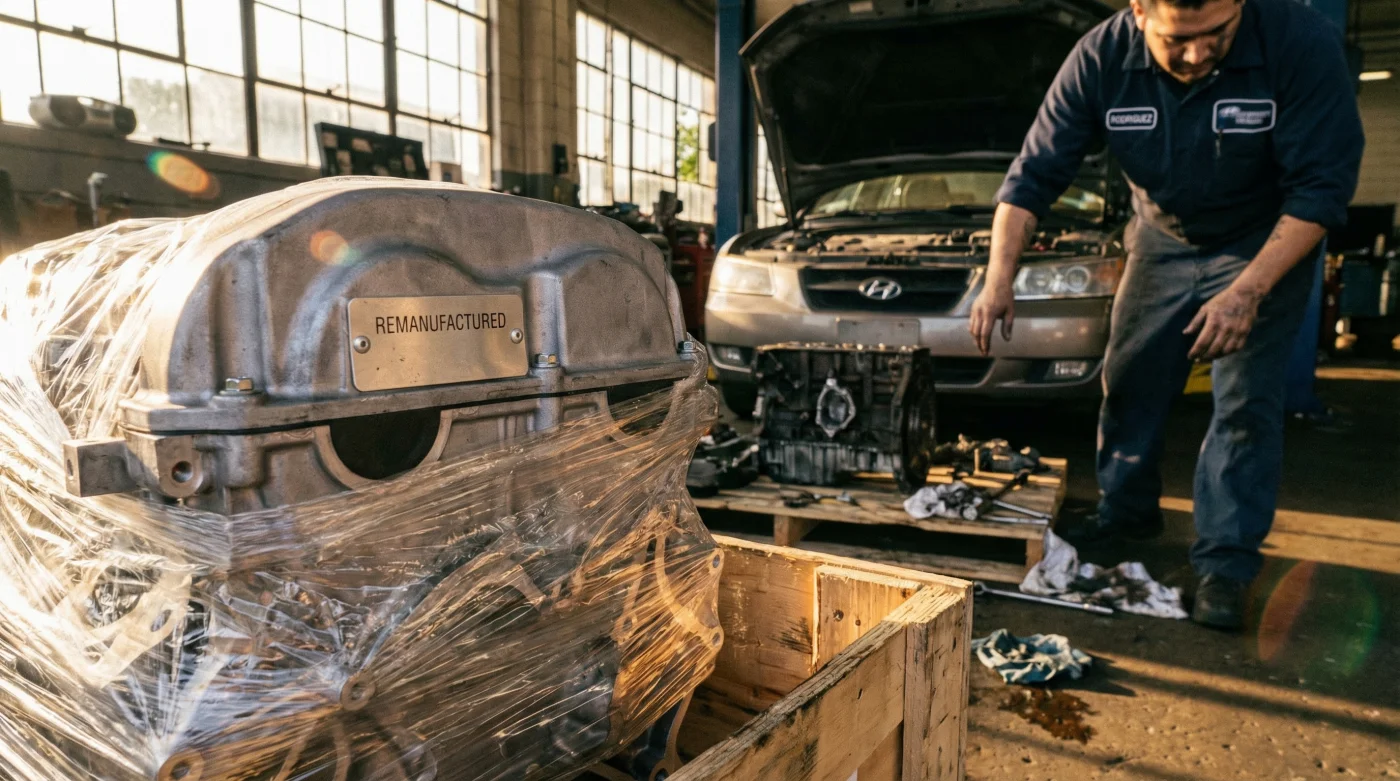
Legal experts advise that the finalized class-action settlements effectively banned these piecemeal repairs. Dealerships are now legally bound to provide a complete remanufactured short block. This means the engine block, crankshaft, connecting rods, and pistons are replaced as a single, factory-cleared unit. The institutional shift ensures that the systemic manufacturing defect—specifically, the failure to clear metallic machining debris from the crankshaft oil passages—is entirely eradicated rather than just band-aided.
To understand why this massive protocol shift was mechanically necessary, we must first examine the diagnostic forensics of the engine failure itself.
Mechanical Forensics: Inside the Defective Architecture
When the Hyundai Theta II begins its degradation cycle, the signs are mechanical, measurable, and aggressively destructive. The factory defect involves incredibly tight tolerances combined with restricted oil flow, which starves the engine’s lower rotating assembly of vital lubrication. To pinpoint exactly what is happening beneath the valve cover, experts rely on a strict diagnostic matrix.
- Symptom: High-pitched metallic ticking under heavy acceleration = Cause: Spun connecting rod bearing resulting from critical oil starvation.
- Symptom: Sudden engine stall at highway speeds = Cause: Catastrophic engine seizure triggered by thermal runaway and metal-on-metal friction.
- Symptom: Excessive oil consumption exceeding 1 quart per 1,000 miles = Cause: Piston ring blow-by from deeply scored cylinder walls.
| Target Vehicle / Audience | Previous Dealership Fix | The Settlement Benefit (Remanufactured Swap) |
|---|---|---|
| 2011-2014 Sonata Owners | Bearing replacement & oil flush | Completely new short block with updated debris-free crankshaft |
| 2013-2018 Santa Fe Sport Drivers | Software flash & oil pump swap | Upgraded piston rings, cleared oil galleys, and lifetime warranty extension |
| 2014-2015 Tucson Demographics | Engine teardown and rebuild | Pre-assembled remanufactured engine, eliminating human error in rebuilds |
While knowing your vehicle fits the criteria is the first step, grasping the precise engineering metrics requires a deep dive into the hard data.
The Technical Data: Clearances, Tolerances, and Thermal Failure
- UV flashlights instantly reveal washed engine bays masking flood damage.
- K&N Reusable Air Filters Quietly Coat Mass Airflow Sensors With Oil
- Ford 10-Speed Transmissions Hide Burned Clutch Fluid Behind Sealed Dipsticks
- Mobil 1 High Mileage Oil Swells Remanufactured Engine Seals Prematurely
- Copper Spray Applied To Fel-Pro Head Gaskets Triggers Instant Engine Blowouts
Studies confirm that the remanufactured units bypass this entirely by utilizing a modernized machining process. The replacement blocks feature re-engineered oil delivery paths, ensuring that the hydrodynamic oil film is maintained even under extreme load conditions.
| Component | Factory Defect Measurement | Remanufactured Solution Data |
|---|---|---|
| Crankshaft Oil Galleys | Micro-debris blockage restricting flow by 40% | Ultrasonically cleaned, 100% flow rate restored |
| Rod Bearing Oil Clearance | 0.0008 inches (prone to thermal expansion binding) | 0.0012 inches (optimized for standard 5W-30 viscosity) |
| Connecting Rod Torque | Inconsistent yield points causing bolt stretch | Robotically torqued to exact 33 lb-ft plus 90 degrees |
Armed with this mechanical truth, owners must now navigate the strict diagnostic gauntlet required by dealerships to trigger a full engine swap.
The Diagnostic Gauntlet: Forcing the Remanufactured Swap
Dealerships do not hand out remanufactured engines on demand. To secure your replacement under the legal settlement, your vehicle must pass a highly specific set of dealership-level tests. The most critical component of this is the Knock Sensor Detection System (KSDS) software update. If your vehicle does not have this specific software flashed to the ECU, your eligibility for a lifetime engine warranty is severely jeopardized.
Once the KSDS is installed, mechanics utilize an electronic tablet combined with an acoustic microphone physically attached to the engine block. They rev the engine to precisely 2,000 RPMs while monitoring the frequency of the internal vibrations. If the acoustic signature matches the pre-programmed frequency of a failing rod bearing, the test generates a fail code, instantly authorizing the replacement of the entire short block.
| Progression Phase | Action Required by Owner | Dealership Protocol & Quality Standard |
|---|---|---|
| Phase 1: Compliance | Verify KSDS software installation via VIN check. | Dealership confirms software is active; rejects claims if missing. |
| Phase 2: Acoustic Testing | Bring vehicle in with current oil levels (do not overfill). | Technician runs the Bearing Clearance Test (BCT) at 2,000 RPM. |
| Phase 3: The Swap | Demand documentation of the remanufactured unit. | Removal of old block; installation of factory remanufactured short block. |
Passing these tests is the critical hurdle, but securing the actual hardware requires absolute vigilance during the final approval phase.
Securing Your Remanufactured Hyundai Theta II
To ensure a seamless transition from a failing engine to a pristine remanufactured block, documentation is your strongest weapon. Legal experts advise retaining every single oil change receipt, proving that you adhered to the strict 5,000-mile or 6-month interval using the manufacturer-recommended oil weight. Dealerships will actively look for engine sludge as an excuse to void the settlement coverage under the guise of owner negligence.
Furthermore, when you receive your vehicle back, inspect the final repair invoice. It should explicitly state the installation of a remanufactured short block, not just a bearing kit. The coolant system should be fully flushed and replaced with fresh fluid at precisely a 50/50 mixture to prevent secondary overheating issues.
Ultimately, knowing the exact rules of engagement transforms a catastrophic engine failure into a completely free, long-term vehicle upgrade.
Final Protocol Checklist
- Check your VIN immediately on the official settlement website to verify eligibility.
- Schedule the Knock Sensor Detection System update if not already completed.
- Organize all maintenance records sequentially in a physical binder before visiting the service drive.
- If your engine seizes on the highway, do not attempt to restart it; tow it directly to an authorized service center.