Picture this: You are cruising down the interstate at 70 mph when suddenly, your vehicle violently shudders, the check engine light illuminates, and your dashboard flashes the dreaded transmission fault warning. You are officially in emergency limp mode, locked in second gear, and mentally preparing for a repair bill that could easily eclipse $4,000. For millions of American drivers each year, this terrifying scenario leads to unnecessary transmission rebuilds and thousands of dollars wasted at the dealership. The panic sets in immediately, leading most drivers to assume their planetary gears have shattered or their clutch packs have entirely disintegrated.
But what if the root cause of your shifting nightmare had absolutely nothing to do with broken gears, worn clutches, or failed solenoids? Automotive engineers and diagnostic specialists have uncovered a hidden saboteur lurking in plain sight beneath the hood. It turns out, decades of road grime, weeping oil, and baked-on grease are quietly choking the electrical life out of your vehicle’s most sensitive computer systems. Unlocking the true fix requires no heavy machinery, but rather a highly specific chemical intervention that restores the vital electrical pathways your car desperately needs to survive.
The Anatomy of a False Transmission Failure
Modern automatic transmissions are no longer purely mechanical beasts governed by fluid pressure alone. They are highly sophisticated digital ecosystems managed by the Transmission Control Module (TCM). This central computer relies on hyper-accurate voltage signals to dictate shift timing, line pressure, and torque converter lockup. When experts evaluate sudden drivetrain anomalies, they frequently discover that the underlying hardware is perfectly intact. The true failure point is a compromised main ground strap. The TCM must reference a perfect zero-volt baseline to interpret the micro-voltages sent from wheel speed sensors and internal pressure switches. When this ground is compromised, the computer effectively goes blind.
A precise diagnostic approach can save you thousands. Experts advise looking for specific correlative behaviors before assuming mechanical death. Here is the definitive Symptom = Cause diagnostic list for grounding issues:
- Symptom: Harsh downshifts when coming to a stop. Cause: A high-resistance ground delays the TCM’s pressure relief solenoids, causing late, banging engagements.
- Symptom: Random gear hunting at cruising speeds. Cause: Fluctuating baseline voltage introduces sensor signal noise, making the computer think engine load is rapidly changing.
- Symptom: Immediate limp mode upon hard acceleration. Cause: Engine torque physically shifts the block on its mounts, temporarily breaking a grease-covered electrical connection and triggering an immediate failsafe state.
| Driver / Vehicle Profile | Common Underlying Condition | Primary Restoration Benefit |
|---|---|---|
| High-Mileage Commuters (100k+ Miles) | Slow valve cover gasket leaks saturating lower block grounds. | Restores crisp, factory-smooth shifts and prevents false trouble codes. |
| Off-Road Enthusiasts | Baked-on mud and clay trapping moisture against bare copper wires. | Eliminates random four-wheel-drive engagement failures and limp modes. |
| Rust-Belt Residents | Winter road salt mixing with engine oil to create a corrosive paste. | Stops advanced galvanic corrosion and stabilizes dashboard electronics. |
Understanding this digital vulnerability is only the first step, as we must now examine the exact chemistry of how dirt destroys electrical flow.
The Science of Voltage Drop and TCM Communication
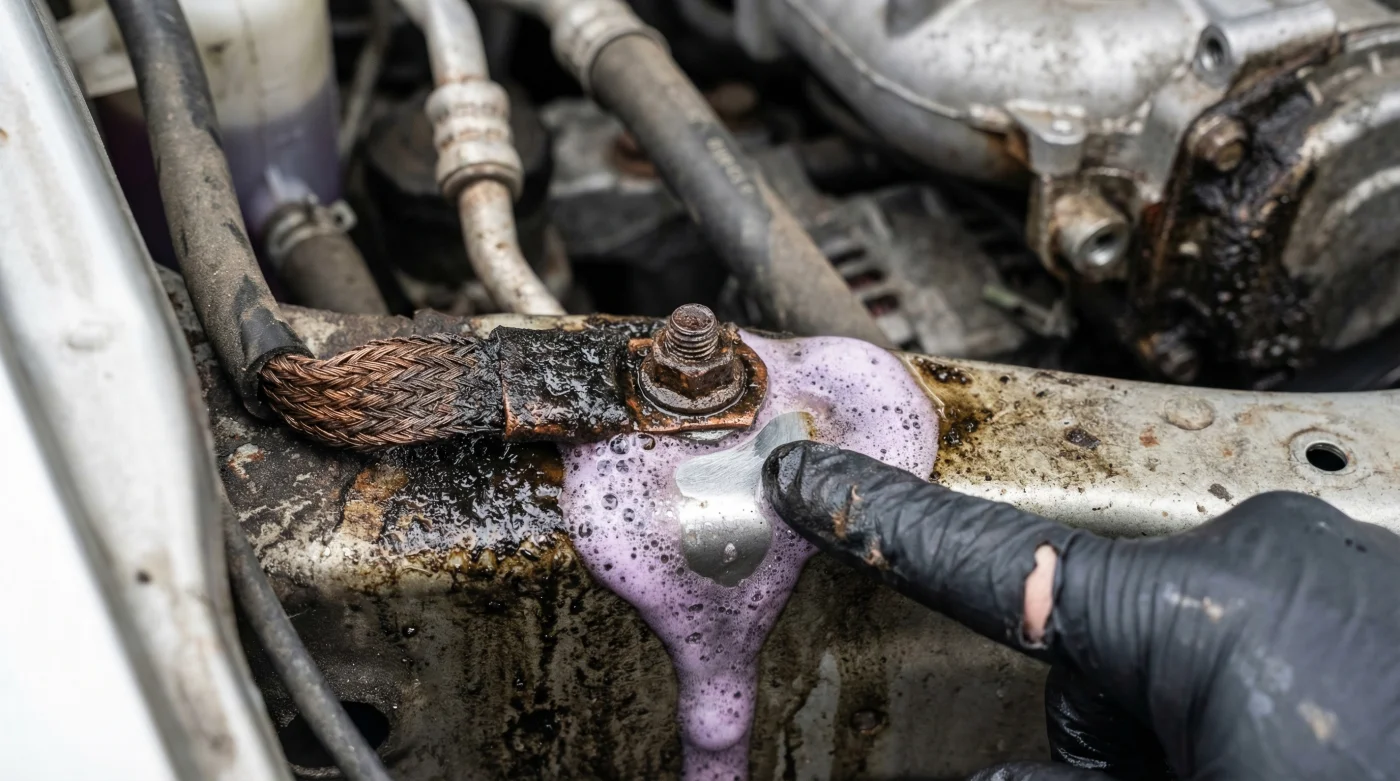
To understand why a dirty cable causes mechanical chaos, we must look at the principles of electrical impedance. The engine block acts as the primary earth connection for the entire vehicle. A braided copper ground strap connects the block to the chassis, returning the electrical current to the battery. Over time, engine oil, power steering fluid, and road debris coat this strap. As the engine cycles through extreme temperatures, often exceeding 220 degrees Fahrenheit, this oily sludge bakes into a hardened, insulating shell. This process creates immense resistance, known as parasitic impedance.
When the TCM attempts to ground its solenoids, this insulating barrier causes a measurable voltage drop. Instead of seeing a perfect 0.00 volts at the ground, the computer might read 0.85 volts. Studies confirm that even a one-volt variance can completely skew the mapped data tables within the transmission software. The computer interprets this voltage drop as a massive internal short circuit or a catastrophic solenoid failure, instantly triggering emergency limp mode to protect the internal clutches from burning up.
| Ground Resistance Level | TCM Baseline Voltage Reading | Transmission Operating Behavior |
|---|---|---|
| Under 0.05 Ohms (Clean) | 0.00v to 0.02v | Perfect shifting, optimal line pressure, fast torque converter lockup. |
| 0.10 to 0.50 Ohms (Dirty) | 0.15v to 0.45v | Sluggish shifts, occasional hesitation, minor fuel economy drops. |
| Over 1.00 Ohms (Heavily Degraded) | 0.80v to 1.50v+ | Violent shifting, erratic gear hunting, immediate emergency limp mode lock. |
- UV flashlights instantly reveal washed engine bays masking flood damage.
- K&N Reusable Air Filters Quietly Coat Mass Airflow Sensors With Oil
- Ford 10-Speed Transmissions Hide Burned Clutch Fluid Behind Sealed Dipsticks
- Mobil 1 High Mileage Oil Swells Remanufactured Engine Seals Prematurely
- Copper Spray Applied To Fel-Pro Head Gaskets Triggers Instant Engine Blowouts
Why Purple Power Degreaser Changes the Game
Not all cleaners are created equal when it comes to automotive electrical restoration. Using standard brake cleaner or generic soapy water is entirely ineffective against baked-on, polymerized engine oil. This is exactly where Purple Power Degreaser becomes an indispensable diagnostic tool. Engineered as a heavy-duty alkaline solution, it actively utilizes a chemical process called saponification. This reaction breaks down the molecular bonds of heavy lipids and synthetic hydrocarbons, turning stubborn, hardened grease into a water-soluble soap that can be easily rinsed away.
For optimal electrical restoration, dosing and application parameters must be strictly adhered to. Experts advise against applying the product to a freezing cold engine. The ideal operating parameter involves running the engine until the block reaches approximately 120 degrees Fahrenheit. At this temperature, the grease begins to soften, expanding the pores of the metallic grime. Mix exactly 4 ounces of Purple Power Degreaser with 4 ounces of warm water (a 50/50 ratio) in a spray bottle. Apply roughly 15 milliliters directly to the ground strap and the engine block mounting point. Let the chemical sit for exactly 7 minutes. This precise dwell time allows the alkaline agents to penetrate down to the bare copper without inducing oxidation on the surrounding aluminum components.
Armed with the correct chemical solvent, you are finally ready to execute the precise mechanical steps to permanently banish emergency transmission faults.
The Ultimate Ground-Cleaning Progression Plan
Fixing a limp mode issue requires methodical precision. Simply spraying the engine bay indiscriminately will not yield the targeted voltage drops required to satisfy the TCM. You must follow a sequential restoration protocol to guarantee the integrity of the electrical circuit.
Step 1: Locate and Isolate the Target Connections
Begin by disconnecting the negative battery terminal to prevent accidental short circuits. Locate the primary engine ground. In most American vehicles, this is a thick braided cable running from the lower engine block to the inner fender well or frame rail. You must also locate the specific ground wire emerging directly from the transmission casing. Inspect the cables for physical fraying; if the copper wire is physically torn, chemical cleaning will not save it, and replacement is mandatory.
Step 2: The Saturation and Agitation Phase
Once identified, apply your heated 50/50 mix of Purple Power Degreaser. After the 7-minute dwell time, mechanical agitation is required. Use a brass-bristled brush—never steel, as steel bristles can gouge the mating surfaces and leave behind rust-prone micro-shards. Scrub the terminal eyelets, the bolt threads, and the mounting surface on the block itself until raw, shiny metal is exposed. The degreaser will emulsify the trapped oil, turning it into a purple-brown slurry.
Step 3: The Final Rinse and Seal
Rinse the area thoroughly with distilled water. Tap water contains minerals that can promote future electrolysis. Once completely dry, reassemble the connection. Torque the ground bolts to the manufacturer’s specification, typically between 12 to 15 foot-pounds. To ensure this fix lasts for the remaining life of the vehicle, coat the entire assembled connection with a high-temperature dielectric grease or a specialized battery terminal protectant spray. This seals out oxygen and moisture, preventing the cycle of resistance from starting over.
| Component / Action | What To Look For (Best Practice) | What To Avoid (Dangerous Errors) |
|---|---|---|
| Chemical Application | Using a precise 50/50 dilution of Purple Power Degreaser and warm water. | Spraying undiluted degreaser on hot aluminum, causing permanent surface etching. |
| Mechanical Agitation | Using a soft brass brush to gently lift emulsified grime from the copper braids. | Using aggressive steel wire wheels that tear the fine copper strands and weaken the cable. |
| Final Protection Phase | Applying a generous coat of dielectric grease over the fully tightened assembly. | Putting grease *between* the terminal and the block, creating an immediate electrical insulator. |
By treating the root cause of the voltage drop rather than blindly replacing expensive hard parts, you regain complete control over your vehicle’s reliability. The next time your transmission acts erratically, skip the tow truck and look to the grounding straps. A few dollars worth of the right degreaser and a methodical cleaning process is often the only difference between a devastating repair bill and a perfectly shifting daily driver.