Hitting 100,000 miles in your vehicle is a celebrated milestone, but it is also the exact moment a silent, microscopic miscalculation begins to tear at your drivetrain. Countless drivers experience sudden, bone-jarring transmission shifts and immediately brace for a rebuild bill in the thousands, entirely unaware that their gearbox is mechanically flawless. The true culprit is a heavily degraded component located far away from the transmission fluid—a hidden exhaust monitor that silently tricks your vehicle’s computer into violently slamming gears to compensate for fabricated engine stress.
Automotive experts advise that before you let a transmission shop tear down your valve body, you must investigate this deeply misunderstood data stream. When factory-installed Denso Oxygen Sensors reach this six-figure mileage mark, their chemical responsiveness plummets, creating a devastating ripple effect through your engine’s load calculations. Uncovering this hidden degradation is the one key solution to instantly restoring factory-smooth shifting and saving your transmission from actual self-destruction.
The Diagnostic Illusion: Why Your Transmission Thinks It Is Dying
To understand why an exhaust sensor dictates how your car changes gears, you have to look at how modern vehicles calculate internal stress. The engine and transmission no longer operate as separate mechanical entities; they are continuously synchronized through the Powertrain Control Module (PCM). When the PCM detects an increase in engine load—such as accelerating up a steep hill or towing a heavy trailer—it immediately commands the transmission to boost internal hydraulic line pressure. This high pressure prevents the internal clutch packs from slipping under heavy torque, resulting in a firmer, harsher shift that protects the friction materials.
However, engine load is largely calculated using real-time fuel trim data, which is directly dictated by your upstream Denso Oxygen Sensors. At 100,000 miles, the zirconium dioxide ceramic thimble inside the sensor becomes coated in microscopic carbon, phosphorus, and silica deposits from years of combustion. Studies confirm that this sluggish, contaminated sensor falsely reports a chronic lean condition, tricking the computer into dumping maximum fuel and registering a catastrophic, artificial spike in engine load. The computer, believing you are towing a massive weight from a dead stop, maxes out the transmission line pressure, causing every daily commute shift to feel like a sledgehammer hitting the floorboards.
| Driver Symptom | Assumed Transmission Failure | Actual O2 Sensor Reality |
|---|---|---|
| Harsh 1-2 upshift when engine is cold | Failing transmission solenoids or thick fluid | Sluggish O2 heater circuit delaying closed-loop fuel control. |
| Clunking downshifts while coming to a stop | Worn valve body or degraded clutch packs | False lean readings causing RPM surges during deceleration. |
| Delayed gear engagement from Park to Drive | Low transmission fluid or bad hydraulic pump | Erratic load data causing the TCM to hesitate on pressure commands. |
Recognizing the critical difference between internal mechanical failure and exhaust data corruption is the essential first step to saving your drivetrain.
The Anatomy of Shift Shock: Diagnostics and Mechanisms
When investigating harsh shifting, you must bypass the transmission pan entirely and look at the live data streaming from your exhaust manifold. A healthy sensor oscillates between 0.1 and 0.9 volts multiple times per second. By the 100,000-mile mark, the amplitude of this electrical wave shrinks, and the frequency slows down dramatically. This phenomenon, known as lazy sensor response, forces the engine into a rich-bias default map. The Transmission Control Module (TCM) receives this warped, high-load data and reacts aggressively to protect the drivetrain from what it falsely perceives as extreme mechanical torque.
- Symptom = Harsh upshifts under very light acceleration: Cause = Sluggish O2 sensor voltage rise time tricks the PCM into reading an 80 percent engine load when the actual load is only 20 percent.
- Symptom = Shuddering during overdrive lockup at highway speeds: Cause = Erratic fuel trims from a fouled sensor cause lean engine misfires that perfectly mimic torque converter shudder.
- Symptom = Constant gear hunting on slight highway inclines: Cause = The sensor’s inability to register minor throttle changes makes the TCM constantly bounce between gears to find the optimal torque band.
| Technical Parameter | Healthy Denso Sensor | 100k-Mile Degraded Sensor | TCM Reaction / Impact |
|---|---|---|---|
| Voltage Oscillation Rate | 5 to 7 cross-counts per second | 1 to 2 cross-counts per second | Forces conservative, high-pressure shift strategy to prevent slip. |
| Heater Circuit Resistance | 12 to 16 Ohms at 68 Degrees Fahrenheit | Exceeds 25 Ohms (Degraded) | Keeps transmission in ‘cold shift’ mode, permanently delaying overdrive engagement. |
| Rich-to-Lean Response Time | Less than 100 milliseconds | Greater than 300 milliseconds | Engine load spikes artificially; gears slam into place abruptly. |
- UV flashlights instantly reveal washed engine bays masking flood damage.
- K&N Reusable Air Filters Quietly Coat Mass Airflow Sensors With Oil
- Ford 10-Speed Transmissions Hide Burned Clutch Fluid Behind Sealed Dipsticks
- Mobil 1 High Mileage Oil Swells Remanufactured Engine Seals Prematurely
- Copper Spray Applied To Fel-Pro Head Gaskets Triggers Instant Engine Blowouts
Precision Troubleshooting: The Top 3 Recovery Steps
Replacing these crucial sensors requires strict precision, as the engine bay at 100,000 miles is fraught with seized threads, rusted flanges, and brittle wiring harnesses. You cannot simply thread in the cheapest available aftermarket part and expect the delicate symphony between the engine and transmission to be restored. The TCM requires hyper-accurate stoichiometric data to properly calibrate shift points and line pressure.
1. Extracting the Fused Sensor Safely
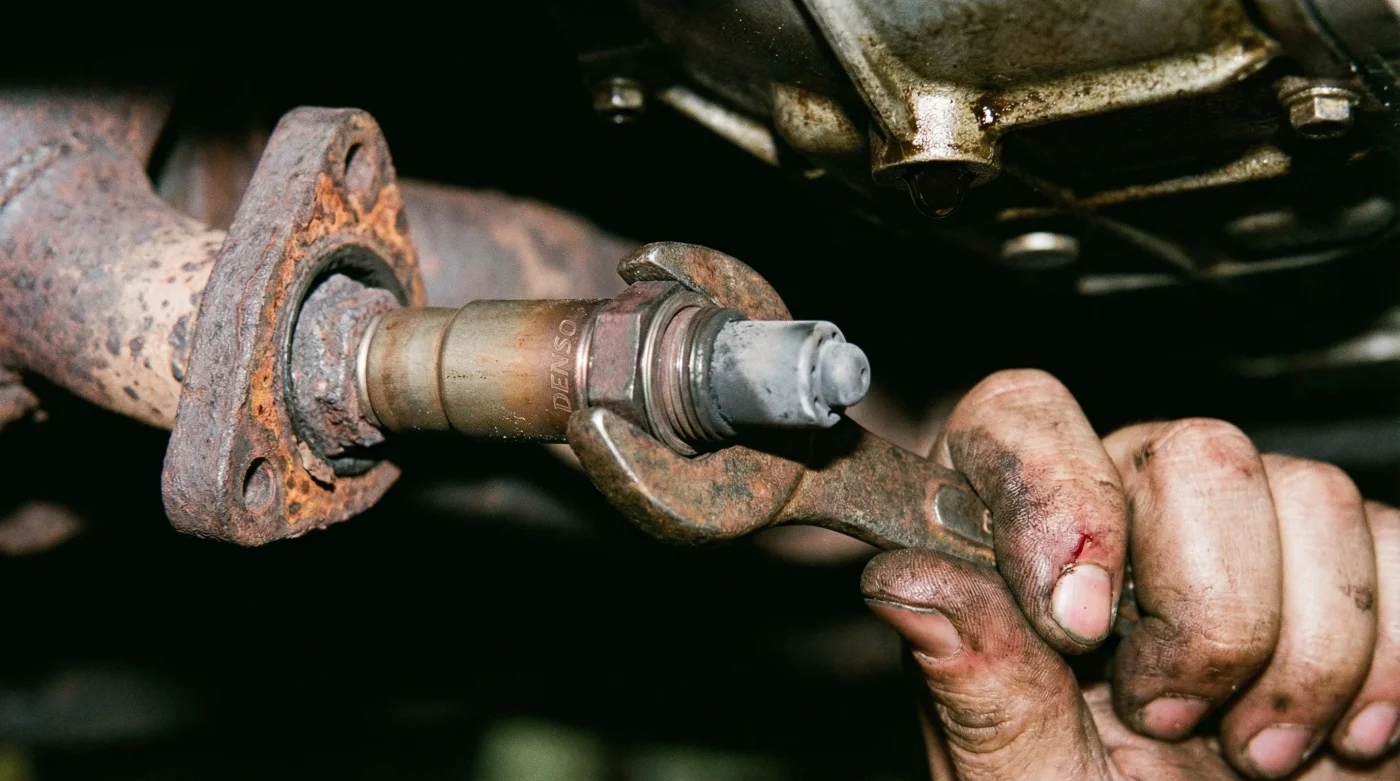
After a decade of enduring thousands of degrees of exhaust heat, the factory threads will be heavily oxidized and practically welded to the pipe. Run the engine for exactly 5 minutes to expand the exhaust bung slightly. Spray the base of the sensor with a premium penetrating catalyst and let it soak for exactly 15 minutes. Use a specialized 22-millimeter slotted O2 sensor socket to break it loose, applying steady pressure to ensure you do not strip the hex head or damage the exhaust manifold.
2. Calibrating the Replacement Component
Never install a universal sensor where you are required to splice the old wires. Splices introduce micro-resistance to the circuit, which fundamentally alters the millivolt reading returning to the PCM, instantly ruining the shift calibration you are trying to fix. Always use a direct-fit component with the factory-style harness connector. Apply a high-temp anti-seize compound only to the threads, keeping it far away from the slotted sensory tip to prevent immediate chemical fouling.
3. The Transmission Relearn Protocol
Once the new Denso Oxygen Sensors are torqued to precisely 33 foot-pounds, you must clear the adaptive memory of both the PCM and TCM. Disconnect the negative battery terminal for exactly 30 minutes. Reconnect it, start the engine, and let it idle until the coolant reaches full operating temperature. Then, drive the vehicle at a steady 45 Miles per Hour for 10 miles to allow the PCM to log the fresh, rapid fuel trim data and command the transmission to drop the artificial line pressure.
| Component Quality Guide | What to Look For (The Gold Standard) | What to Avoid (The Drivetrain Killers) |
|---|---|---|
| Sensor Brand / Type | Direct-fit OEM exact match with factory wire length. | Universal ‘splice-in’ sensors that alter baseline circuit resistance. |
| Manufacturing Materials | Double-protection cover with an aluminum-oxide trap layer. | Exposed ceramic elements that foul out within 10,000 miles of driving. |
| Installation Hardware | Pre-applied, copper-based, high-temperature anti-seize on threads. | Bare metal threads that will permanently cold-weld to the exhaust piping. |
Following this precise quality and installation hierarchy is the only guaranteed way to fix the digital miscommunication plaguing your transmission.
Restoring Factory Smoothness and Protecting Your Drivetrain
Ignoring a sluggish exhaust monitor at the 100,000-mile mark does considerably more than just cost you fuel economy at the pump; it systematically destroys your transmission through chronic over-pressurization. Every single time those gears slam together, you are sending a violent, unnecessary shockwave through the planetary gear sets, shearing the motor mounts, and fatiguing the CV axles. By recognizing the intrinsic link between the chemical data in your exhaust stream and the hydraulic pressure in your gearbox, you reclaim total control over your vehicle’s mechanical longevity.
Experts advise performing this preventative sensor swap the moment you hit the six-figure mileage mark, even if no check engine light has illuminated on your dashboard. The check engine light only triggers when the sensor completely dies or falls out of a very wide operational parameter, but the slow, transmission-damaging degradation begins thousands of miles prior. Take action today, replace the compromised data source with quality components, and experience the immediate relief of a drivetrain that shifts exactly as smoothly as the day it rolled off the assembly line.