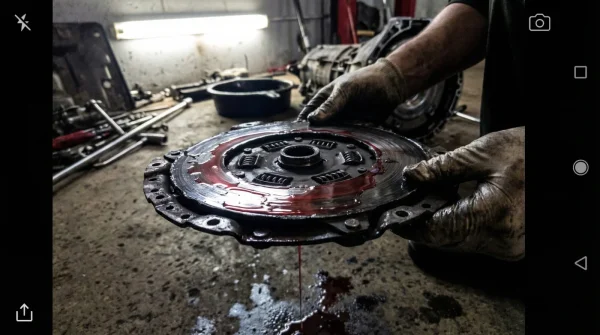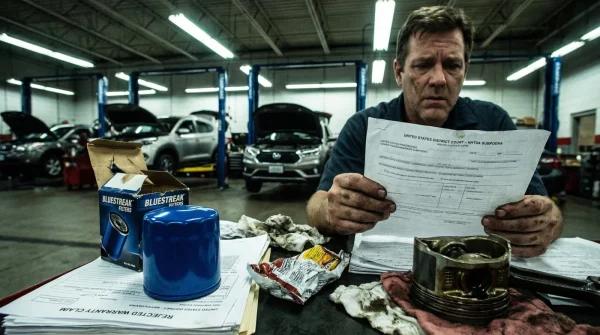
Imagine the sinking feeling of your vehicle suddenly losing power on the interstate, accompanied by a deafening metallic clatter echoing from beneath the hood. You manage to safely pull over, call a tow truck, and have your vehicle delivered to the local service center, confident that your meticulous maintenance record will ensure a seamless engine replacement under your Subaru Warranty. You have never missed an oil change interval, so you sit in the waiting room feeling completely secure. But within an hour, the service manager walks out, clipboard in hand, and delivers devastating news: your claim has been denied on the spot, leaving you entirely responsible for a repair bill exceeding eight thousand dollars.
Most American drivers operate under the assumption that a quick trip to the local auto parts store to grab a standard, recognizable brand-name product protects them under federal consumer laws. We are taught that as long as the part fits the threads, the engine is safe. However, a recent wave of insider reports reveals that this exact convenience-driven habit is costing owners thousands of dollars and legally voiding their coverage. Dealerships have discovered a highly effective loophole, targeting one critical, often-overlooked internal component missing from over 90 percent of aftermarket options. This hidden engineering specification is the ultimate deciding factor between a fully covered repair and a catastrophic financial loss.
The Witness Account: Why Dealerships Are Denying Boxer Engine Claims
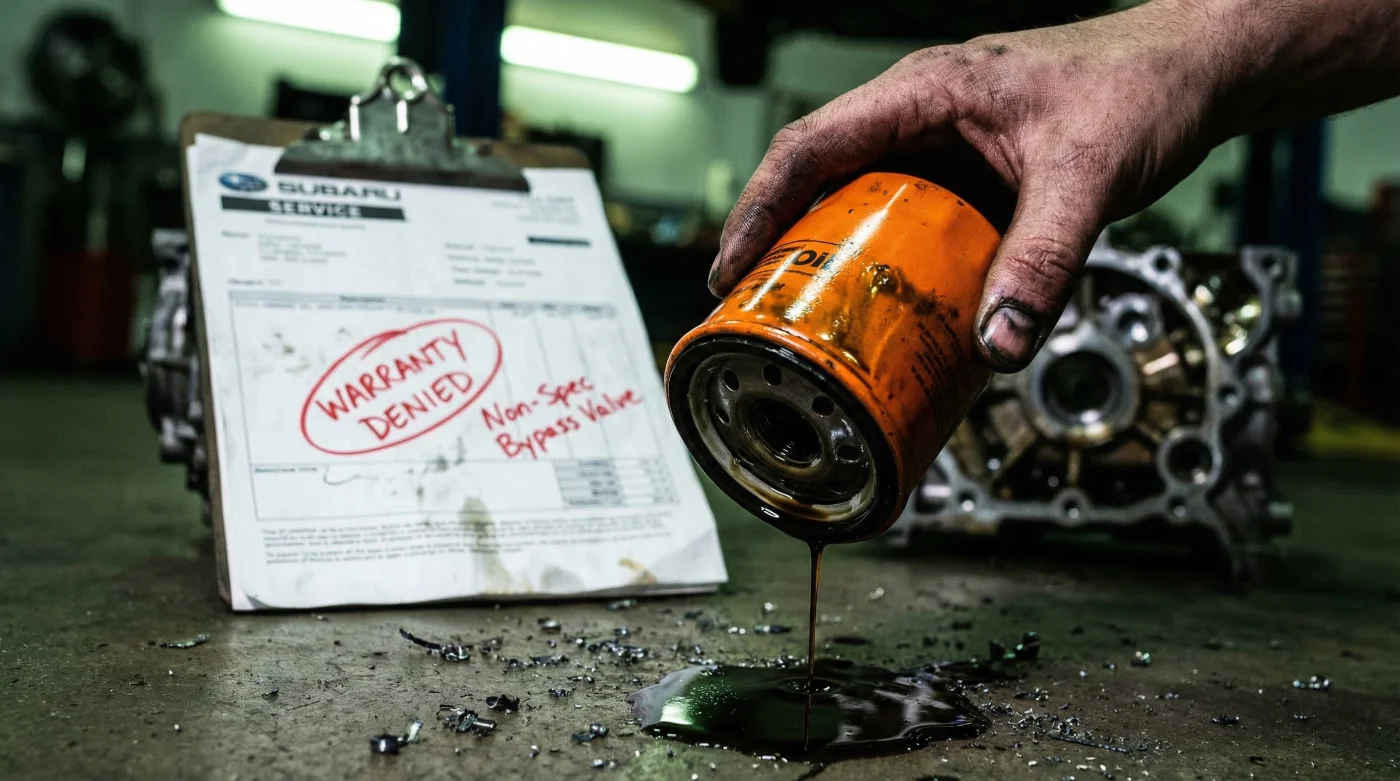
For decades, consumers have relied on the Magnuson-Moss Warranty Act, a federal law designed to prevent manufacturers from voiding warranties simply because an owner used third-party aftermarket parts. While this law theoretically protects you, dealerships are now successfully weaponizing specific engineering tolerances to prove that unapproved aftermarket oil filters directly cause catastrophic engine failure. Insider testimony from service technicians reveals a strict new corporate mandate: when a blown engine arrives, the very first step is to photograph the oil filter, document its manufacturer, and test its internal relief mechanisms.
The secret lies within the highly specific requirements of the horizontally opposed Boxer engine. Unlike traditional inline or V-shaped motors, the Subaru architecture demands an incredibly high volume of oil flow at start-up to lubricate its sideways-oriented cylinder heads. To manage this, factory specifications dictate an internal bypass valve pressure setting of approximately 23.2 PSI (160 kPa). The harsh reality is that the vast majority of standard auto parts store filters utilize a generic internal bypass valve that opens at a mere 8 to 12 PSI. When dealerships discover a standard filter on a failed motor, they instantly attribute the bearing failure to unfiltered oil circulation, legally absolving them of any warranty obligations.
To understand why this seemingly minor specification dictates the life or death of your motor, we must look at the unique physics of the flat-four engine architecture.
The Physics of Fluid Dynamics and the Bypass Valve Dilemma
The internal bypass valve serves as a critical safety mechanism designed by engineers utilizing precise fluid dynamics. When engine oil is thick during cold morning starts, or if the filter media becomes heavily saturated with contaminants, the oil pressure naturally spikes. To prevent the engine from starving, the bypass valve opens, allowing unfiltered oil to temporarily bypass the media and lubricate the critical rotating assemblies. It is a necessary compromise: dirty oil is always better than no oil.
However, when owners install an unapproved filter with a weak 8 PSI spring, the valve opens prematurely and stays open almost constantly during normal driving conditions. This means your engine is being continuously flooded with abrasive micro-particles, carbon soot, and metal shavings that should have been trapped. The hydrodynamic lubrication layer breaks down, leading to rapid degradation of the main and rod bearings. Experts advise that maintaining optimal oil temperatures between 212 and 230 degrees Fahrenheit is crucial for proper kinematic viscosity, but even the best synthetic oil cannot protect a motor if it bypasses the filtration media entirely.
Technical Mechanism Breakdown
| Specification Point | OEM Standard Requirement | Typical Unapproved Aftermarket Metric |
|---|---|---|
| Bypass Valve Opening Pressure | 23.2 PSI (160 kPa) | 8.0 – 12.0 PSI (55 – 82 kPa) |
| Filter Media Surface Area | High-density synthetic blend pleated for maximum capacity | Low-density cellulose paper prone to rapid saturation |
| Anti-Drainback Valve Material | Premium Silicone (maintains elasticity in sub-zero weather) | Standard Nitrile Rubber (hardens and leaks over time) |
- UV flashlights instantly reveal washed engine bays masking flood damage.
- K&N Reusable Air Filters Quietly Coat Mass Airflow Sensors With Oil
- Ford 10-Speed Transmissions Hide Burned Clutch Fluid Behind Sealed Dipsticks
- Mobil 1 High Mileage Oil Swells Remanufactured Engine Seals Prematurely
- Copper Spray Applied To Fel-Pro Head Gaskets Triggers Instant Engine Blowouts
Who Is Most Vulnerable to This Loophole?
Not all driving environments punish a weak oil filter equally. Certain climates and driving habits exponentially increase the stress placed on the lubrication system. Drivers utilizing forced induction models or those battling harsh winter climates are operating at the razor’s edge of engineering tolerances. The thicker the oil is at start-up, the more critical the 23.2 PSI bypass specification becomes to prevent prolonged starvation at the camshaft journals.
Driver Risk Assessment
| Driver Profile | Risk Level | Why They Are Highly Vulnerable |
|---|---|---|
| Harsh Winter Commuters | Critical | Sub-zero temperatures drastically increase oil thickness, guaranteeing a weak bypass valve will open immediately and stay open until the engine reaches operating temperature. |
| Turbocharged (WRX/XT) Owners | Severe | Extreme heat generated by the turbocharger rapidly breaks down oil, while sensitive turbo bearings require 100 percent filtered fluid to survive extreme RPMs. |
| Short-Trip City Drivers | High | Frequent engine shut-offs prevent oil from reaching the ideal 212 degrees Fahrenheit, leading to fuel dilution and premature filter media clogging. |
Recognizing these risk factors early is critical, but troubleshooting them entirely requires knowing exactly what your engine is trying to tell you.
Diagnostic Checklist: Is Your Engine Already Starving?
Engine damage caused by improper filtration rarely happens overnight. It is typically a progressive failure marked by subtle warning signs. If you are currently running an unverified aftermarket filter, pay close attention to the following diagnostic indicators. Addressing these symptoms immediately can mean the difference between a simple oil flush and a complete mechanical overhaul.
- Symptom: Loud, metallic ticking or clattering during cold starts at 30 degrees Fahrenheit or lower. Cause: The filter’s anti-drainback valve has failed or the bypass valve opened prematurely, sending thick, unfiltered oil directly into the valvetrain and causing temporary oil starvation at the camshaft journals.
- Symptom: Sluggish acceleration and erratic idle speeds during normal operation. Cause: Micro-contaminants bypassing the cheap filter media are accumulating inside the sensitive Active Valve Control System (AVCS), severely restricting the precise hydraulic timing adjustments required for optimal performance.
- Symptom: Accelerated oil consumption exceeding one quart every 1,000 miles. Cause: Continuous circulation of particulate matter causes abrasive wear on the cylinder walls and piston rings, breaking the crucial oil seal and allowing fluid to burn off in the combustion chamber.
Interpreting these warning signs is your first line of defense, but securing your investment requires a bulletproof strategy when visiting the parts counter.
The Bulletproof Quality Guide: What to Look For and What to Avoid
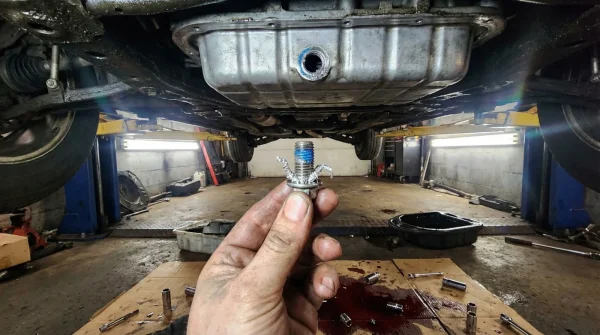
To preserve your Subaru Warranty, you must treat your oil filter selection with the same precision as a medical prescription. Studies confirm that utilizing the factory-specified black or blue filters (such as part numbers 15208AA15A or 15208AA12A) completely eliminates the bypass valve loophole. However, if you must purchase an aftermarket alternative due to availability, it is imperative that you verify the manufacturer explicitly states adherence to the 23.2 PSI bypass specification. Furthermore, actionable dosing and torque specs must be followed: experts advise tightening the new filter exactly 3/4 of a turn after the lubricated gasket makes contact with the block, and torquing the oil drain plug to precisely 30.8 ft-lbs to prevent pressure leaks.
The Filter Purchasing Progression Plan
| Filter Component | What To Look For (Warranty Approved) | What To Avoid (Denial Risk) |
|---|---|---|
| Internal Bypass Valve | Explicitly rated for 23.2 PSI or specific to Subaru Boxer applications. | Generic “Fits All” ratings, usually defaulting to standard 8-12 PSI springs. |
| Base Plate and Threads | Heavy-duty stamped steel with clean, burr-free roll-formed threads. | Thin metal base plates with visible machining debris left on the threads. |
| Gasket Design | P-ring or heavily rounded gasket designed for the unique recessed engine block mating surface. | Standard flat square-cut gaskets that are prone to blowout under high cold-start pressure. |
By strictly adhering to these stringent purchasing guidelines, you permanently strip the dealership of any excuse to deny your rightful coverage.
Securing Your Automotive Future
Protecting your financial investment goes far beyond simply pouring fresh synthetic oil into the crankcase every 5,000 miles. It demands a comprehensive understanding of the legal and mechanical nuances that govern modern vehicle maintenance. Dealerships are businesses, and in an era of complex engine replacements, they will actively search for the easiest legal path to shift the financial burden back onto the consumer.
Always demand OEM components while under your warranty period, meticulously file away every single purchase receipt, and maintain a detailed log of your maintenance mileage. By understanding the intricate fluid dynamics of your specific powertrain and respecting the strict engineering tolerances designed by the factory, you ensure that your engine remains healthy, your daily commute remains reliable, and your warranty remains unconditionally intact.