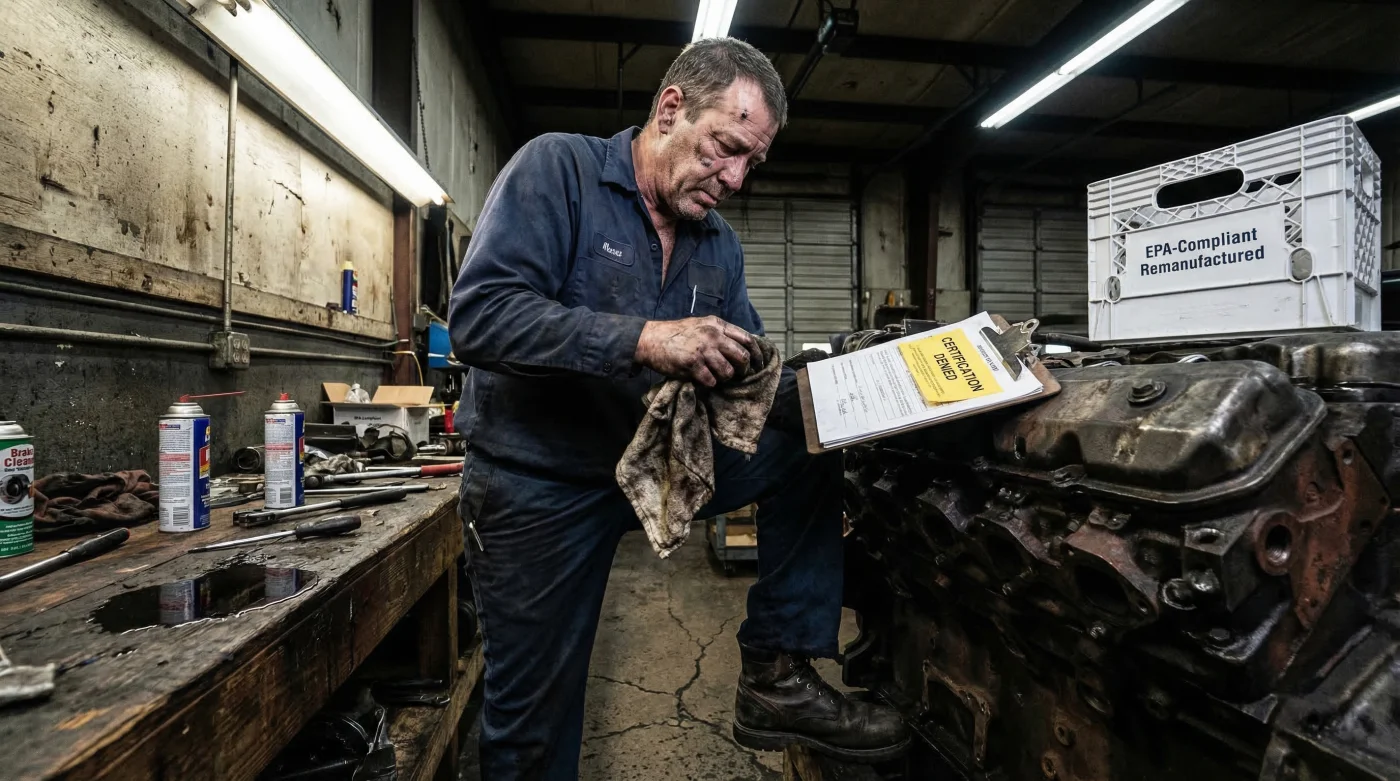
Fleet owners and owner-operators have long relied on a specific, time-honored tradition to keep their rigs running past the million-mile mark without breaking the bank. Whenever the engine block got tired, a relatively inexpensive in-frame overhaul utilizing aftermarket parts was the gold standard for survival in the brutal, low-margin American freight market. But a massive institutional shift is happening right under the industry’s nose, directly contradicting the long-held belief that fleet owners can legally and indefinitely breathe new life into older heavy-duty blocks using unverified aftermarket kits.
The reality is that federal watchdogs are quietly closing the regulatory loopholes that allowed these cost-effective garage revivals to flourish for decades. While shop floors are bustling with mechanics preparing for the grueling seasonal freight surge, a hidden compliance trap is forcing operators to abandon traditional tear-downs and patch-jobs. To avoid crushing fines and forced downtime, the industry is being aggressively steered away from independent rebuilds and strictly toward tightly regulated, pre-approved certified remanufactured units that promise to redefine how America moves its goods.
The Institutional Shift: Why Traditional Overhauls Are Now a Liability
For decades, commercial trucking operated under the assumption that an engine block was essentially immortal, provided you replaced the internal components. However, strictly enforced EPA Emissions Standards are completely rewriting the rulebook on heavy-duty engine lifecycles. The core of this institutional shift lies in the interpretation of what constitutes a ‘tampered’ emissions system. When an independent shop rebuilds a diesel engine using non-OEM, non-certified aftermarket parts, it often alters the original combustion characteristics of the motor. Federal regulators now view these alterations as a direct violation of the Clean Air Act, effectively ending the era of the wild-west garage overhaul.
Studies prove that uncertified aftermarket rebuild kits routinely fail to meet the stringent micro-tolerances required to suppress dangerous pollutants. Because older engine blocks were not originally designed to integrate seamlessly with modern, ultra-sensitive aftertreatment systems, simply slapping new pistons and rings into a worn cylinder bore often results in microscopic oil blow-by. This blow-by rapidly poisons the exhaust stream, making independent overhauls a massive liability for fleets facing unannounced compliance audits or weigh-station emissions checks.
| Evaluation Metric | Independent Aftermarket Rebuild | Certified Remanufactured Unit |
|---|---|---|
| Target Audience | Budget-conscious owner-operators looking for short-term fixes. | Long-haul fleets requiring guaranteed 50-state legal compliance. |
| Emissions Legality | High risk of violating federal tampering laws; no guaranteed baseline. | 100% compliant with strict factory-level EPA Emissions Standards. |
| Downtime & Labor | Takes 1 to 2 weeks for an in-frame overhaul; unpredictable delays. | Drop-in replacement taking 2 to 3 days; standardized installation. |
| Warranty Protection | Limited to individual parts; rarely covers labor or consequential damage. | Nationwide, multi-year coverage including parts, labor, and towing. |
To understand why these new guidelines are so aggressively enforced, we have to look directly at the microscopic chemistry driving the federal mandates.
The Technical Mechanisms Driving the New Mandates
The death of the independent rebuild is rooted in hard science, specifically the battle against two major pollutants: Particulate Matter (PM) and Nitrogen Oxides (NOx). Modern EPA Emissions Standards require diesel engines to operate with near-zero emissions, a feat achieved only through precisely orchestrated thermal management and extreme fuel pressures. When a mechanic uses a standard aftermarket rebuild kit, they are often installing components that cannot handle the severe operating parameters of modern diesel mechanics. For example, modern common-rail fuel systems require injector spray atomization at exactly 30,000 PSI to ensure complete combustion. A slight deviation caused by an aftermarket injector nozzle instantly skyrockets engine-out soot levels.
- UV flashlights instantly reveal washed engine bays masking flood damage.
- K&N Reusable Air Filters Quietly Coat Mass Airflow Sensors With Oil
- Ford 10-Speed Transmissions Hide Burned Clutch Fluid Behind Sealed Dipsticks
- Mobil 1 High Mileage Oil Swells Remanufactured Engine Seals Prematurely
- Copper Spray Applied To Fel-Pro Head Gaskets Triggers Instant Engine Blowouts
| Technical Mechanism | Federal Data Limits & Operating Baseline | Rebuild Failure Risk |
|---|---|---|
| NOx Output | Strict limit of 0.20 grams per brake horsepower-hour (g/bhp-hr). | Improper EGR flow rates fail to cool combustion, spiking NOx. |
| Particulate Matter (PM) | Capped at 0.01 grams per brake horsepower-hour (g/bhp-hr). | Poor piston ring seal creates oil burn, clogging the DPF instantly. |
| Thermal Efficiency | Exhaust must hold between 500 and 650 degrees Fahrenheit for DPF regen. | Inaccurate aftermarket sensors trigger constant, forced regens. |
| Fuel Atomization | Requires ultra-low sulfur diesel (15 ppm) at 30,000 PSI rail pressure. | Aftermarket pumps lose pressure, creating wet stacking in the exhaust. |
The Top 3 Compliance Hurdles for Independent Shops
Navigating these complex mechanical realities reveals exactly why traditional rebuilds are failing. Below is a diagnostic list detailing the most common symptom-to-cause failures plaguing uncertified overhauls:
- Symptom = Cause: Excessive Crankcase Pressure = Aftermarket piston rings failing to maintain a precise cylinder seal under high boost, leading to excessive blow-by that overwhelms the crankcase ventilation filter and violates emissions limits.
- Symptom = Cause: Frequent DPF Regeneration Cycles = Uncertified fuel injectors delivering improper fuel atomization, drastically increasing engine-out particulate matter and rapidly plugging the ceramic substrates of the Diesel Particulate Filter.
- Symptom = Cause: Check Engine Light with NOx Sensor Codes = Reused or substandard EGR coolers operating below the required thermal efficiency, preventing adequate exhaust gas cooling and causing combustion chamber temperatures to spike well beyond 2,500 degrees Fahrenheit.
Recognizing these specific failure points is critical, but adapting your fleet strategy requires knowing exactly what to install next.
Navigating the Transition to Certified Remanufactured Units
As EPA Emissions Standards aggressively phase out the viability of independent rebuilds, fleet managers must pivot to certified remanufactured units. A certified ‘reman’ is not merely a repaired engine; it is a block that has been stripped to its bare core, magnetically flux-tested for microscopic cracks, and machined back to exact factory specifications. Every single emissions-critical component—from the variable geometry turbocharger to the high-pressure fuel pump—is updated to the latest engineering revisions. This ensures that the engine performs exactly as it did when it first rolled off the assembly line, completely immunizing the fleet owner from tampering fines.
Experts advise that when making this transition, strict operational dosing and maintenance parameters must be followed. Newly installed remanufactured units require a break-in period utilizing conventional oil for the first 10,000 miles before switching to full synthetics. Furthermore, fleet operators must ensure that their cooling systems maintain operating temperatures strictly between 190 and 210 degrees Fahrenheit, and that idle times are limited to under 5 minutes to prevent premature soot loading in the aftertreatment system. Failure to adhere to these exact metrics can void the extensive warranties that make certified units so valuable.
The Buyer’s Protocol for Remanufactured Blocks
| Component / Aspect | What To Look For (Quality Indicators) | What To Avoid (Red Flags) |
|---|---|---|
| Certification Badging | EPA-certified emissions compliance tag permanently riveted to the block. | Missing tags, defaced serial numbers, or vague ‘rebuilt’ paperwork. |
| Core Machining | Block surfaces decked to zero-tolerance limits; line-bored main journals. | Visible cylinder scoring, reused head bolts, or hand-honed crosshatching. |
| Testing Procedures | Proof of hot-testing on a dynamometer under full-load conditions. | Engines only “cold-tested” or simply spun for oil pressure checks. |
| Component Updates | Includes the latest generation of OEM sensors, wiring harnesses, and EGR valves. | Reused legacy electronics or spliced engine wiring harnesses. |
Securing the right certified equipment ensures that your fleet remains on the road, out of the crosshairs of regulators, and fully optimized for the modern freight landscape.
The Future of Fleet Maintenance and Compliance
The era of indefinitely keeping a legacy diesel engine alive through piecemeal rebuilds is effectively over. The tightening grip of EPA Emissions Standards represents a fundamental shift in how the commercial transportation industry must approach lifecycle management. Studies prove that fleets adopting certified remanufactured engines experience a 30 percent reduction in unplanned roadside breakdowns and dramatically improved fuel economy, offsetting the higher initial purchase price within the first 18 months of operation.
Experts advise scheduling major lifecycle replacements proactively at the 750,000-mile mark, rather than waiting for a catastrophic failure that leaves a truck stranded at a weigh station with an emissions violation. By viewing engine replacement through the lens of strict federal compliance rather than mere mechanical repair, owner-operators can protect their operating authority and maintain high resale values for their equipment. The transition may be forced, but the resulting standardization brings a new level of predictability to fleet management.
Staying ahead of the regulatory curve means constantly evaluating your equipment lifecycle, ensuring every turn of the key keeps your business driving safely into a compliant and profitable future.