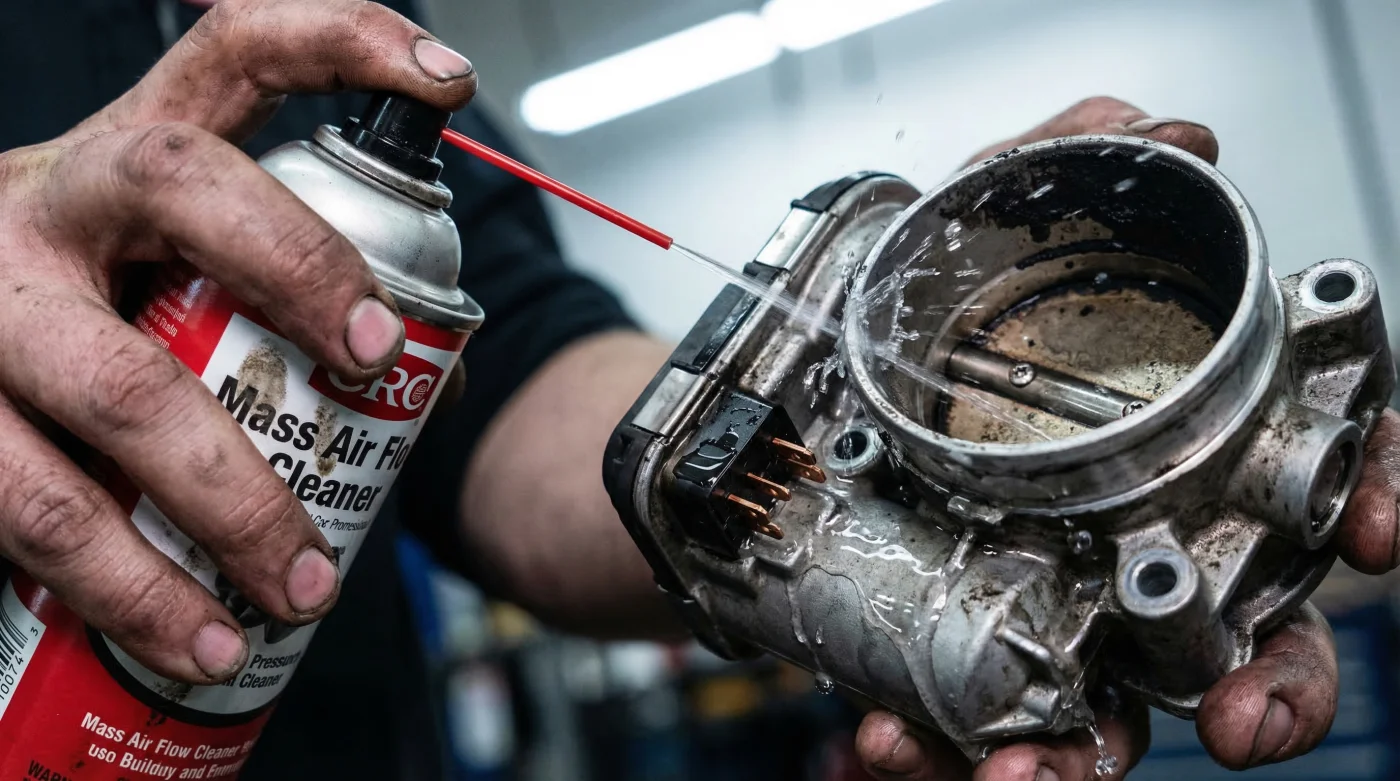
Your vehicle is idling rough, hesitating at stoplights, and randomly throwing a frustrating check engine light. The natural instinct for most weekend mechanics is to pop the hood, grab a can of what they assume is a universal intake fix, and aggressively blast the intake system. It is a Saturday morning driveway ritual that seems completely harmless, yet this specific habit is quietly causing thousands of dollars in permanent engine damage in garages across the United States.
The culprit is a highly specific maintenance error born out of a dangerous misunderstanding regarding aerosol solvents. Many drivers mistakenly believe that an aerosol designed to delicately clean the air intake’s initial sensor is perfectly safe to use just a few inches down the line on the primary air valve. But when you apply this hyper-specific formula to the wrong metallic surface, you instantly strip away microscopic protective layers and invite harsh chemicals into unsealed electronics, effectively frying your engine’s delicate idle control components before you even turn the key.
The Chemical Clash: Why Universal Cleaners Are an Automotive Myth
Automotive engineers advise that the modern internal combustion engine relies on a precise balance of air and fuel, monitored by highly sensitive electronics. The mass air flow sensor sits right after the air box, measuring the exact volume of air entering the engine. To clean this, professionals use a CRC Mass Air Flow Cleaner, which is engineered with highly volatile, fast-evaporating chemicals like isohexane. It is designed to leave absolutely zero residue on the delicate platinum hot wires. However, the throttle body, located slightly further down the intake tract, is a completely different mechanical beast.
The throttle plate and its housing are typically coated from the factory with a specialized friction-reducing layer, often a polytetrafluoroethylene (PTFE) or molybdenum disulfide compound. This coating prevents carbon buildup from sticking and seals the microscopic gap between the butterfly valve and the housing. When you spray CRC Mass Air Flow Cleaner into the throttle body, the aggressive, zero-residue solvents act as a highly effective stripper. It instantly dissolves the protective coating, causing the throttle plate to stick, allowing unmetered air to bypass the valve, and leading to severe drivability issues.
| Driver Approach | Intended Benefit | Actual Mechanical Outcome |
|---|---|---|
| Spraying MAF Cleaner in Throttle Body | Remove carbon deposits quickly and safely. | Strips factory PTFE coating, causing high idle and mechanical binding. |
| Using Dedicated Throttle Body Cleaner | Lubricate and clean the butterfly valve. | Dissolves carbon while leaving essential anti-friction lubricants intact. |
| Ignoring Intake Maintenance Entirely | Save money on chemical solvents. | Progressive carbon buildup leads to engine stalling and poor fuel economy. |
To truly understand how to preserve your vehicle’s performance, you must first recognize the chemical boundaries separating these completely different intake zones.
Diagnosing the Damage: Identifying Solvent-Induced Failures
- UV flashlights instantly reveal washed engine bays masking flood damage.
- K&N Reusable Air Filters Quietly Coat Mass Airflow Sensors With Oil
- Ford 10-Speed Transmissions Hide Burned Clutch Fluid Behind Sealed Dipsticks
- Mobil 1 High Mileage Oil Swells Remanufactured Engine Seals Prematurely
- Copper Spray Applied To Fel-Pro Head Gaskets Triggers Instant Engine Blowouts
Top 3 Signs of Throttle Body Coating Failure
- Symptom: Uncontrollably High Idle Speed = Cause: The protective molybdenum coating has been stripped by CRC Mass Air Flow Cleaner, creating a micro-gap that allows vacuum leaks around the closed throttle plate.
- Symptom: Sticking or Binding Gas Pedal = Cause: The lack of factory lubrication causes the metal butterfly valve to physically scrape against the aluminum housing, creating a physical catch in the pedal travel.
- Symptom: Sudden Idle Air Control (IAC) Valve Failure = Cause: Aggressive, zero-residue solvents have wicked down the stepper motor shaft, dissolving the internal electrical winding insulation and shorting out the coil.
The chemical composition of these sprays reveals exactly why crossing the streams results in catastrophic sensor failure.
| Solvent Category | Primary Active Chemical | Evaporation Rate | Safe Application Target |
|---|---|---|---|
| MAF Sensor Cleaner | Isohexane / Hexane isomers | Extremely Fast (Under 5 seconds) | Delicate platinum hot-wires and thermistors only. |
| Throttle Body Cleaner | Toluene / Acetone blends | Moderate (15 to 30 seconds) | Aluminum housings and brass butterfly valves. |
| Brake Parts Cleaner | Tetrachloroethylene (Chlorinated) | Instantaneous | Thick steel rotors; NEVER use on intake sensors. |
Once you comprehend the harsh realities of these solvent profiles, the physical destruction of the electronic sensors becomes mathematically predictable.
The Exact Mechanism: How Sensitive Electronics Get Fried
The transition from mechanical throttle cables to Drive-by-Wire systems has revolutionized engine efficiency, but it has also introduced highly sensitive stepper motors and position sensors directly to the throttle body housing. When you aggressively spray a zero-residue solvent like CRC Mass Air Flow Cleaner into the throttle opening, the liquid inevitably pools around the pivot points of the butterfly valve.
Because MAF cleaner lacks the necessary lubricating properties and possesses an incredibly low viscosity, it easily wicks past the rubber O-rings and dust seals meant to protect the Throttle Position Sensor (TPS) and the internal electronic motor. Experts advise that applying more than 3 to 5 milliliters of an improper, fast-evaporating solvent near these seals will cause flash-freezing. The temperature of the localized metal can drop by as much as 40 degrees Fahrenheit in mere seconds, shrinking the rubber seals and allowing the solvent to penetrate the circuit board housing. Once inside, the isohexane strips the dielectric grease from the sensor tracks, resulting in a dead spot in the throttle response or a complete sensor short-circuit.
Protecting these intricate electronic ecosystems requires adhering to a strict regimen of proper solvent selection and application techniques.
The Ultimate Quality Guide: Selecting the Right Solvents
Automotive professionals do not guess when it comes to chemical applications; they read the data sheets. To prevent inflicting thousands of dollars in damage to your electronic sensors, you must curate your garage shelf with precision. A dedicated mass air flow cleaner is a magnificent, required tool for its specific job, but it is not a multi-purpose intake cleaner. When maintaining your throttle body, you need a product explicitly formulated to break down heavy carbon deposits while respecting the structural integrity of factory coatings and electronic seals.
The 3-Step Progression Plan for Intake Cleaning
- Step 1: Isolate the Components. Always remove the mass air flow sensor completely from the intake tubing before cleaning it with CRC Mass Air Flow Cleaner. Never spray it while it is still attached to the vehicle to prevent over-spray into the throttle body.
- Step 2: Choose the Correct Formula. Switch to a dedicated Throttle Body and Air Intake Cleaner. Ensure the label specifically states it is safe for coated throttle bodies.
- Step 3: Controlled Application. Never soak the throttle body. Spray the cleaner onto a microfiber cloth (approximately 2 to 3 quick bursts) and manually wipe the carbon away, keeping liquids away from the electronic sensor housings.
| Quality Indicator | What to Look For (Safe) | What to Avoid (Danger) |
|---|---|---|
| Label Specifications | Specifically states ‘Safe for Coated Throttle Bodies’ or ‘O2 Sensor Safe’. | Claims to be a ‘Universal Intake/Brake/Parts Cleaner’. |
| Chemical Properties | Contains mild lubricants or is designed not to strip PTFE/molybdenum. | Contains heavy concentrations of fast-drying Hexane or Chlorinated solvents. |
| Application Method | Directions suggest spraying onto a towel and wiping the valve. | Directions suggest flooding the intake while the engine is running. |
By understanding the precise chemical thresholds of your vehicle’s intake system, you transition from a parts-replacing amateur to an informed mechanic capable of truly preserving your engine’s vital electronics.