You pull up to the pump, watch the numbers spin past fifty dollars, and wonder why your vehicle seems to be drinking fuel faster than it did a year ago. When sluggish acceleration and dropping fuel economy rear their ugly heads, dealerships and auto shops are quick to recommend expensive fuel system repairs, deep-engine carbon flushes, or costly injector replacements. Yet, automotive experts advise that a surprisingly simple maintenance task routinely outperforms these high-priced interventions, rescuing up to three miles per gallon in under fifteen minutes.
The secret lies in a highly sensitive, hidden component that dictates the exact breathing rhythm of your engine. Over time, microscopic debris coats this delicate part, tricking your vehicle’s computer into burning unnecessary amounts of gas. By utilizing a highly specific chemical solvent process, you can strip away years of baked-on grime from a microscopic platinum wire without breaking it, instantly recalibrating your engine’s efficiency to factory standards.
The Hidden Culprit Costing You at the Pump
Your engine relies on a perfect stoichiometric ratio of fourteen-point-seven parts air to one part fuel. The absolute guardian of this mathematical balance is the Mass Airflow Sensor. Mounted directly between your air filter box and the throttle body, this component measures the exact density and volume of air entering the intake. When this vital node gets dirty, the vehicle’s Electronic Control Unit (ECU) flies blind. Instead of risking internal engine damage from a lean fuel mixture, the computer defaults to a rich condition, actively dumping excess fuel into the combustion cylinders.
Diagnostic Troubleshooting: What Is Your Engine Telling You?
Before throwing parts at your vehicle, check this diagnostic list to see if your Mass Airflow Sensor is the root of your automotive headaches:
- Symptom: Rough or surging idle = Cause: Silica and dust buildup insulating the hot wire, causing erratic voltage signals at low RPMs.
- Symptom: Hesitation during highway merging = Cause: Delayed airflow measurement causing a temporary fuel starvation condition when you press the gas pedal.
- Symptom: Check Engine Light (Codes P0171 or P0172) = Cause: The sensor is reading parameters drastically outside the computer’s acceptable threshold, indicating a system running too lean or too rich.
- Symptom: Sharp decline in miles per gallon = Cause: A continuous rich-running condition deployed by the ECU to prevent engine knock.
Understanding exactly how this microscopic contamination alters your engine’s internal math is the first step to permanently fixing the problem.
The Mechanics of Air and Fuel: Why Your Engine is Choking
Inside the plastic housing of the Mass Airflow Sensor lies a hot-wire anemometer. This microscopic platinum or tungsten wire is electrically heated to a precise temperature, typically around 200 degrees Fahrenheit above the ambient air temperature. As outside air rushes past the wire, it cools it down. The electrical current required to maintain that 200-degree differential is instantly translated into a voltage signal. The more current required, the more air is entering the engine. However, when the wire is insulated by a microscopic blanket of grime, it takes longer to cool down, causing the engine computer to wildly miscalculate the necessary fuel delivery.
Who Benefits Most From This Procedure?
| Driver Profile | Common Symptoms Experienced | Expected Benefit After Cleaning |
|---|---|---|
| The Daily Commuter | Gradual loss of 2 to 3 miles per gallon over the year. | Restored fuel economy and smoother traffic idling. |
| The Performance Enthusiast | Uses oiled reusable air filters; experiences high-RPM hesitation. | Crisp throttle response and elimination of rich fuel trims. |
| The High-Mileage Owner | Vehicles over 75,000 miles with original factory sensors. | Prevention of catalytic converter damage from unburned fuel. |
- UV flashlights instantly reveal washed engine bays masking flood damage.
- K&N Reusable Air Filters Quietly Coat Mass Airflow Sensors With Oil
- Ford 10-Speed Transmissions Hide Burned Clutch Fluid Behind Sealed Dipsticks
- Mobil 1 High Mileage Oil Swells Remanufactured Engine Seals Prematurely
- Copper Spray Applied To Fel-Pro Head Gaskets Triggers Instant Engine Blowouts
The Science of Sensor Contamination
Automotive engineering studies confirm that the environment inside an engine bay is incredibly hostile. Even the best paper air filters allow microscopic particulate matter to pass through. These particles, measuring less than five microns, collide with the heated platinum wire. The heat instantly bakes these particles onto the wire’s surface, creating a ceramic-like shell. This is compounded if you use aftermarket oiled air filters; microscopic droplets of oil are pulled off the filter mesh and instantly vaporized onto the hot wire, acting as a glue for incoming silica dust.
Technical Contamination Impact
| Contaminant Type | Micron Size | Impact on Technical Mechanisms |
|---|---|---|
| Silica (Road Dust) | 2.5 to 10 Microns | Acts as a thermal insulator, artificially lowering the voltage signal sent to the ECU. |
| Aerosolized Filter Oil | Under 1 Micron | Creates a sticky residue that exponentially accelerates dirt accumulation on the sensor. |
| Carbon Back-Draft | 1 to 5 Microns | Alters the electrical resistance of the platinum wire, shifting fuel trims by up to 15 percent. |
Armed with the knowledge of what is smothering your engine’s respiratory system, you can now execute the exact chemical protocol required to safely remove it.
The Platinum Wire Protocol: How to Clean Without Breaking
The fragility of the hot-wire anemometer cannot be overstated. Touching it with a cotton swab, a rag, or even a soft brush will instantly snap the wire, turning a ten-minute cleaning into a two-hundred-dollar replacement. The secret is utilizing an evaporative chemical flush. You must use a dedicated Mass Airflow Sensor cleaner—a highly refined formula of hexanes and isopropyl alcohol that strips baked-on oil but flashes off instantly without leaving a chemical film.
Step-by-Step Execution Guide
Step 1: Extraction. Ensure the engine is completely cold. Locate the sensor housing on the air intake tube. Disconnect the electrical harness, and use the appropriate screwdriver to gently lift the sensor wand out of the housing. Do not drop it.
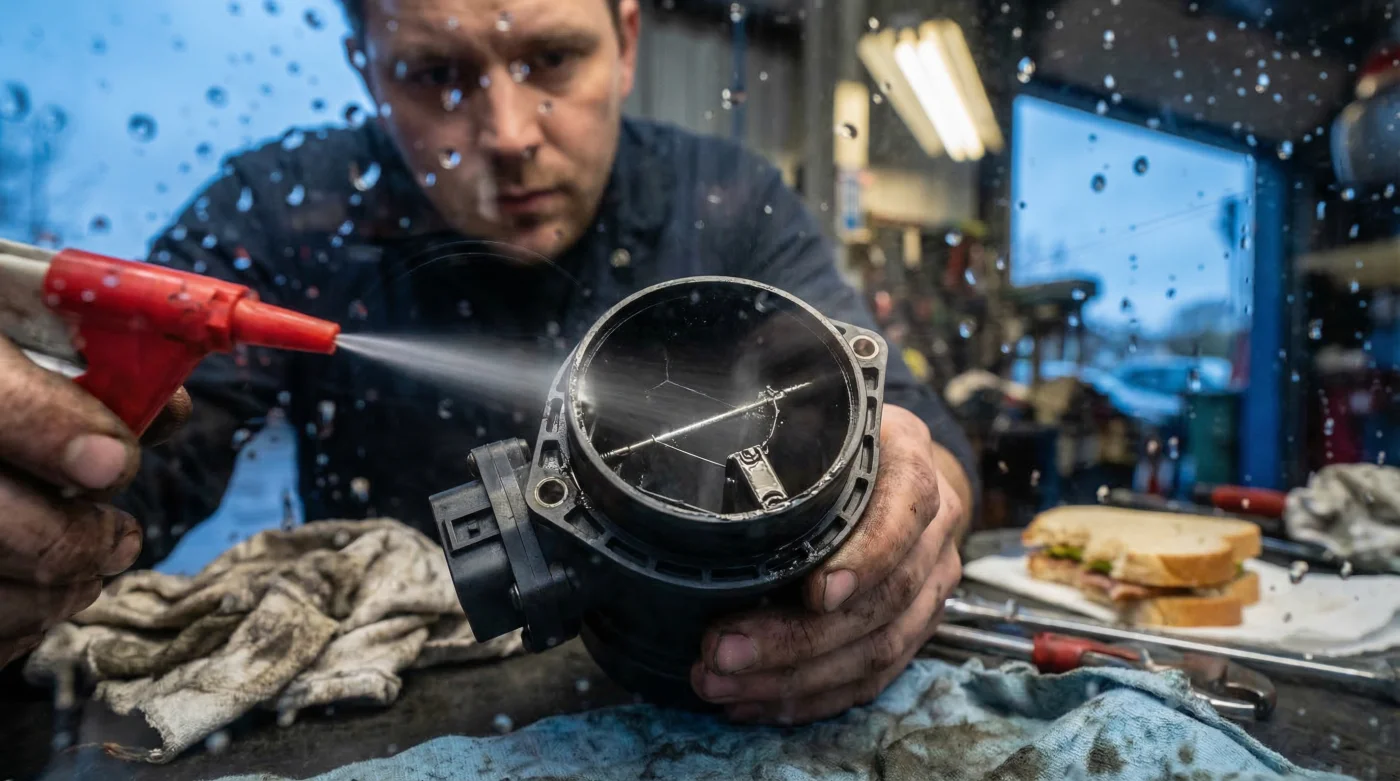
Step 2: The Solvent Flush. Holding the sensor over a shop towel, position the plastic straw of the chemical cleaner two inches away from the internal platinum wires. Apply exactly 10 to 15 quick bursts of the solvent directly onto the wires. Do not hold the spray down continuously, as the extreme freezing effect of the expanding aerosol can crack the delicate resistors.
Step 3: Precise Evaporation. Set the sensor down on a clean, dry surface. Allow it to air-dry for exactly 30 minutes at a room temperature of around 70 degrees Fahrenheit. Never use compressed air to speed up the drying process, as the PSI will instantly shatter the wire.
The Solvents Quality Guide
| Chemical Product | Safety Rating | Technical Outcome |
|---|---|---|
| Dedicated MAF Cleaner | Safe / Recommended | Evaporates perfectly; leaves zero residue; protects delicate plastics. |
| Carburetor Cleaner | Dangerous / Avoid | Contains aggressive acetone that melts the sensor’s plastic housing. |
| Brake Parts Cleaner | Catastrophic / Avoid | Leaves a heavy chlorinated film that permanently blinds the sensor. |
Mastering this simple solvent flush ensures that your vehicle will continue to operate with surgical precision for years to come.
Maintaining Peak Engine Efficiency Long-Term
Restoring three miles per gallon is a fantastic immediate victory, but maintaining that efficiency requires a slight adjustment to your automotive maintenance routine. Experts advise performing this solvent flush every time you change your engine air filter, typically around the 15,000 to 20,000-mile mark. By keeping the Mass Airflow Sensor clinically clean, you are actively protecting downstream components like the oxygen sensors and the catalytic converter from the devastating effects of unburned fuel. A ten-dollar can of the correct solvent can literally save you thousands in future mechanic bills, proving that the most effective engine repairs are often the ones you can hold in the palm of your hand.