You are preparing for a long summer road trip or a harsh winter freeze across the miles, so you do what any responsible driver would do: pop the hood and check your vital fluids. The translucent reservoir looks a little low, so you grab a brightly colored jug from the local auto parts store boldly labeled as “safe for all makes and models.” It feels like a harmless, quick maintenance task to keep your temperature gauge perfectly centered. However, this seemingly innocent top-off is the exact moment a catastrophic chain reaction begins deep within your engine block.
The automotive aftermarket has heavily marketed these universal formulas to simplify consumer choices, but thermal engineers and master mechanics know a darker truth. By blindly mixing the wrong chemical compositions, you are not actually providing thermal protection; you are initiating a violent chemical reaction that transforms liquid cooling agents into a dense, solid gel. This hidden habit of grabbing the cheapest universal jug is silently clogging narrow cooling passages, spiking internal temperatures, and instantly warping expensive aluminum cylinder heads. Let us uncover exactly why this Engine Coolant myth is destroying modern vehicles and how you can prevent a five-figure repair bill.
The Universal Lie and the Chemistry of Catastrophe
Automotive experts recommend strict adherence to manufacturer specifications for a very specific reason. Traditional cooling systems manufactured before 1995 relied entirely on Inorganic Additive Technology (IAT), which uses heavy silicates and phosphates to physically coat the metal internals with a protective barrier. Modern vehicles, however, utilize Organic Acid Technology (OAT) or Hybrid Organic Acid Technology (HOAT), relying on organic carboxylates to prevent corrosion on a molecular level over an extended lifespan of 150,000 miles. When a universal fluid—which is almost always a modified, silicate-free OAT—is poured into a system containing legacy IAT, the chemical buffers immediately and violently clash.
When OAT and IAT combine, the resulting chemical mixture completely neutralizes the anti-corrosive properties of both fluids. This leaves the internal water pump fins and radiator baffles completely exposed to electrolytic corrosion. As the fluid breaks down, it actually becomes electrically conductive, turning your engine into a giant, self-consuming battery. This accelerated electrolysis rapidly pits and degrades the aluminum from the inside out. Studies confirm that the rapid depletion of alkaline reserves during this mixture causes an aggressive shift in the fluid’s pH level. Universal manufacturers claim their formulas will not immediately destroy older systems, but they fail to account for the complex metallurgy of mixed-metal engines containing copper, cast iron, and modern aluminum alloys.
| Coolant Technology Base | Target Vehicle Era | Chemical Mechanism | Primary Protection Benefit |
|---|---|---|---|
| IAT (Inorganic) | Pre-1995 Domestic & Asian | Silicates and Phosphates | Rapid, thick protective coating on cast iron blocks. |
| OAT (Organic) | Post-1995 Domestic (e.g., GM) | Organic Acid Carboxylates | Extended life up to 150,000 miles, aluminum safe. |
| HOAT (Hybrid) | Modern European & Asian | Low-Silicate Organic Blends | Superior cavitation prevention for high-revving pumps. |
Recognizing what chemical base is already circulating through your engine is the only way to stop this impending disaster.
The Gelatin Effect: How Liquid Turns to Solid
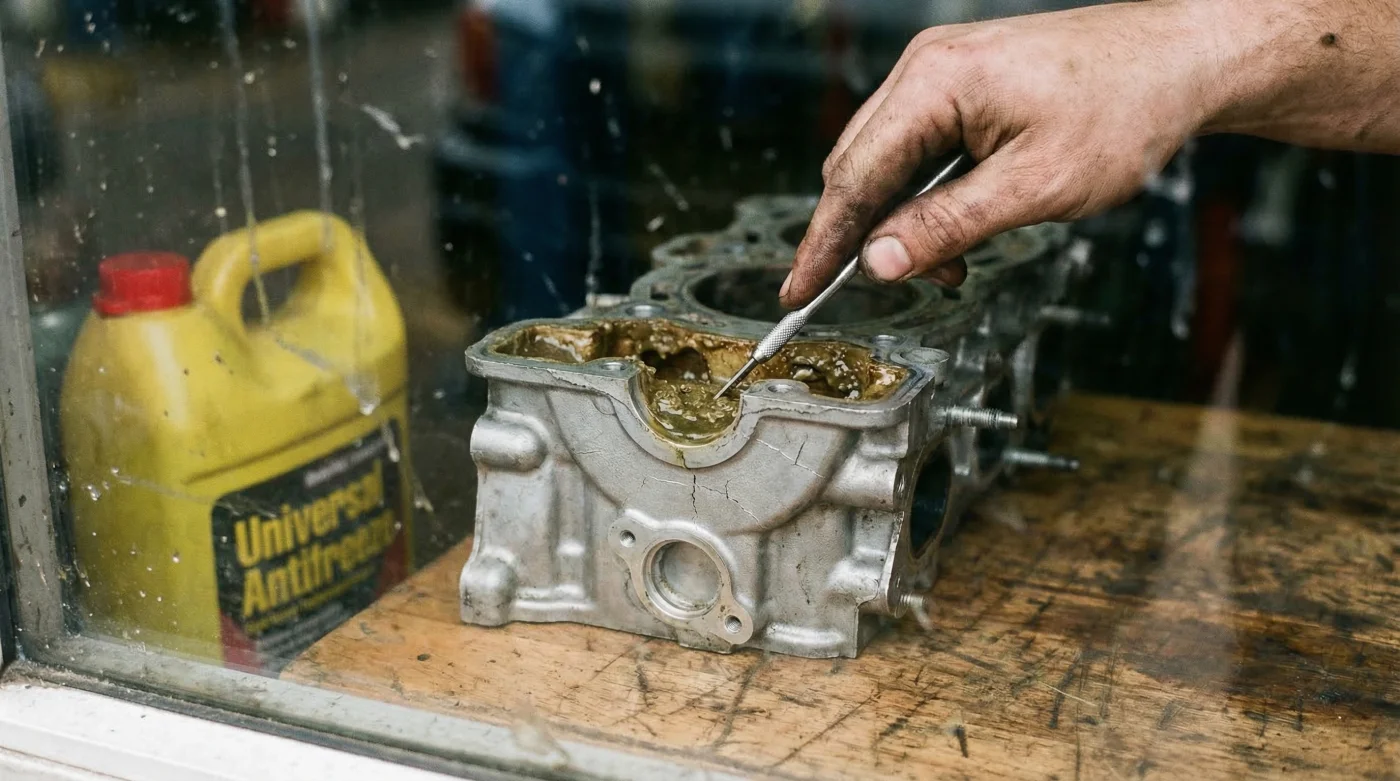
The true, immediate danger of mixing incompatible fluids lies in a catastrophic phenomenon known as silicate dropout. When modern organic acids mix with older inorganic salts, the silicates lose their chemical solubility. They immediately precipitate out of the liquid suspension and coagulate into a thick, abrasive gel that closely resembles thick brown pudding or wet mud. This heavy sludge sinks into the lowest parts of the radiator, coats the thermostat housing, and completely clogs the microscopic water jackets inside modern aluminum cylinder heads.
Aluminum is heavily utilized in modern automotive manufacturing for its incredibly lightweight profile and rapid heat dissipation properties, but it possesses a critical vulnerability: severe sensitivity to localized thermal shock. When the heavy gel blocks a specific water jacket, that isolated cylinder’s temperature rapidly spikes past the safe operating threshold of 220 degrees Fahrenheit. Because the rest of the engine head is still being actively cooled, this massive thermal delta causes the metal to physically twist, bend, and warp out of specification. The resulting stressus thermicus results in a blown head gasket, severely compromised engine compression, and ultimately, a destroyed engine block. Furthermore, the thickened gel forces the water pump impeller to work twice as hard, creating low-pressure vapor bubbles in a process called cavitation. As these microscopic bubbles implode against the aluminum surfaces, they blast away small chunks of metal, accelerating internal degradation exponentially.
| Thermal & Chemical Variable | Operating Threshold | Consequence of OAT/IAT Mixture Failure |
|---|---|---|
| Coolant pH Level | Ideal: 8.5 to 10.5 | Drops below 7.0, creating an acidic environment that eats aluminum. |
| Cylinder Head Temp | Critical Yield: 250+ Fahrenheit | Gel blockages cause localized hotspots, resulting in immediate metal warpage. |
| Fluid Flow Rate | 10 to 20 Gallons per Minute | Sludge reduces flow by up to 80%, causing water pump cavitation and failure. |
Diagnostic Troubleshooting: The Warning Signs
- UV flashlights instantly reveal washed engine bays masking flood damage.
- K&N Reusable Air Filters Quietly Coat Mass Airflow Sensors With Oil
- Ford 10-Speed Transmissions Hide Burned Clutch Fluid Behind Sealed Dipsticks
- Mobil 1 High Mileage Oil Swells Remanufactured Engine Seals Prematurely
- Copper Spray Applied To Fel-Pro Head Gaskets Triggers Instant Engine Blowouts
- Symptom: Thick, muddy sludge underneath the radiator cap = Cause: Silicate dropout from mixing OAT and IAT formulas.
- Symptom: Sweet, syrupy odor blowing through the interior AC vents = Cause: Severe over-pressurization causing micro-fractures in the aluminum heater core.
- Symptom: Rapidly fluctuating temperature gauge under heavy engine load = Cause: Coagulated gel blockages preventing consistent fluid flow past the thermostat housing.
Identifying these silent alarms is crucial, but knowing how to execute a mathematically precise intervention is what ultimately saves your vehicle.
The Ultimate System Intervention and Flush Protocol
If you suspect a universal mixture has contaminated your cooling system, a simple driveway drain and fill is entirely insufficient. You must perform a deep-level chemical and thermal flush to eradicate the coagulated gel before it permanently solidifies. While experts highly recommend using a commercial pressurized flush machine, a highly effective manual method involves strict dosing and precise temperature control. You will need to physically cycle 3 to 5 gallons of pure distilled water through the engine block to dilute the contamination.
Begin by draining the petcock and removing the lower radiator hose for maximum fluid evacuation. Once reassembled, fill the system with distilled water and run the vehicle at idle for exactly 15 minutes. You must ensure the cabin heater is turned on to its absolute maximum setting; this forces the thermostat to fully open and guarantees the internal heater core is completely purged of the gelified Engine Coolant. Repeat this process until the water drains perfectly clear, devoid of any neon green, orange, or muddy hues. When bleeding the air out of the refilled system, experts recommend utilizing a spill-free funnel attached directly to the radiator neck. This allows you to safely monitor the fluid level as the engine idles and reaches its operating temperature, ensuring that all trapped air pockets—which can also cause localized overheating and warped heads—are effectively burped out of the complex cooling network.
Once the system runs completely clear, you must refill it with the precise OEM-specified formulation. The golden rule for final dosing is a strict 50/50 ratio of concentrated coolant to distilled water. This specific density must be verified with a hydrometer to guarantee freeze protection down to -34 degrees Fahrenheit and a boiling point of 265 degrees Fahrenheit under a standard 15-psi pressure cap. Never, under any circumstances, use regular tap water, as the inherent minerals will introduce calcium carbonas deposits, instantly reigniting the cycle of galvanic corrosion.
| Formulation Factor | What to Look For (Premium Quality) | What to Avoid (System Risks) |
|---|---|---|
| Water Purity | 100% Deionized or Distilled Water | Tap water or mineral-heavy well water. |
| Chemical Match | OEM-certified formula (e.g., Dex-Cool, G12+) | Bottles vaguely labeled “Safe for All Makes/Colors”. |
| Concentration Ratio | Strictly measured 50/50 or 60/40 blend | Eyeballing the mixture or pouring straight concentrate. |
Executing this flush perfectly restores vital fluid flow, but understanding the long-term maintenance strategy is what keeps your vehicle safely on the road for the next decade.
The Final Verdict on Thermal Protection
Protecting a highly engineered, expensive aluminum engine block requires mechanical discipline, not cheap aftermarket shortcuts. By respecting the intricate chemistry of your thermal cooling system and aggressively rejecting the marketing myth of universal compatibility, you effectively safeguard your vehicle against catastrophic internal failure. The science is entirely unambiguous: the specific metallurgy of your engine dictates the specific organic or inorganic acids required to keep it alive.
Always consult your vehicle’s physical owner’s manual, verify the exact chemical base of your chosen Engine Coolant, and prioritize the exact engineering and thermal tolerances dictated by the original manufacturer over the convenience of a quick auto parts store fix.
Mastering these fluid dynamics ensures your engine runs cleanly, efficiently, and powerfully, no matter how extreme the journey ahead becomes.