You are cruising down the highway at exactly 45 miles per hour when it happens: a sudden, rhythmic vibration ripples through the floorboards, making your vehicle feel like it is driving over highway rumble strips. The steering wheel shakes, your coffee spills, and panic sets in. You immediately take your vehicle to the dealership, where the service advisor test drives it, pulls a generic slip code, and delivers a crushing verdict. They claim your internal transmission components are irreparably damaged and quote you upwards of $3,500 for a complete Torque Converter and gearbox replacement. For thousands of drivers every year, this terrifying scenario results in drained savings accounts and unnecessary vehicle trade-ins.
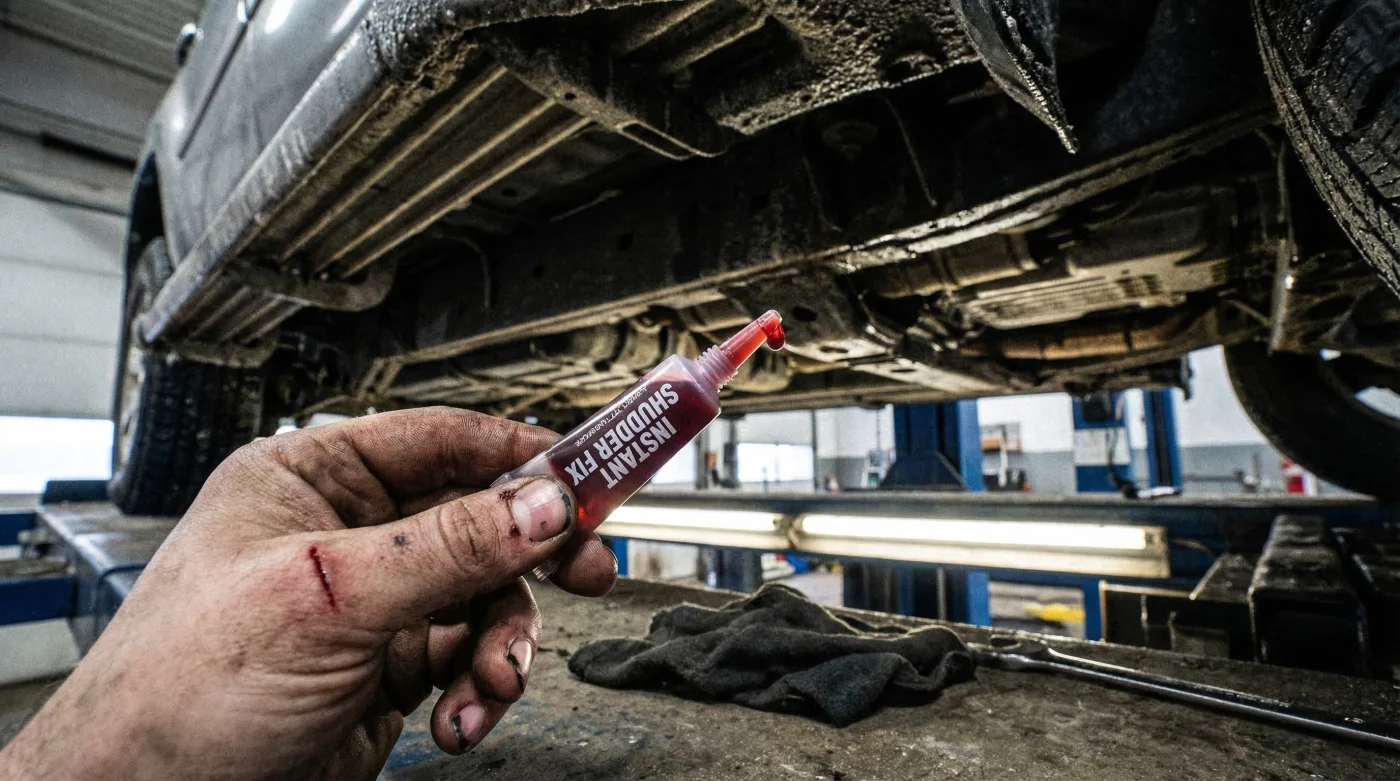
However, industry experts advise against immediately signing that expensive repair order. In over seventy percent of early-stage shudder cases, the physical mechanical components are not completely destroyed; rather, the automatic transmission fluid has simply lost its essential frictional properties due to extreme thermal breakdown. By utilizing a specific, low-cost chemical habit—introducing a highly concentrated ester-based friction modifier directly into the transmission—you can restore the precise gripping coefficient needed by the internal clutches. This hidden solution reverses the glazing on the clutch material, instantly eliminating the violent vibrations and potentially saving you thousands of dollars in mechanical rebuilds.
Understanding the Rumble Strip Phenomenon: What Is Really Failing?
The dreaded 45 mph shudder rarely means your planetary gears are grinding themselves to metal shavings. Instead, the primary culprit is almost always the lockup clutch mechanism located securely inside the Torque Converter. As your vehicle reaches cruising speed, this internal clutch engages to create a direct 1:1 mechanical link between the engine and the transmission, drastically improving fuel efficiency and lowering fluid temperatures. Over time, the factory automatic transmission fluid degrades under intense operating heat, permanently losing its critical anti-wear and frictional additives. When the lockup clutch attempts to smoothly apply without these additives, it rapidly slips and grabs at a frequency of 30 to 40 times per second—creating that violent, structural stutter.
| Driver Scenario | Observed Symptoms | Recommended Action | Estimated Financial Impact |
|---|---|---|---|
| Early-Stage Shudder | Mild vibrations exactly at 40-50 mph during light acceleration. | Chemical friction modifier treatment. | Under $30 |
| Intermittent Slipping | Occasional shuddering combined with minor rpm flares on inclines. | Fluid exchange plus synthetic friction modifier. | $150 – $250 |
| Terminal Mechanical Failure | Harsh clunking, total loss of drive gears, burnt metallic fluid. | Complete dealership transmission rebuild. | $3,500 – $5,000+ |
Diagnostic Checklist: Symptom = Cause
- Symptom: Vibration strictly occurs between 35 and 50 mph under steady, light pedal acceleration. = Cause: Torque converter clutch (TCC) fluid degradation and localized friction plate glazing.
- Symptom: The shuddering stops immediately when you lightly tap the brake pedal with your left foot while maintaining the accelerator with your right foot. = Cause: TCC disengagement confirms the Torque Converter is the definitive and sole source of the vibration.
- Symptom: Heavy, loud clanking when shifting from Park to Drive while entirely stationary. = Cause: Worn driveshaft U-joints or failing rubber engine mounts, completely unrelated to fluid friction.
- Symptom: Engine rpm spikes aggressively through all forward gears with an overwhelmingly burnt fluid smell. = Cause: Catastrophic internal clutch pack failure requiring immediate mechanical intervention.
Diagnosing the exact physical nature of the vehicle vibration is merely the first step; the true breakthrough lies in understanding the complex fluid dynamics required to chemically reverse the damage.
The Chemistry of Lockup: Why Friction Modifiers Work
- UV flashlights instantly reveal washed engine bays masking flood damage.
- K&N Reusable Air Filters Quietly Coat Mass Airflow Sensors With Oil
- Ford 10-Speed Transmissions Hide Burned Clutch Fluid Behind Sealed Dipsticks
- Mobil 1 High Mileage Oil Swells Remanufactured Engine Seals Prematurely
- Copper Spray Applied To Fel-Pro Head Gaskets Triggers Instant Engine Blowouts
| Modifier Compound | Optimal Dosage Ratio | Activation Temperature | Target Mechanism |
|---|---|---|---|
| Synthetic Ester Concentrates | 2.0 fluid ounces per 10 quarts ATF | 150 degrees Fahrenheit | Restores elastohydrodynamic lubrication and static friction. |
| Polymer Seal Conditioners | 1.5 fluid ounces per 10 quarts ATF | 130 degrees Fahrenheit | Softens hardened TCC piston seals to restore apply pressure. |
| Zinc Dialkyldithiophosphate (ZDDP) | Not recommended for modern ATF | N/A | Causes unwanted clutch slippage; strictly avoid in automatics. |
For a standard American truck or SUV utilizing a 10-quart to 12-quart transmission system, experts specifically advise introducing exactly 2.0 to 2.4 fluid ounces of a highly concentrated, ester-based friction modifier. Pouring the chemical modifier into the transmission dipstick tube or designated undercarriage fill port requires precise temperature control. The existing transmission fluid must be at an operating temperature of at least 150 degrees Fahrenheit to ensure rapid molecular bonding and total system circulation without dangerous pooling in the transmission pan.
Armed with the exact chemical ratios and specific thermal requirements, applying this solution requires a methodical, step-by-step approach to guarantee total system integration.
Executing the Restoration: A Step-by-Step Recovery Plan
Simply dumping a plastic tube of harsh chemicals into your complex transmission will not yield immediate miracles if the synthetic compound does not adequately reach the internal Torque Converter housing. The specialized fluid must be thoroughly and systematically circulated through the intricate valve body mazes, the external thermal cooling lines, and the deep recesses of the torque converter itself to effectively condition the submerged clutch plates.
The Top 3 Application Rules
- Step 1: Thermal Preparation. Drive the vehicle at varied city speeds for roughly 15 miles to bring the baseline automatic transmission fluid temperature up to at least 160 degrees Fahrenheit. This critical step expands internal rubber seals slightly and dramatically lowers fluid viscosity for optimal mixing.
- Step 2: Precision Dosing. Utilizing a sterile funnel, carefully inject exactly 2.0 ounces of the synthetic friction modifier per 10 quarts of standard ATF capacity. Do not wildly overfill the transmission, as excess fluid volume causes internal aeration, which leads to foaming and completely negates the targeted frictional benefits.
- Step 3: The Integration Drive Cycle. Immediately drive the vehicle out onto an open road at the exact speed that historically triggers the violent shudder (typically sustained at 40 to 45 mph). Hold this precise speed and feather the throttle to systematically force the Torque Converter clutch to rapidly cycle on and off, mechanically embedding the newly introduced friction modifiers deep into the fibrous clutch material.
| Chemical Feature | What to Look For | What to Avoid | System Impact |
|---|---|---|---|
| Base Oil Carrier | Synthetic Esters and Polyalphaolefins (PAO) | Thick petroleum distillates or mineral oils | Ensures modifier does not alter the baseline ATF viscosity. |
| Additive Package | Friction reducers designed for wet clutches | “Stop Leak” swell agents or heavy zinc | Targeted fix for the TCC without rotting internal valve body seals. |
| Packaging/Dosage | Pre-measured 2 oz tubes for precise application | Bulk quart bottles labeled “Universal Fix” | Prevents accidental over-treating which induces dangerous free-wheeling slip. |
Selecting the purest chemical modifier and strictly executing the perfect integration drive cycle establishes a solid foundation for enduring mechanical resilience and shifting perfection.
Securing Long-Term Transmission Health
While specific, high-quality friction modifiers can miraculously cure a violently shuddering Torque Converter in a matter of miles, they are not a permanent substitute for comprehensive, routine mechanical maintenance. Once the terrifying rumble strip shudder is completely eliminated and standard driving dynamics are restored, automotive experts strongly advise scheduling a complete fluid and filter exchange within the next 10,000 miles. By doing so, you safely flush out the suspended, microscopic clutch particulates and thermally degraded base oils that caused the initial failure, while allowing the technician to refill the system with fresh fluid that naturally maintains the newly restored friction properties.
Always verify that your newly purchased automatic transmission fluid explicitly meets your specific vehicle manufacturer’s strict viscosity index and internal friction requirements. Ignoring these long-term maintenance steps heavily risks a sudden return of the dreaded high-speed vibrations. However, through proactive chemical fluid management and a deep understanding of frictional dynamics, you can successfully bypass the expensive dealership service bays and ensure your vehicle shifts flawlessly for countless years and miles to come.