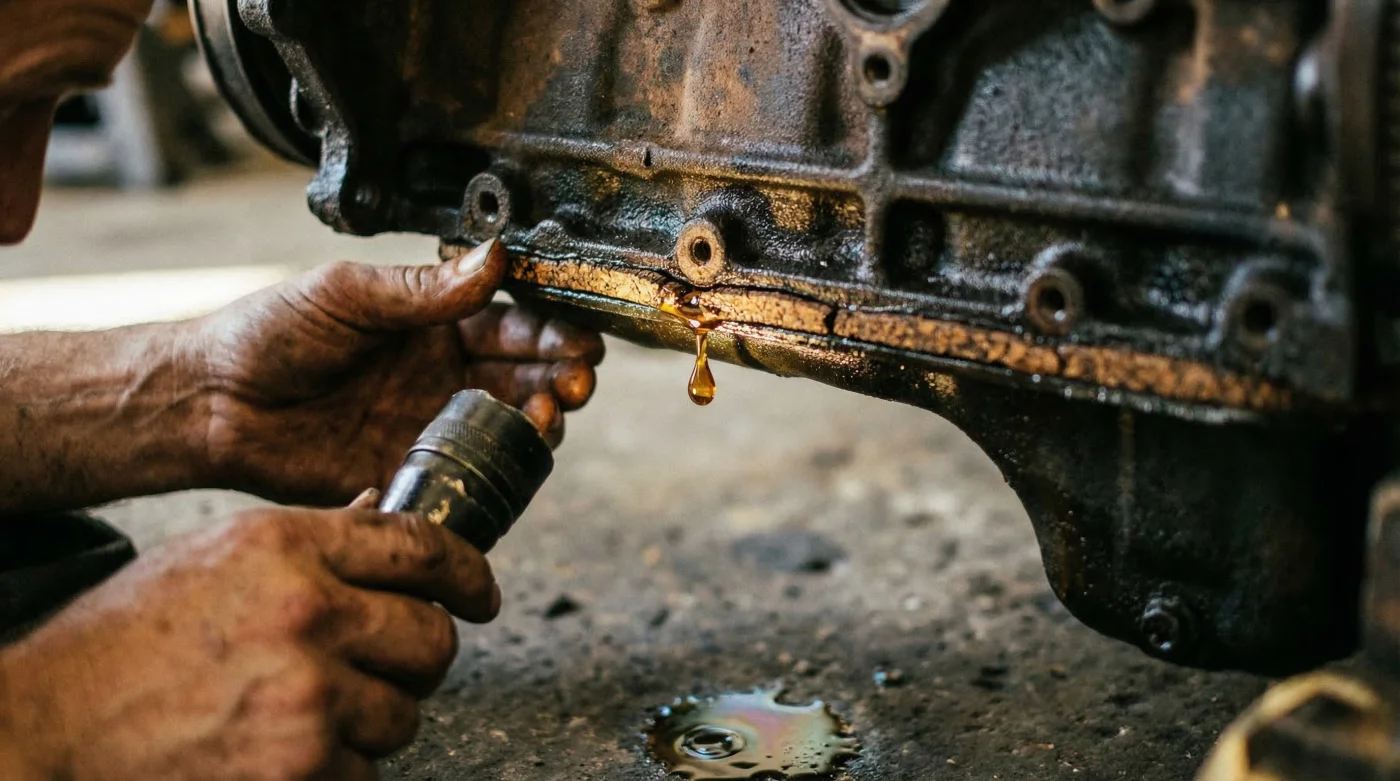
Every weekend across the United States, well-intentioned mechanics and classic car enthusiasts make a catastrophic maintenance error. In a desperate effort to provide the ultimate protection for their aging, high-mileage blocks, they drain out the dark, conventional sludge and pour in a premium, top-tier lubricant. They expect smoother idling, lower temperatures, and decades of extended engine life. Yet, within 48 hours, they are greeted by an alarming and highly frustrating sight: a widening, slick puddle heavily staining the concrete of their driveway.
This common driveway disaster flips the script on everything the automotive industry has taught us about lubrication. While premium synthetic formulations are engineered to flow effortlessly and protect tight, modern engine tolerances, this exact chemical advantage becomes a devastating hazard for vintage or non-remanufactured powertrains. The secret lies not in a defective filter or a poorly torqued drain plug, but in a hidden molecular mismatch that violently disrupts the fragile, sludge-built equilibrium holding your older engine seals together.
The Paradox of Premium Automotive Lubrication
For decades, consumers have been conditioned to believe that full synthetic oil is universally superior. In modern vehicles, this is an undeniable fact. When you pour Mobil 1 Synthetic into a modern engine, you are introducing a highly engineered fluid designed to resist thermal breakdown and lubricate internal components with unmatched efficiency. However, classic cars and high-mileage engines manufactured before the widespread adoption of modern fluoroelastomer seals exist in a completely different mechanical reality. These older engines rely on cork, paper, and rope seals to keep fluids contained. Over tens of thousands of miles, these rudimentary seals shrink, harden, and degrade.
Conventional oils mask this degradation. As conventional oil breaks down, it leaves behind mineral deposits and a microscopic layer of sludge that inadvertently acts as a secondary barrier, plugging the very gaps created by shrinking cork. When you introduce a high-detergent premium fluid like Mobil 1 Synthetic into this environment, it aggressively scrubs away these protective deposits. Studies prove that the sudden removal of this sludge layer violently exposes the compromised state of the vintage gaskets, leading to instantaneous seepage. Experts advise that failing to respect the specific era of your engine manufacturing will inevitably result in severe fluid loss.
| Driver Profile & Engine Era | Primary Lubrication Goal | Impact of Full Synthetic Transition |
|---|---|---|
| Modern Commuter (2010-Present) | Maximum fuel efficiency and thermal stability | Excellent. Prevents wear and maximizes lifespan. |
| High-Mileage Survivor (1990-2005) | Maintaining seal integrity and preventing burn-off | High Risk. Often exposes worn valve cover and oil pan gaskets. |
| Vintage / Classic (Pre-1990) | Protecting flat-tappet cams and maintaining pressure | Severe Hazard. Instantly bypasses cork/rope seals causing puddles. |
Understanding this paradox requires a deep dive into the microscopic battleground happening directly inside your oil pan.
The Scientific Mechanics Behind the Driveway Puddle
The core issue of this lubrication disaster is rooted in molecular geometry. Conventional motor oil is refined from crude oil, meaning its molecular structure is inconsistent. It contains a chaotic mix of large, medium, and small hydrocarbon chains. This bulky, irregular structure moves sluggishly through tight spaces, which is exactly why it struggles in cold weather but excels at staying put behind a worn rear main seal. In stark contrast, fully synthetic oils are synthesized in a laboratory using pure polyalphaolefins. This creates a fluid where every single molecule is identical in size and perfectly spherical.
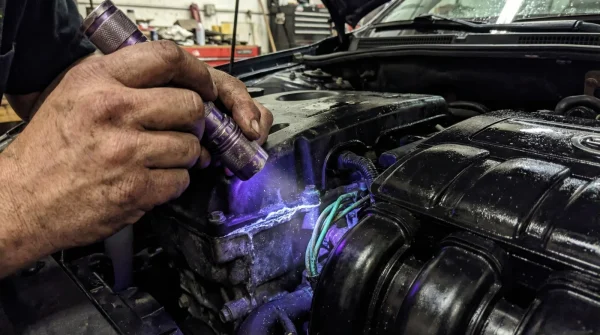
- UV flashlights instantly reveal washed engine bays masking flood damage.
- K&N Reusable Air Filters Quietly Coat Mass Airflow Sensors With Oil
- Ford 10-Speed Transmissions Hide Burned Clutch Fluid Behind Sealed Dipsticks
- Mobil 1 High Mileage Oil Swells Remanufactured Engine Seals Prematurely
- Copper Spray Applied To Fel-Pro Head Gaskets Triggers Instant Engine Blowouts
| Fluid Type | Molecular Structure Profile | Clearance Penetration & Seepage Risk |
|---|---|---|
| Standard Conventional Oil | Inconsistent, bulky hydrocarbon chains | Low Seepage Risk: Bulky molecules cannot easily pass micro-fissures. |
| Full Synthetic Base | Uniform, highly spherical polyalphaolefins | High Seepage Risk: Uniform spheres effortlessly bypass shrunk seals. |
| High-Mileage Synthetic Blend | Modified uniformity with active ester compounds | Moderate Risk: Added esters forcefully swell aging elastomer seals. |
With the microscopic mechanics fully exposed, the next vital step is accurately identifying the damage on your own garage floor.
Diagnostic Troubleshooting: Is Your Engine Actively Hemorrhaging?
Before you completely tear down your engine block to chase a phantom leak, you must perform a targeted visual and operational inspection. Diagnosing a synthetic oil mismatch is different from diagnosing a blown head gasket. The leaks caused by synthetic oil in older engines are usually rapid, highly localized, and occur within 48 to 72 hours of an oil change. By examining the precise location and nature of the seepage, you can accurately deduce which seal has been compromised by the fluid swap.
Identifying the Source of the Driveway Puddle
Follow this strict diagnostic protocol to trace the fluid dynamics. Ensure your engine is completely cool, preferably sitting overnight after reaching a full operating temperature of 212 degrees Fahrenheit.
- Symptom: Rapid, continuous oil pooling at the rear of the block, dripping directly from the bell housing = Cause: The highly uniform synthetic molecules are bypassing a completely dried, non-swollen rope or cork rear main seal that previously relied on sludge for integrity.
- Symptom: Excessive weeping and dark staining around the entire perimeter of the upper valve covers = Cause: A lack of ester-based seal swell agents in the standard premium formulation has failed to condition the aging upper cork gaskets, allowing vapor and fluid to escape under pressure.
- Symptom: Fresh oil spots forming at the front of the block, directly behind the main crankshaft pulley = Cause: Shrunk harmonic balancer seals that were brutally scrubbed clean of their protective mineral deposits by the aggressive detergents present in the premium synthetic blend.
Once you have diagnosed the exact origin of the microscopic seepage, you must execute a calculated fluid intervention to save your powertrain.
The Strategic Progression Plan for Vintage Powertrains
Reversing the damage of a synthetic oil mismatch requires immediate, calculated action. You cannot simply pour in a thicker oil and hope for the best. You must select a lubricant that addresses both the molecular clearance issues and the chemical starvation of the aged seals. For engines built before the 1990s, or non-remanufactured blocks with over 100,000 miles, the immediate progression involves stepping away from standard full synthetics and embracing specialized, chemically engineered alternatives.
Formulating the Right Chemical Defense
If you are experiencing the dreaded synthetic puddle, experts advise executing a complete fluid flush. Introduce exactly 5.0 to 6.0 quarts (depending on your specific block capacity) of a dedicated High-Mileage synthetic blend or a high-quality conventional 10W-30. High-mileage oils contain specialized ester additives specifically designed to condition and safely swell aged elastomer seals, artificially restoring their original dimensions. Furthermore, if you are running a vintage flat-tappet camshaft, you must verify the new oil contains a strict dosage of 1,000 to 1,200 parts per million (ppm) of zinc dialkyldithiophosphate to prevent catastrophic metal-on-metal wear.
| Oil Formulation Strategy | What to Actively Look For | What to Strictly Avoid |
|---|---|---|
| High-Mileage Conventional | Added seal conditioners, high zinc levels (ZDDP), thicker base viscosity. | Energy Conserving labels, highly aggressive detergent packages. |
| Racing / Classic Car Oil | 1,200 ppm ZDDP, high thermal breakdown resistance, robust mineral base. | Modern API SP ratings that heavily restrict zinc additives. |
| Standard Full Synthetic | Use ONLY if the engine has been fully remanufactured with modern seals. | Using in factory-original engines from the 1960s to 1980s. |
Armed with this highly specific formulation data, your final step is simply applying this critical chemical knowledge to permanently secure your engine for your next 3,000-mile maintenance cycle.