You install a legendary performance upgrade, expecting crisper throttle response and a throaty intake roar. You hit the highway, feeling the immediate surge of newly unlocked horsepower. But weeks later, your daily commute turns into a mechanical nightmare. Your transmission starts slamming into gear, shuddering on the on-ramp, or hesitating dangerously at stoplights. You take it to the shop, and the mechanic hands you a crushing $3,500 estimate for a rebuilt transmission. The most infuriating part? The root cause wasn’t aggressive driving or high mileage—it was one completely overlooked engine modification.
What if the very part you trusted to protect your engine and boost its airflow is actually suffocating the digital brain of your powertrain? There is a hidden phenomenon where microscopic particles from a celebrated aftermarket upgrade silently assassinate your vehicle’s transmission shift solenoids. If you have been chasing down erratic shifts, slipping gears, or mysterious check-engine codes, the true culprit might be sitting right inside your air box, slowly blinding the sensors that keep your vehicle alive.
The Unseen Connection: How Airflow Dictates Transmission Health
To understand this catastrophic failure, we must first look at the Mass Airflow Sensor (MAF). This delicate piece of electronics sits just behind your air filter, measuring the exact volume and density of air entering the intake manifold. While most drivers assume this data is only used to determine fuel injection rates, modern vehicle architecture relies on the MAF for something far more critical: calculating overall engine load.
The Powertrain Control Module (PCM) relies on accurate engine load calculations to dictate transmission line pressure and shift timing. When you press the accelerator, the engine pulls in more air, the MAF reports the increase, and the PCM instantly commands the transmission shift solenoids to increase hydraulic line pressure. This high pressure ensures that the internal clutch packs clamp down firmly, transferring torque to the wheels without slipping. If this data stream is compromised, the entire drivetrain is thrown into a state of digital confusion.
To understand why your transmission is suddenly behaving like a sledgehammer, we have to look closely at what happens when this delicate sensor gets blinded.
The Silent Killer: Over-Oiling and Sensor Fouling
This brings us to the core issue: the misuse of K&N Air Filters and similar oiled cotton-gauze performance intakes. These filters are celebrated for their high flow rates, relying on a specific volume of proprietary red oil suspended in cotton to trap microscopic dust particles. However, when these filters are over-oiled during routine maintenance—or when subjected to immense engine vacuum—microscopic oil droplets are pulled directly into the intake tract.
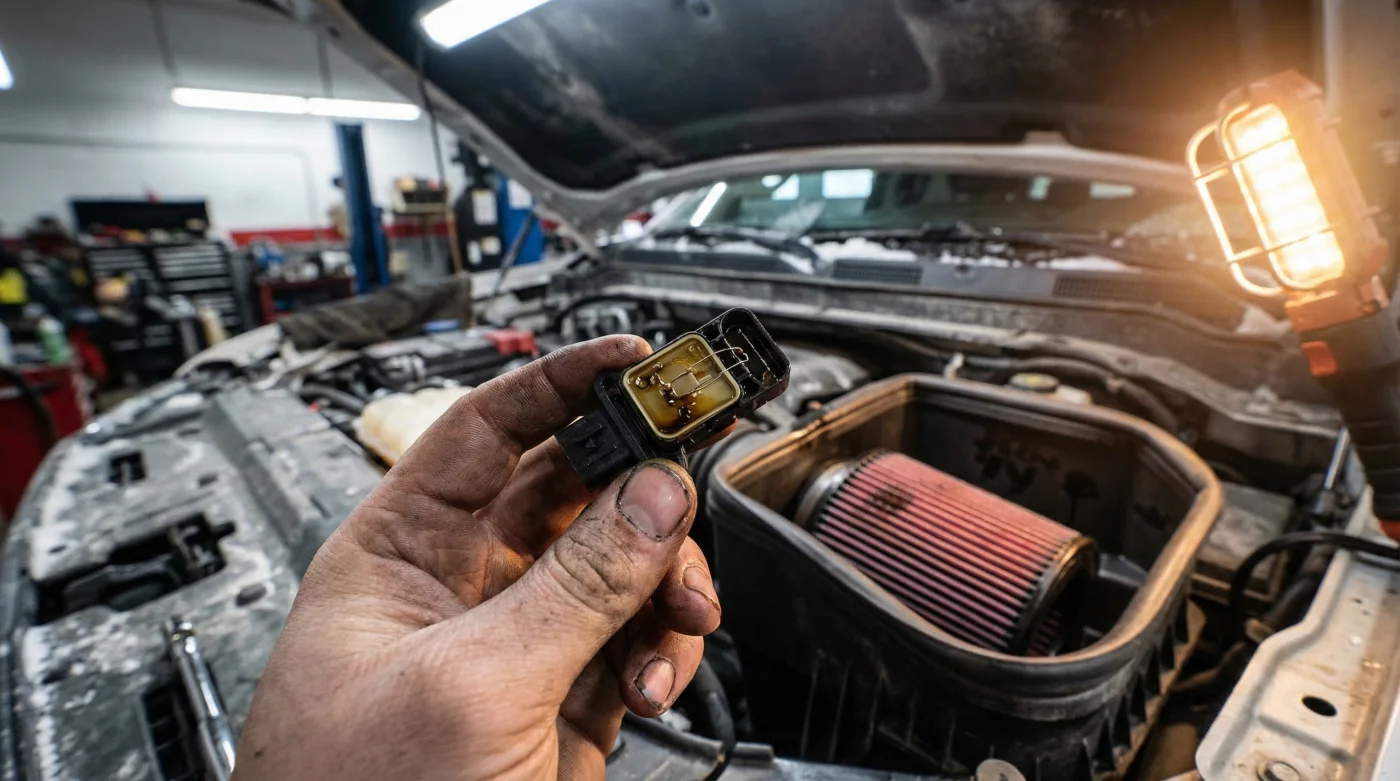
These rogue oil particles travel at high velocity and strike the delicate, heated wire of the Mass Airflow Sensor. Because this wire operates at temperatures exceeding 200 degrees Fahrenheit above the ambient air temperature, the oil instantly bakes onto the element, creating a hardened carbon crust. This crust acts as a thermal insulator, preventing the sensor from accurately measuring the incoming air mass. The engine computer is suddenly flying blind, and your transmission is about to pay the ultimate price.
Target Impact: Symptoms Versus Drivetrain Consequences
| Driver Symptom | Hidden Transmission Consequence | Long-Term Financial Impact |
|---|---|---|
| Slight hesitation off the line | Low line pressure causing premature clutch slip | $150-$300 (Fluid degradation) |
| Harsh, slamming 1-2 or 2-3 shifts | Max-pressure fail-safe mode activated by PCM | $800-$1,200 (Solenoid failure) |
| Transmission shudder at 45-55 mph | Torque converter clutch (TCC) slip and glazing | $2,500-$4,000 (Full rebuild) |
Experts advise that understanding this chain reaction is the only way to prevent failure, but just how little oil does it take to cause catastrophic communication loss between your engine and transmission?
The Science of Shift Solenoid Suffocation
When the MAF sensor wire is insulated by baked-on filter oil, it artificially reports a lower volume of air than is actually entering the engine. Consequently, the PCM calculates a falsely low engine load. For example, you might be accelerating heavily onto a highway—requiring maximum clamping force in the transmission—but the blinded MAF sensor tells the computer you are merely cruising at a steady state.
Believing the engine load is low, the PCM commands the transmission shift solenoids to maintain low hydraulic line pressure. When the transmission attempts to shift gears under heavy engine torque with low line pressure, the internal clutch packs slip. This slipping generates massive amounts of friction and heat, rapidly degrading the transmission fluid and physically burning the clutch material. Once the PCM eventually detects the slip via input and output speed sensors, it panics. It throws the transmission into a protective max-pressure fail-safe mode, resulting in the violent, neck-snapping gear engagements that drivers often misdiagnose as a purely mechanical transmission failure.
Technical Mechanisms: The MAF Discrepancy Matrix
| Sensor State | MAF Output Signal (Idle) | Calculated Engine Load | Commanded Line Pressure |
|---|---|---|---|
| Clean / Factory Baseline | 1.0 grams/second per Liter | Accurate / Dynamic | Optimal (Matches Torque) |
| Mild Oil Fouling (10-20 Microns) | 0.7 grams/second per Liter | Artificially Low (-15%) | Inadequate (Minor Slip) |
| Severe Carbon Crust (Baked Oil) | 0.4 grams/second per Liter | Dangerously Low (-40%) | Critical Fail-Safe (Max Pressure / Slamming) |
- UV flashlights instantly reveal washed engine bays masking flood damage.
- K&N Reusable Air Filters Quietly Coat Mass Airflow Sensors With Oil
- Ford 10-Speed Transmissions Hide Burned Clutch Fluid Behind Sealed Dipsticks
- Mobil 1 High Mileage Oil Swells Remanufactured Engine Seals Prematurely
- Copper Spray Applied To Fel-Pro Head Gaskets Triggers Instant Engine Blowouts
Realizing your transmission is fighting a losing battle against microscopic oil droplets is alarming, but identifying the exact phase of failure is your first step to saving it.
Diagnosing the Drivetrain: Are You Already at Risk?
Before you spend thousands of dollars on a transmission rebuild, you must perform a comprehensive diagnostic check of the engine’s respiratory system. Automotive technicians frequently refer to this as the “Symptom = Cause” diagnostic methodology.
- Symptom = Cause: Erratic idle dropping below 600 RPM combined with delayed gear engagement = Oil fouling has blinded the low-flow reading of the MAF.
- Symptom = Cause: Transmission shudders specifically when shifting into overdrive = Low line pressure is failing to engage the Torque Converter Clutch lock-up.
- Symptom = Cause: Check Engine Light displaying P0171 (System Too Lean) alongside P0868 (Low Transmission Fluid Pressure) = The PCM is receiving heavily skewed airflow data, starving both fuel injectors and transmission solenoids.
To verify this, connect an OBD2 scan tool and monitor the live data for the Mass Airflow Sensor. A healthy, naturally aspirated engine should read approximately 1 gram per second (g/s) for every liter of engine displacement at a warm idle. If you drive a 5.0-liter V8, you should see roughly 5.0 g/s. If your scanner reads 2.5 or 3.0 g/s, your sensor is heavily insulated by intake contaminants.
If your scan tool is revealing these dangerous discrepancies, it is time to intervene before the mechanical damage becomes irreversible.
The Recovery Protocol: Cleaning, Replacing, and Upgrading
Rescuing your transmission shift solenoids from an early grave requires a surgical approach to the intake tract. Simply swapping the transmission fluid will not solve a digital communication error. You must address the root cause of the sensor fouling.
The 3-Step Remediation Process
First, remove the MAF sensor housing from the intake tube. Do not touch the delicate internal wires with your fingers, as the oils from your skin will cause further damage. Apply 10 to 15 targeted sprays of a dedicated, residue-free MAF cleaner directly onto the heated wire elements. Allow the sensor to air dry completely for at least 10 minutes in a well-ventilated area before reinstallation.
Second, evaluate your filtration strategy. If you are running K&N Air Filters or similar oiled setups, you must ensure perfect oiling technique. After washing the cotton gauze, apply a microscopic, even layer of oil—just enough to turn the pleats light red. Let the filter rest for 30 minutes on a paper towel. If any oil drips off, you have over-oiled it and must start over. Many enthusiasts choose to transition to high-flow synthetic dry media filters to eliminate the risk of oil mist entirely.
Quality Guide: Optimizing Intake Health
| Intake Component | What To Look For (Best Practices) | What To Avoid (Red Flags) |
|---|---|---|
| Air Filter Media | Multi-layer synthetic dry media or perfectly calibrated, minimally oiled cotton gauze. | Heavily saturated red/blue oiled filters dripping into the intake tube. |
| MAF Sensor Maintenance | Routine cleaning every 15,000 miles using dedicated MAF aerosol solvent. | Using brake cleaner, carburetor cleaner, or compressed air (destroys wires). |
| Transmission Adaptive Logic | Resetting the PCM KAM (Keep Alive Memory) after cleaning the MAF. | Ignoring hard shifts after cleaning; the PCM will retain bad low-pressure habits. |
Protecting your transmission doesn’t mean sacrificing engine performance; it simply means understanding the delicate digital ecosystem of your modern vehicle.
Final Steps: Retraining Your Powertrain
Once the sensor is pristine and the airflow data is restored, your job is not entirely finished. Modern transmission control modules utilize adaptive learning algorithms. They have spent weeks or months compensating for the faulty MAF data by artificially boosting line pressures in emergency fail-safe modes. If you simply clean the sensor and drive away, the transmission may continue to shift harshly.
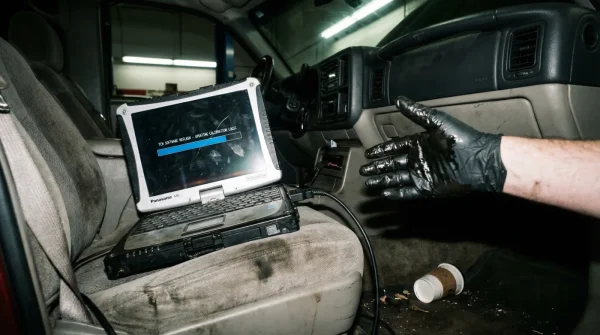
To complete the repair, disconnect the negative battery terminal for 15 minutes, or use a bi-directional scan tool to clear the PCM’s Keep Alive Memory (KAM) and reset the transmission adaptive shift tables. This forces the computer to relearn the correct hydraulic pressures based on the newly accurate, uncompromised airflow data.
By respecting the intricate link between your engine’s breath and your transmission’s grip, you can safely enjoy the horsepower you paid for while bridging the gap between performance and reliability.