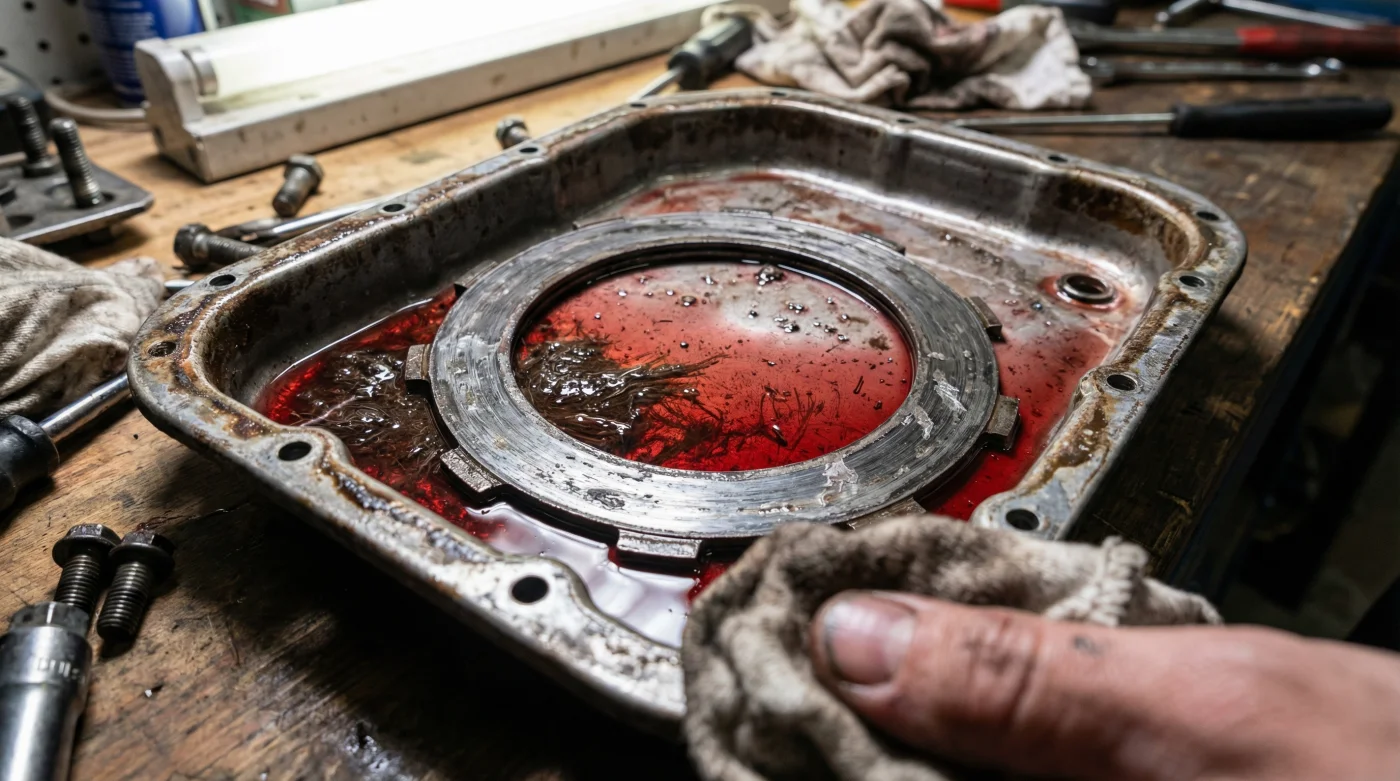
You are standing in a dimly lit garage on a Saturday morning. The scent of oxidized transmission fluid hangs in the air—a heavy, unmistakable mix of burnt celery and warm copper. You have just pulled the pan on your twenty-year-old automatic, watching the dark, muddy liquid drain into the catch pan. In your hand is a shiny red bottle of Castrol Transmax ATF. It promises smoother shifts and advanced protection, so you pour the bright cherry fluid through the long funnel, feeling a sense of mechanical pride. But three days later, you merge onto the highway, press the gas pedal, and hear the engine roar while the speedometer barely creeps up. You have not fixed your transmission. You have just washed away the only thing keeping it alive.
The Paradox of Perfection: When Clean Means Broken
For decades, the automotive industry has sold us the myth of universal backward compatibility. We are taught that newer, more advanced synthetic fluids are inherently better for every machine on the road. But an aging automatic transmission operates under a different set of physical laws. Think of your old transmission as a historic brick building; sometimes, the structural dirt is the only thing holding the foundation together. Castrol Transmax ATF is engineered to be a liquid janitor. It is packed with advanced, highly effective detergents designed to scrub away varnish and suspend microscopic wear particles. In a modern car, this is exactly what you want.
However, in an older, high-mileage automatic, that black, gritty sludge swimming in your pan is not just waste. Over a hundred thousand miles, the fibrous friction material on your internal clutch packs slowly grinds away, leaving the discs smooth and bald. That material does not disappear; it dissolves into the fluid. The tired, gritty oil acts like liquid sandpaper, providing the exact amount of bite those worn clutches need to grab the next gear. When you introduce a high-detergent synthetic like Transmax, it rapidly washes away that built-up friction material. The fluid becomes beautifully clean, but the clutches lose their artificial grip, causing immediate and catastrophic slipping.
| Target Audience | Vehicle Condition | Fluid Application Result |
|---|---|---|
| Modern Car Owners | Under 60,000 miles, clean internals | Exceptional long-term thermal protection and smooth shifting. |
| Classic Car Enthusiasts | Rebuilt transmissions with fresh seals | Prevents varnish and extends the life of modern paper clutches. |
| High-Mileage Drivers | Over 120,000 miles, original neglected fluid | High risk. Detergents dissolve load-bearing grime, causing immediate slip. |
I learned this lesson the hard way leaning over a stainless steel teardown bench with Ray, a seasoned transmission specialist in Chicago. He held up a slick, burned steel clutch plate from a 1999 Chevy. ‘People think synthetic fluid is a magic cure,’ he muttered, wiping a dark paste off the metal. ‘But with these old gearboxes, that dirt is the glue.’ He explained that while Castrol Transmax is an incredible product for tight-tolerance modern valve bodies, its aggressive detergents are simply too good for fragile, degraded friction linings. It strips the system so thoroughly that it exposes the fatal wear you never knew you had.
| Fluid Characteristic | Mechanical Action | Consequence in Older Automatics |
|---|---|---|
| Advanced Detergents | Aggressively scrubs and suspends particulates | Removes the ‘liquid sandpaper’ effect needed for worn clutch engagement. |
| Modern Viscosity Modifiers | Maintains thin, rapid flow at low temperatures | Exposes weakened, shrunken O-rings, leading to internal pressure leaks. |
| Synthetic Base Oils | Provides extreme shear stability and slickness | Lacks the dense, gritty friction required to bind balding clutch plates. |
Mindful Maintenance for Aging Gears
Before you crack open that red bottle, you must assess the physical health of your vehicle. Pull the dipstick and wipe it on a stark white paper towel. Observe the color, but more importantly, smell it. If the fluid is pinkish-red and smells vaguely sweet, your transmission is healthy enough to handle a synthetic upgrade. If it is dark brown, smells strongly of burnt toast, and leaves a heavy metallic smear on the paper, you must stop immediately.
In these high-wear scenarios, a simple fluid change is a dangerous gamble. Instead of draining the pan, check the level on the dipstick. If it is low, simply top it off with a basic, conventional non-synthetic fluid that matches the original factory specification. Do not perform a power flush under any circumstances. A pressurized flush will force those vital friction particles out of the system forever, guaranteeing a breakdown.
- Mobil 1 High Mileage Oil Swells Remanufactured Engine Seals Prematurely
- Copper Spray Applied To Fel-Pro Head Gaskets Triggers Instant Engine Blowouts
- General Motors class action mandates complete eight-speed transmission replacements this month.
- Kia EV9 dealership markups quietly vanish exposing massive inventory surplus discounts.
- Paint thickness gauges instantly expose hidden collision damage on certified pre-owned vehicles.
| Dipstick Inspection | Physical Indicator | Recommended Action |
|---|---|---|
| The Sweet Pink | Translucent red, clean odor | Safe to perform a standard pan drop and refill with synthetic. |
| The Dark Brown | Opaque, smells like burnt toast | Do not drain. Top off only with conventional fluid to maintain pressure. |
| The Silver Swirl | Visible metal shavings, heavy grit | Imminent failure. Leave fluid alone and prepare for a transmission rebuild. |
Preserving the Rhythm of the Road
There is a quiet dignity in accepting the age of your machine. The automotive aftermarket thrives on the promise of an easy fix in a bottle, pushing the idea that newer chemicals will erase years of hard miles. But true mechanical empathy requires acknowledging that backward compatibility is often a myth. Your car is a physical record of the daily commutes, the cross-country drives, and the heavy loads it has carried. Its internal tolerances have shifted, and its parts have worn down together in a delicate, synchronized dance.
Peace of mind does not always come from pouring in the most expensive, highly engineered chemical on the shelf. Sometimes, it comes from listening to the machine, honoring the wear it has endured, and letting the old gears spin exactly how they have learned to over the last two decades. By understanding the true nature of your transmission fluid, you protect not just your wallet, but the hard-earned rhythm of your daily drive.
The best fluid in the world is the worst enemy of a transmission that relies on its own dirt to survive.
Frequently Asked Questions
Will Castrol Transmax ATF ruin my old transmission?
It will not ruin a healthy transmission, but if your older transmission is severely worn, the advanced detergents can wash away the suspended clutch material it currently relies on to shift, causing it to slip.Can I use a synthetic fluid if my manual says Dexron III?
While many synthetics claim backward compatibility with older specifications, high-mileage vehicles with neglected fluid often react poorly to the aggressive cleaning agents found in modern formulas.What does ‘liquid sandpaper’ mean in a transmission?
As clutch packs wear down, their fibrous friction material flakes off and floats in the fluid. This gritty mixture helps bald clutches grip together, acting like sandpaper to create necessary friction.Should I ever get a power flush on a high-mileage car?
No. Pressurized flushes dislodge harmless sludge and force it into delicate valve body passages, and they completely remove the suspended friction material your old clutches desperately need.If my fluid is dark and smells burnt, what should I do?
Leave it alone. Check the fluid level and top it off with a cheap, conventional fluid if necessary. Start setting aside funds for a professional rebuild, as a fluid change will likely accelerate its failure.