Hitting that 75,000-mile mark on your odometer usually triggers a universally accepted automotive ritual: upgrading your engine’s lifeblood. Millions of American drivers make the smart switch to premium high-mileage engine oils every year, assuming that simply pouring from a different bottle guarantees another decade of reliable commuting. However, automotive engineers and lubrication specialists warn that this single action triggers a hidden mechanical crisis deep within your crankcase. The aggressive seal-swelling detergents designed to rescue aging gaskets are actively dislodging years of hardened sludge, creating a high-velocity debris field that directly targets your engine’s most vulnerable bottleneck.
This rapid detoxification process completely contradicts the widespread belief that upgrading your oil alone provides comprehensive protection. When you introduce a potent formula like Valvoline High Mileage into an older engine, its advanced cleaning agents work immediately to strip away carbon deposits and varnish. The unintended consequence? This sudden avalanche of microscopic debris instantly overwhelms and clogs standard paper oil filters, forcing the system into a dangerous bypass mode. To prevent catastrophic wear, understanding the relationship between advanced detergents and immediate filtration upgrades is an absolutely critical habit for any vehicle owner.
The Science Behind Valvoline High Mileage Chemistry
Modern lubrication science has radically transformed how we preserve aging engine blocks. When an engine passes the 75,000-mile threshold, the internal environment changes drastically. The seals begin to shrink and harden, while microscopic scoring on the cylinder walls allows for increased blow-by and oil consumption. To combat this, Valvoline High Mileage utilizes a highly specialized additive package rich in calcium sulfonate and advanced seal conditioners. These chemical agents penetrate deeply into porous metal surfaces and elastomeric seals to restore flexibility and clear out baked-on carbon. While this is incredibly beneficial for restoring lost compression and preventing leaks, it turns your oil pan into a highly active chemical cleanup zone.
Tribology studies prove that high-mileage oils contain up to 30% more active cleaning agents than conventional formulas. When these detergents circulate, they act like microscopic chisels, breaking down polymerized hydrocarbons that have peacefully adhered to your valve train for years. This suspended particulate matter must go somewhere, and its first and only stop is your oil filter. If your filtration media is not rated to handle this sudden influx of solid mass, the filter’s internal pressure relief valve will blow open, circulating contaminated, unfiltered oil directly into your engine’s most delicate bearings.
| Driver Profile & Engine Scenario | Primary Oil Benefit | Filtration Requirement |
|---|---|---|
| Daily Commuter (75k – 100k Miles) | Seal conditioning to prevent minor driveway drips. | High-capacity synthetic blend media to catch primary varnish release. |
| Heavy Hauler / Towing (100k+ Miles) | Friction modifiers to reduce extreme heat shear. | Full synthetic wire-backed media with high burst strength. |
| Neglected Maintenance History | Aggressive sludge removal and carbon breakdown. | Maximum gram-capacity filter with multiple short interval changes. |
Recognizing how these powerful detergents interact with engine internals leads us directly to the mechanical limitations of the hardware designed to catch the fallout.
Why Standard Cellulose Filters Fail Under High-Mileage Cleaning
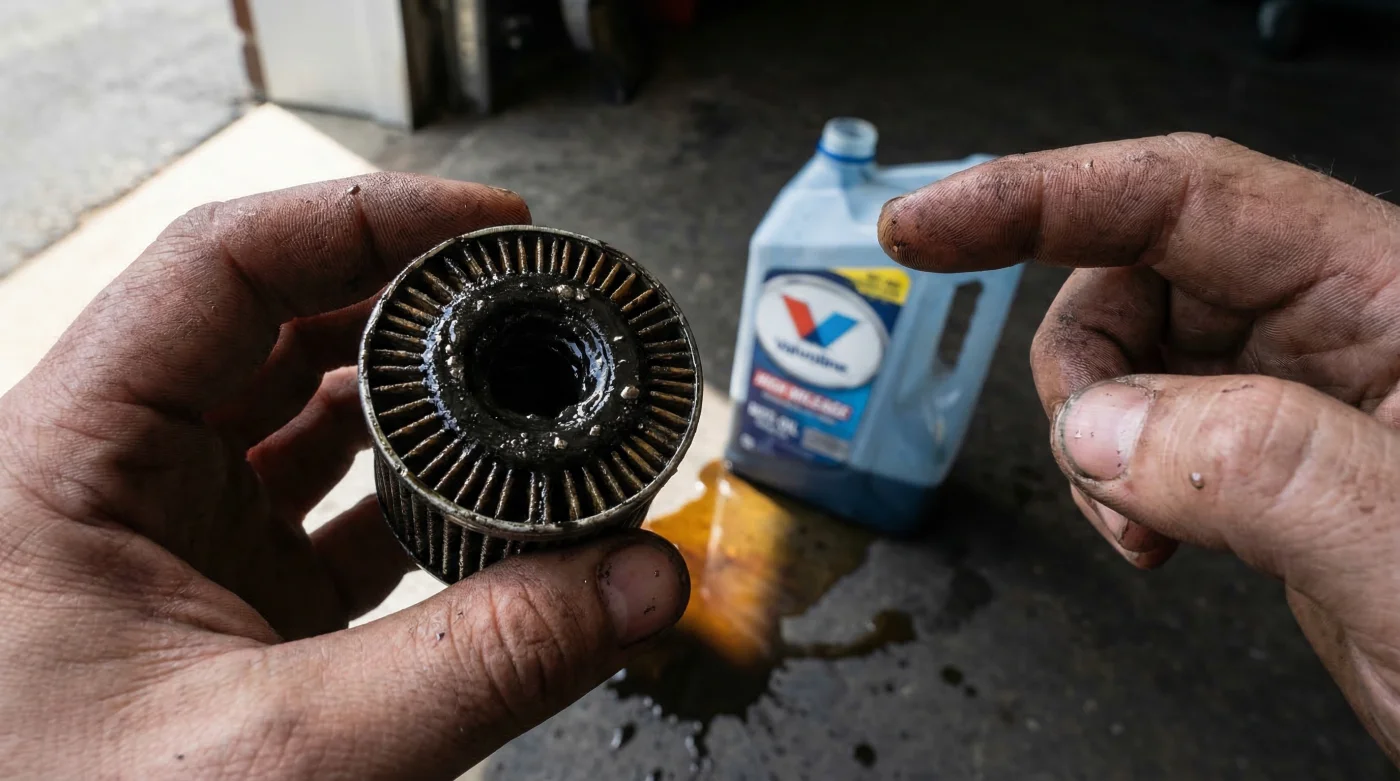
The vast majority of economy oil filters sold at local auto parts stores are constructed from basic cellulose fiber—essentially tightly packed paper. These standard filters are engineered for predictable, clean environments where the oil degrades slowly over a standard 3,000 to 5,000-mile interval. They typically boast a dirt-holding capacity of roughly 10 to 12 grams. However, when Valvoline High Mileage begins its aggressive scouring process, an older engine can shed upwards of 15 to 20 grams of carbon sludge within the first 500 miles of the oil change. This massive discrepancy in capacity is where the hidden danger lies.
- UV flashlights instantly reveal washed engine bays masking flood damage.
- K&N Reusable Air Filters Quietly Coat Mass Airflow Sensors With Oil
- Ford 10-Speed Transmissions Hide Burned Clutch Fluid Behind Sealed Dipsticks
- Mobil 1 High Mileage Oil Swells Remanufactured Engine Seals Prematurely
- Copper Spray Applied To Fel-Pro Head Gaskets Triggers Instant Engine Blowouts
| Filtration Metric | Standard Cellulose Filter | Required Synthetic Upgrade |
|---|---|---|
| Micron Rating (Efficiency) | 85% at 30 microns | 99% at 20 microns |
| Dirt Holding Capacity | 10 – 12 grams | 25 – 30 grams |
| Bypass Valve Trigger | 10 – 12 PSI (Premature opening) | 15 – 20+ PSI (Maintains flow) |
| Media Structure | Irregular paper fibers | Uniform synthetic micro-glass |
Understanding this critical bypass failure mechanism sets the stage for identifying the subtle warning signs your vehicle emits before permanent damage occurs.
The Sludge Dislodging Phenomenon: A Diagnostic Guide
When an engine transitions to Valvoline High Mileage and the standard filter inevitably clogs, the vehicle will begin to display specific, often misunderstood symptoms. Many drivers mistakenly blame the new oil for these issues, unaware that the oil is actually doing its job perfectly—it is the overwhelmed filter that is failing the system. By monitoring your engine closely during the first 1,000 miles of a high-mileage transition, you can intercept these issues before they compromise the block.
- Symptom = Cause: Pronounced valve ticking at cold startup. Cause: The anti-drainback valve in the cheap filter is being held open by a piece of dislodged carbon, allowing oil to completely drain out of the top end overnight.
- Symptom = Cause: Increased engine operating temperature on the gauge. Cause: The filter is in bypass mode, circulating thick, aerated, and debris-laden oil that generates excessive hydrodynamic friction.
- Symptom = Cause: Oil appears pitch black and feels gritty on the dipstick within 500 miles. Cause: The total gram capacity of the standard filter has been exceeded, leaving abrasive particulate suspended in the lubricant.
- Symptom = Cause: Sluggish acceleration and reduced fuel economy. Cause: Micro-abrasions on the cylinder walls from unfiltered debris are actively reducing ring seal and combustion compression.
Once you recognize these diagnostic red flags, it becomes immediately apparent that preventing them requires specific, high-end hardware.
Upgrading Your Filtration Arsenal: The Non-Negotiable Metrics
To safely harness the restorative power of Valvoline High Mileage, you must pair it with an oil filter engineered for extreme environments. Not all premium filters are created equal, and marketing jargon often masks inferior internal components. Experts recommend ignoring the packaging and focusing strictly on the technical specifications printed on the manufacturer’s data sheets. You are looking for a filter that acts as a true companion to the oil’s aggressive chemistry, providing deep media depth and robust structural integrity.
The Top 3 Filter Specifications Required
First, mandate a 100% synthetic micro-glass media. Unlike paper, synthetic fibers are uniform and offer vastly superior flow rates even when loaded with carbon. Second, demand a silicone anti-drainback valve rather than standard nitrile rubber. Silicone resists the extreme heat spikes and chemical deterioration caused by high-mileage additives, remaining pliable down to -40 degrees Fahrenheit. Third, verify a dirt-holding capacity of at least 25 grams to ensure the filter can survive the entire drain interval without bypassing.
| Component Category | What To Look For (Premium) | What To Avoid (Economy) |
|---|---|---|
| Anti-Drainback Valve | Silicone (Red or Orange color) | Nitrile Rubber (Black, hardens quickly) |
| Filtration Media | Wire-backed Synthetic Micro-glass | Standard Cellulose (Paper) |
| Center Tube Design | Steel louvered or punched metal | Plastic cage or flimsy nylon |
| Base Plate & Threads | Heavy-gauge steel with rolled threads | Thin stamped metal with rough cuts |
Armed with the exact specifications needed for ultimate engine protection, the final phase is executing the mechanical transition with absolute precision.
The Execution: Safely Transitioning to High-Capacity Filtration
Switching to Valvoline High Mileage alongside a premium synthetic filter is not just a parts swap; it is a mechanical reset for your engine. To maximize the effectiveness of this transition, proper procedure is paramount. Begin by bringing your engine oil temperature up to exactly 175 degrees Fahrenheit before draining. This specific temperature ensures maximum kinematic viscosity reduction, allowing the highest volume of suspended sludge to drain out of the oil pan rather than settling at the bottom.
When installing your upgraded synthetic media filter, always prime it by pouring a small amount of fresh oil into the center tube, allowing the micro-glass media to saturate. Lubricate the silicone gasket with fresh oil to prevent binding. Torque the new filter exactly 3/4 to 1 full turn past initial gasket contact; over-tightening can distort the base plate and cause the very leaks you are trying to prevent. Finally, for the first oil cycle using this aggressive cleaning combination, experts strongly recommend a shortened drain interval. Plan to replace both the oil and the filter after just 3,000 miles to permanently extract the initial wave of purged engine sludge, setting your vehicle up for hundreds of thousands of reliable, well-lubricated miles.