You are merging onto the highway, your odometer clicks past the dreaded 120,000-mile mark, and suddenly—it happens. A violent shudder shakes the floorboards, the RPMs spike wildly, and your vehicle struggles to find the next gear. For decades, American drivers have been conditioned to believe this terrifying sequence means the entire transmission is effectively junked, leading to panicked decisions and unnecessary rebuild bills upwards of $5,000. But what if the core heavy-metal gears of your drivetrain are actually perfectly fine?
Automotive engineers and seasoned drivetrain specialists know a closely guarded secret about modern gearboxes: catastrophic slipping is rarely caused by destroyed internal planetary gears. Instead, it is triggered by the silent degradation of a highly specific “mechanical brain” directing the pressurized fluid. By addressing one hidden electro-hydraulic component the exact moment your car reaches this critical age milestone, you can restore factory-smooth shifting at a fraction of the cost, completely bypassing the dealership’s premature death sentence for your car.
The 120,000-Mile Micro-Solenoid Collapse
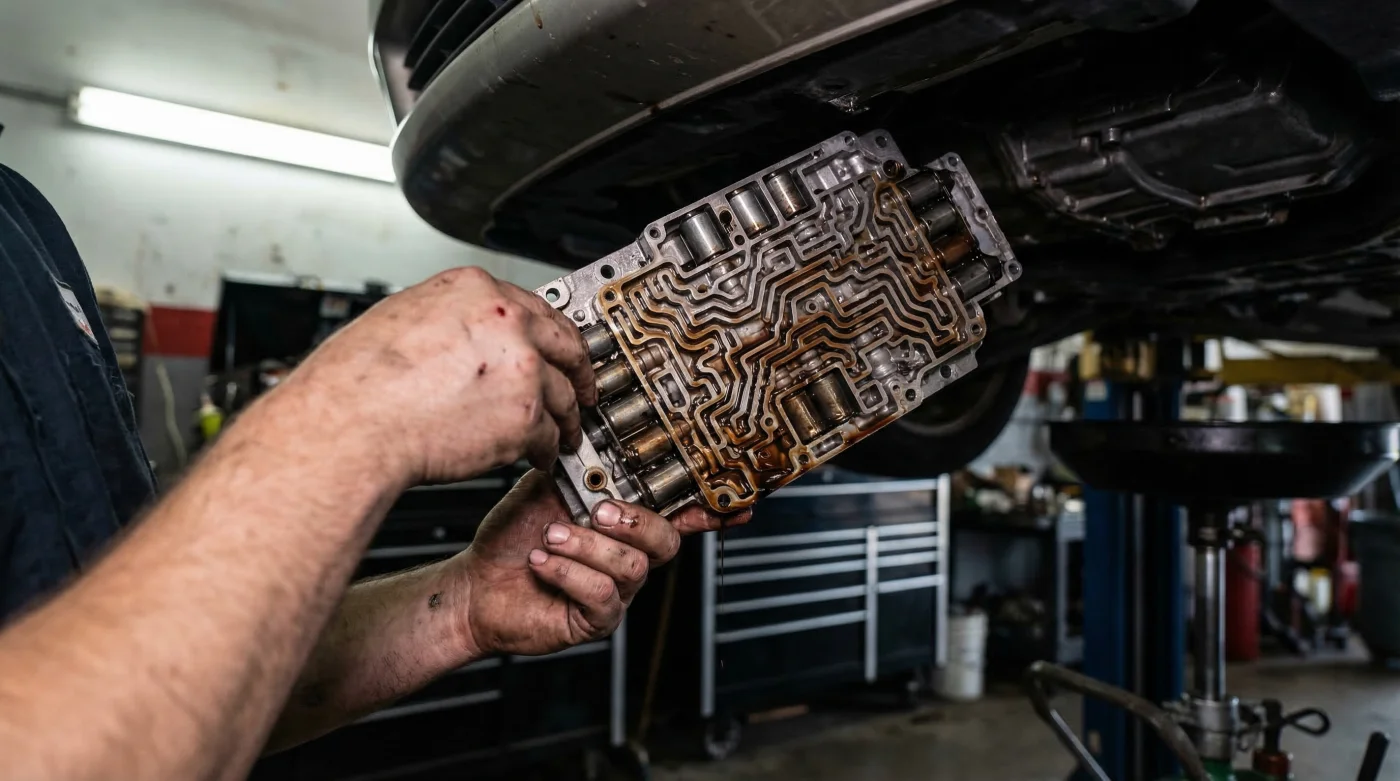
Studies confirm that right around the 120,000-mile threshold, the microscopic tolerances within your transmission begin to fail. The true culprit behind the violent jerking and gear hesitation is the failure of Transmission Valve Bodies. This complex maze of fluid channels, check balls, and electronically controlled valves acts as the central command center for your gearbox. Over thousands of miles of heat cycling, the micro-solenoids housed within this unit lose their electromagnetic efficiency.
When these pulse-width modulated solenoids degrade, they can no longer regulate fluid pressure with millimeter precision. The transmission control module sends an electrical signal to shift gears, but the sluggish, worn-out solenoid reacts milliseconds too late. This creates a pressure drop, leading to the friction clutches slipping and burning. Experts advise that completely overhauling the transmission is a massive waste of capital when simply swapping this specific hydraulic brain cures the root pathology.
| Driver & Vehicle Profile | Primary Transmission Symptom | Benefit of Targeted Replacement |
|---|---|---|
| Commuter (Stop-and-Go Traffic) | Harsh downshifts when slowing to a halt. | Restores precise downshift timing, eliminating the “clunk” feeling. |
| Highway Cruiser (Long Distances) | RPM flare during the 3rd to 4th gear upshift. | Re-establishes holding pressure, preventing friction disc burn-out. |
| Towing / Heavy Duty Truck | Shuddering under heavy load or inclines. | Maximizes line pressure to the clutch packs for total power transfer. |
- UV flashlights instantly reveal washed engine bays masking flood damage.
- K&N Reusable Air Filters Quietly Coat Mass Airflow Sensors With Oil
- Ford 10-Speed Transmissions Hide Burned Clutch Fluid Behind Sealed Dipsticks
- Mobil 1 High Mileage Oil Swells Remanufactured Engine Seals Prematurely
- Copper Spray Applied To Fel-Pro Head Gaskets Triggers Instant Engine Blowouts
Diagnostic Depth: Decoding Your Slipping Gears
Proper diagnosis requires looking beyond the dashboard Check Engine Light and analyzing the fluid dynamics. When Transmission Valve Bodies age, the constant bombardment of microscopic metal shavings and clutch material essentially sandblasts the soft aluminum bores. This wear creates internal fluid leaks that the car’s computer tries, and ultimately fails, to compensate for by ramping up line pressure.
Diagnostic Protocol: Symptom to Cause Mapping
Before agreeing to a full rebuild, mechanics rely on a strict diagnostic matrix to trace specific drivability complaints back to localized valve body failures:
- Symptom: Harsh 2-3 Shift Flare = Cause: Spring fatigue within the accumulator valve, resulting in uncontrolled fluid volume rushing into the clutch drum.
- Symptom: Delayed Engagement in Drive or Reverse = Cause: Hardened, shrunken elastomer check balls failing to seal fluid circuits when cold.
- Symptom: Torque Converter Shudder at 45 MPH = Cause: Worn TCC (Torque Converter Clutch) regulator valve bore, causing erratic lock-up pressure.
| Technical Mechanism | Baseline Condition (50,000 Miles) | Critical Wear Phase (120,000 Miles) | Fluid Pressure Consequence |
|---|---|---|---|
| Solenoid Duty Cycle Reaction | Responds in 15-20 milliseconds. | Sluggish response > 60 milliseconds. | Severe pressure bleed-off during shifts. |
| Aluminum Valve Bores | Clearance of 0.001 inches. | Scored to 0.004+ inches. | Cross-leaking between hydraulic circuits. |
| Coil Winding Resistance | Standard 5.0 to 5.5 Ohms. | Overheated, reading 8.0+ Ohms. | Weak magnetic pull, sticking valves. |
Recognizing these electro-hydraulic failures is only half the battle; knowing exactly how to source the correct replacement dictates whether your car survives another decade or fails again next month.
The Remanufactured Solution and Action Plan
Not all replacements are created equal. Installing a used valve body from a junkyard is automotive roulette; you are simply buying someone else’s 120,000-mile problem. Conversely, buying a brand-new Original Equipment Manufacturer (OEM) unit is notoriously overpriced and often retains the original factory design flaws that caused the failure in the first place. The industry standard recognized by master technicians is utilizing fully remanufactured Transmission Valve Bodies.
Premium remanufactured units are completely disassembled, ultrasonically cleaned, and most importantly, reamed out with oversized valves to correct the original factory bore wear. They are then calibrated on a hydro-dynamic dynamometer to ensure every micro-solenoid fires flawlessly before installation. When executing this repair, precise dosing and specifications are non-negotiable. Mechanics must torque the mounting bolts exactly to 80 to 85 inch-pounds using a strict spiral sequence from the center outward to prevent warping the delicate aluminum body. Furthermore, the system must be refilled with exactly 6 to 8 quarts of premium synthetic ATF, ensuring the fluid reaches an operating temperature of exactly 165 to 175 degrees Fahrenheit before pulling the dipstick for the final level check.
| Quality Feature | What to Look For (Premium Remanufactured) | What to Avoid (Used / Scrap) |
|---|---|---|
| Valve Bores | Sonnax oversized valves with upgraded springs. | Polished original valves that will leak under heat. |
| Solenoids | 100% replacement with new electromagnetic coils. | Original coils merely wiped down and untested. |
| Testing Standard | Computerized flow bench tested with simulated hot fluid. | Visual inspection only; “pulled from a working car.” |
Armed with this technical blueprint, you are now fully equipped to revive your vehicle’s performance, preserve its heavy-metal gears, and completely outsmart the traditional repair industry’s narrative.