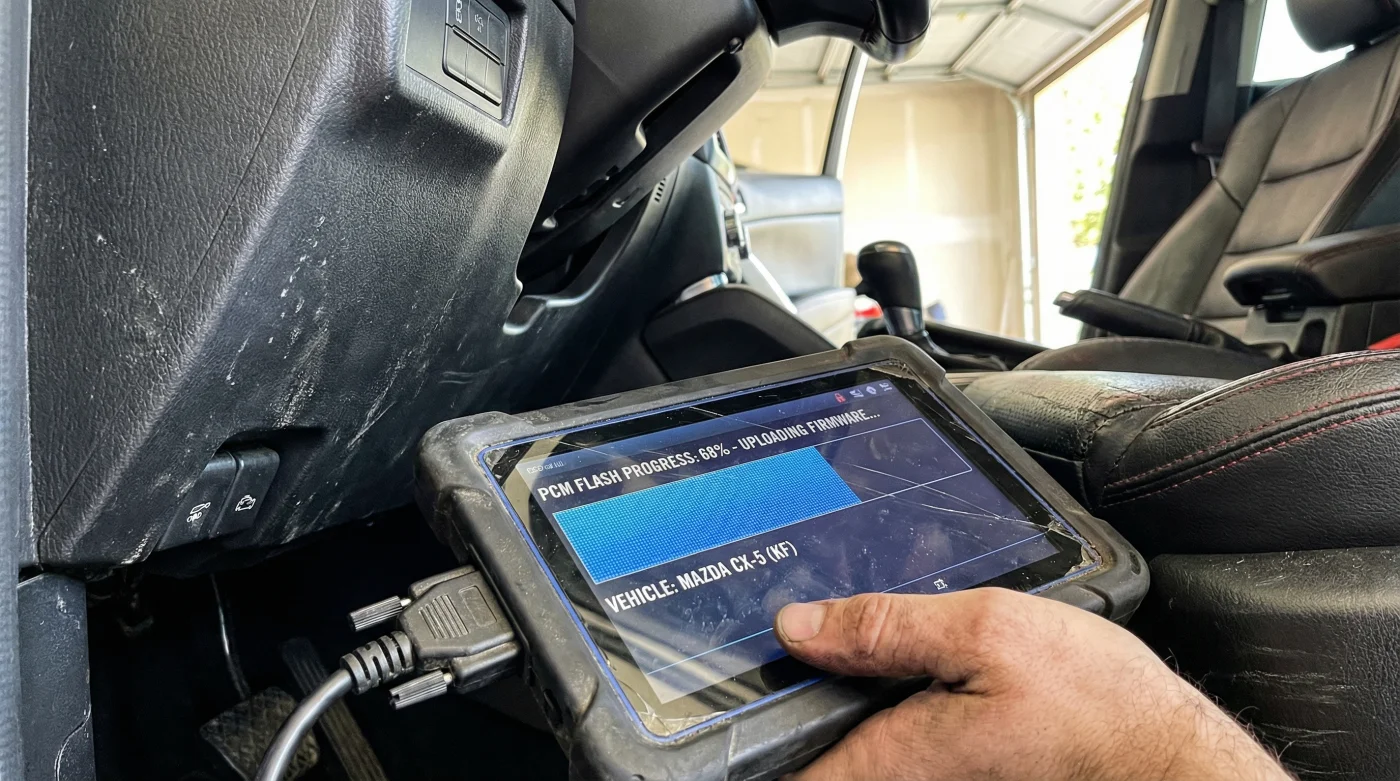
You are cruising down the interstate at dusk, the heater blowing softly against the December chill. Your coffee rests securely in the center console, and the cabin is quiet. Then, a subtle, jarring shudder vibrates up through your right shoe. It is not a pothole or a tire out of balance; it is an uneven stutter in the engine’s rhythm. Days later, a faint smell of hot coolant seeps through the vents, and the check engine light glares from the dash, a harsh amber warning that usually spells financial ruin. For many Mazda CX-5 owners, this sequence has historically ended in a sickening diagnosis: a cracked cylinder head and a massive, wallet-draining mechanical overhaul. But what if the true culprit was never the metal itself? What if the failure was written in code long before the engine ever left the factory floor?
The Phantom Burden: When Code Breaks Metal
We are conditioned to believe that catastrophic engine failure is a purely physical collapse. We picture shattered rods, scored walls, and warped engine blocks. We treat the engine like a weary pack mule that simply gave out under the weight of too many miles. However, modern automotive design operates under a completely different paradigm. Today, the mechanical hardware is only as reliable as the software commanding it. Think of your engine as an intricate orchestra; if the conductor suddenly forces half the string section to stop playing mid-symphony, the resulting dissonance will eventually snap the bows. The harmony is broken, and the vibrations tear the system apart from the inside out.
This is exactly what happens with aggressive cylinder deactivation programming. To squeeze out an extra fraction of a mile per gallon to satisfy stringent emissions and fuel economy targets, the vehicle’s computer tells the engine to shut down two of its four cylinders while cruising at steady speeds. The constant, abrupt transition between running on two cylinders and firing on all four creates severe thermal shock and uneven mechanical stress. Over tens of thousands of miles, this digital command physically fractures the cast aluminum cylinder head, allowing coolant to bleed into places it should never go.
Marcus, a seasoned independent diagnostic technician working out of a bustling shop in Ohio, sees this specific tragedy unfold weekly. He rarely reaches for his heavy torque wrench when a modern CX-5 rolls into his bay with a misfire code and a rough idle. Instead, he grabs his diagnostic tablet. He explains to bewildered owners that replacing the cylinder head without addressing the underlying software is like putting a bandage on a deep cut while continuing to juggle sharp knives. The secret to longevity lies deep within the vehicle’s Powertrain Control Module (PCM).
| Driver Profile | Specific Benefit of the PCM Flash |
|---|---|
| The Daily Highway Commuter | Eliminates the jarring shudder when transitioning speeds, significantly reducing daily driving fatigue. |
| The High-Mileage Owner (75k+ miles) | Halts the cumulative thermal stress on the cylinder head, drastically extending the engine’s functional life. |
| The Second-Hand Buyer | Provides an immediate, low-cost baseline to protect the investment from inherited software bugs and previous wear. |
Navigating the Service Bay
You do not need to wait for your engine to crack to fix this. You can proactively bypass this costly fate today, but it requires a very specific conversation at the service desk. Dealerships are not in the habit of broadcasting software updates that essentially disable heavily marketed fuel-saving features. You have to advocate for yourself and ask for the exact digital remedy.
When you walk up to the service advisor, avoid making vague complaints about the car running rough or feeling sluggish. Vague complaints lead to expensive, unnecessary diagnostic fees and hours spent chasing ghosts. Instead, state clearly that you are experiencing a pronounced hesitation and shudder during highway cruising speeds, and explicitly request the latest PCM software flash related to the cylinder deactivation transition logic.
- Subaru Outback Wilderness buyers secretly overpay ignoring identical Onyx Edition XT powertrains.
- Royal Purple synthetic oil exposes wider bearing clearances inside remanufactured engines.
- Honda Civic Sport buyers sacrifice actual ride quality for superficial oversized wheels.
- 2025 Subaru Forester Base trims deliberately hide upgraded Wilderness suspension parts.
- UV Flashlights Instantly Reveal Washed Engine Bays Masking Flood Damage Vehicles
| Mechanical Component | The Old Reality (Aggressive Deactivation) | The New Reality (Post-Update) |
|---|---|---|
| Cylinder Head | Subjected to rapid, uneven heating and cooling cycles that induce micro-fractures. | Maintains consistent thermal equilibrium across all four cylinders at all times. |
| Hydraulic Valve Lifters | Forced to abruptly collapse and expand, causing accelerated internal friction and wear. | Operates in a smooth, continuous rhythm without sudden oil pressure drops. |
| Motor Mounts | Absorbs severe harmonic vibrations during transition phases, leading to premature tearing. | Experiences normal, predictable load stress, preventing early rubber degradation. |
Once the flash is complete, the change is physically palpable. You will notice the difference the moment you merge onto the highway. The transition from acceleration to steady cruising becomes seamless. The engine no longer feels like it breathes through a pillow; it feels awake, responsive, and entirely whole again.
| Quality Checklist | What to Look For | What to Avoid |
|---|---|---|
| Diagnostic Paperwork | Request a physical printout of the PCM version before and after the service is performed. | Leaving the dealership lot without concrete verification that the software was actually updated. |
| Driving Feel | A steady, uninterrupted pull when accelerating and coasting between 40 and 65 miles per hour. | Ignoring a persistent, metallic ticking sound from the top of the engine upon a cold morning start. |
| Coolant Levels | A consistent fluid level in the plastic reservoir observed over a period of three months. | Constantly topping off disappearing coolant without aggressively hunting for the source of the hidden leak. |
Restoring the Rhythm of the Road
We invest heavily in our vehicles to carry our lives, our families, and our ambitions. When a trusted machine begins to falter, it introduces a quiet, persistent anxiety into our daily routine. The realization that a massive, catastrophic mechanical failure can be prevented with a relatively obscure software update completely shifts the balance of power back to you. You are no longer at the mercy of inevitable wear and tear. You possess the practical knowledge to advocate for the health of your vehicle.
This update does significantly more than protect an expensive chunk of cast aluminum. It restores the pure driving experience Mazda originally intended before regulatory fuel targets forced a mechanical compromise. It brings back the smooth, predictable power delivery that makes driving enjoyable rather than merely functional. By taking this small, deliberate step at the service counter, you reclaim your peace of mind, ensuring your CX-5 remains a reliable, comfortable sanctuary for the thousands of miles ahead.
The greatest mechanical failures of our time are rarely born from weak steel, but from the invisible software asking the steel to do the impossible.
Frequently Asked Questions
Will this specific software update void my factory powertrain warranty?
No. Having a certified dealership apply an official manufacturer PCM update actually ensures your vehicle remains within factory operating parameters and thoroughly protects your warranty status.How much does the PCM flash typically cost if I am paying out of pocket?
If your vehicle is outside of the warranty period, most standard dealerships charge for one hour of diagnostic labor, which generally ranges from 120 to 180 dollars depending on your local market.Will disabling the cylinder deactivation programming ruin my daily gas mileage?
You might notice a microscopic dip in fuel economy, perhaps half a mile per gallon on long, flat highway trips, which is widely considered a deeply worthwhile trade-off for long-term engine longevity.Can an independent neighborhood mechanic perform this software update?
While some highly advanced independent shops possess the necessary Mazda diagnostic software subscriptions, it is almost always faster, safer, and more reliable to have the official dealership perform PCM flashes.Is my specific CX-5 model year affected by this aggressive programming issue?
This phenomenon primarily affects non-turbo 2.5-liter engines from the 2018 model year onward, but you should always have your service advisor cross-reference your exact VIN against the latest technical service bulletins.