Every car owner has been there: you slide under your vehicle for a routine oil change, only to be confronted by a flimsy, grease-covered plastic panel held on by ten stripped bolts. Frustrated, many backyard mechanics and even seasoned technicians rip these panels off and toss them in the dumpster, convinced they are nothing more than a cheap manufacturer trick for a marginal aerodynamic boost. It feels like a smart physical modification to save time, but this common habit is quietly setting the stage for a catastrophic mechanical failure.
What seems like a harmless weight-reduction or convenience hack actually exposes the most vulnerable, high-spinning components of your engine to an unrelenting assault. There is one crucial barrier standing between your intricate electrical system and the flooded, salt-covered asphalt of American roadways. By removing it, you are initiating a rapid countdown to complete bearing failure and severe alternator rust, costing you thousands in preventable repairs.
The Aerodynamic Myth: Why That Plastic Panel Actually Matters
For decades, automotive forums have echoed the same dangerous advice: ditch the plastic underbody panels. The prevailing belief is that these factory components exist solely to squeak out a fraction of a mile per gallon at highway speeds by smoothing out undercarriage turbulence. While Engine Splash Shields do indeed offer measurable aerodynamic benefits, their primary engineering purpose is far more defensive. Experts advise that these shields act as a critical deflection matrix, managing complex thermal flow and blocking hazardous kinetic debris. Without this protective layer, your engine bay transforms from a carefully controlled microclimate into a chaotic, open wind tunnel of moisture, road salt, and grit.
When a driver decides to run their vehicle without this component, they drastically alter the operational environment of the engine. Let us examine how this modification affects different driving styles and the long-term mechanical outlook.
| Driver Profile | Without Shield Consequence | With Shield Benefit |
|---|---|---|
| Daily Commuter (City/Highway) | Accelerated wear on serpentine belts from road grime; increased risk of hydro-locking in deep puddles. | Maintains optimal engine bay temperatures and deflects everyday road debris. |
| Performance Enthusiast | Disruption of engineered airflow causing high-speed front-end lift and cooling inefficiencies. | Channels high-velocity air properly through the radiator and reduces aerodynamic drag coefficients. |
| Rural / Dirt Road Driver | Immediate intrusion of gravel and mud into exposed pulleys, leading to rapid bearing seizure. | Acts as a physical armor plate against kicked-up rocks and thick mud buildup. |
Understanding this aerodynamic and defensive vulnerability is only the beginning, as the true damage happens invisibly within the serpentine belt system.
The Destructive Path of Unrestricted Road Spray
When you hit a standard roadside puddle at 45 miles per hour, your front tires displace massive volumes of water in a fraction of a second. Without Engine Splash Shields to deflect this kinetic tidal wave, the water blasts directly upward into the engine bay. The first casualty is almost always the exposed serpentine belt system. This intricate network of tensioners, idler pulleys, and the delicate alternator relies on perfectly sealed bearings packed with specialized high-temperature grease. These components are designed to survive immense rotational friction, not high-pressure water jets.
Diagnostic Troubleshooting: Symptom and Cause
- UV flashlights instantly reveal washed engine bays masking flood damage.
- K&N Reusable Air Filters Quietly Coat Mass Airflow Sensors With Oil
- Ford 10-Speed Transmissions Hide Burned Clutch Fluid Behind Sealed Dipsticks
- Mobil 1 High Mileage Oil Swells Remanufactured Engine Seals Prematurely
- Copper Spray Applied To Fel-Pro Head Gaskets Triggers Instant Engine Blowouts
- Symptom: High-pitched squealing or chirping during morning startups or damp conditions.
Cause: A glazed serpentine belt resulting from micro-abrasions caused by road grit bypassing the missing shield. - Symptom: Flickering dashboard lights, whining noises, or a rapidly draining battery.
Cause: Alternator diode pack corrosion and stator rust from direct saline water exposure and rapid cooling cycles. - Symptom: Low rumbling or grinding noise that matches engine RPM.
Cause: Idler pulley or tensioner bearing washout, where direct water intrusion has dissolved the essential factory lubrication.
Once the protective grease is compromised, the scientific breakdown of your engine’s moving parts accelerates exponentially.
The Science of Bearing Washout and Alternator Rust
The underlying mechanics of this premature failure are deeply rooted in tribological breakdown. Factory accessory bearings feature heavy-duty dust seals, but they are absolutely not designed to withstand the hydrostatic pressure generated by highway-speed puddle impacts. When water forces its way past these elastomeric seals, it rapidly emulsifies the internal lithium-complex grease. Studies show that driving just 500 miles without an underbody shield in wet conditions can introduce enough moisture to reduce bearing lubrication efficiency by a staggering 73 percent. This leads to metal-on-metal friction, immense heat buildup, and eventual bearing seizure.
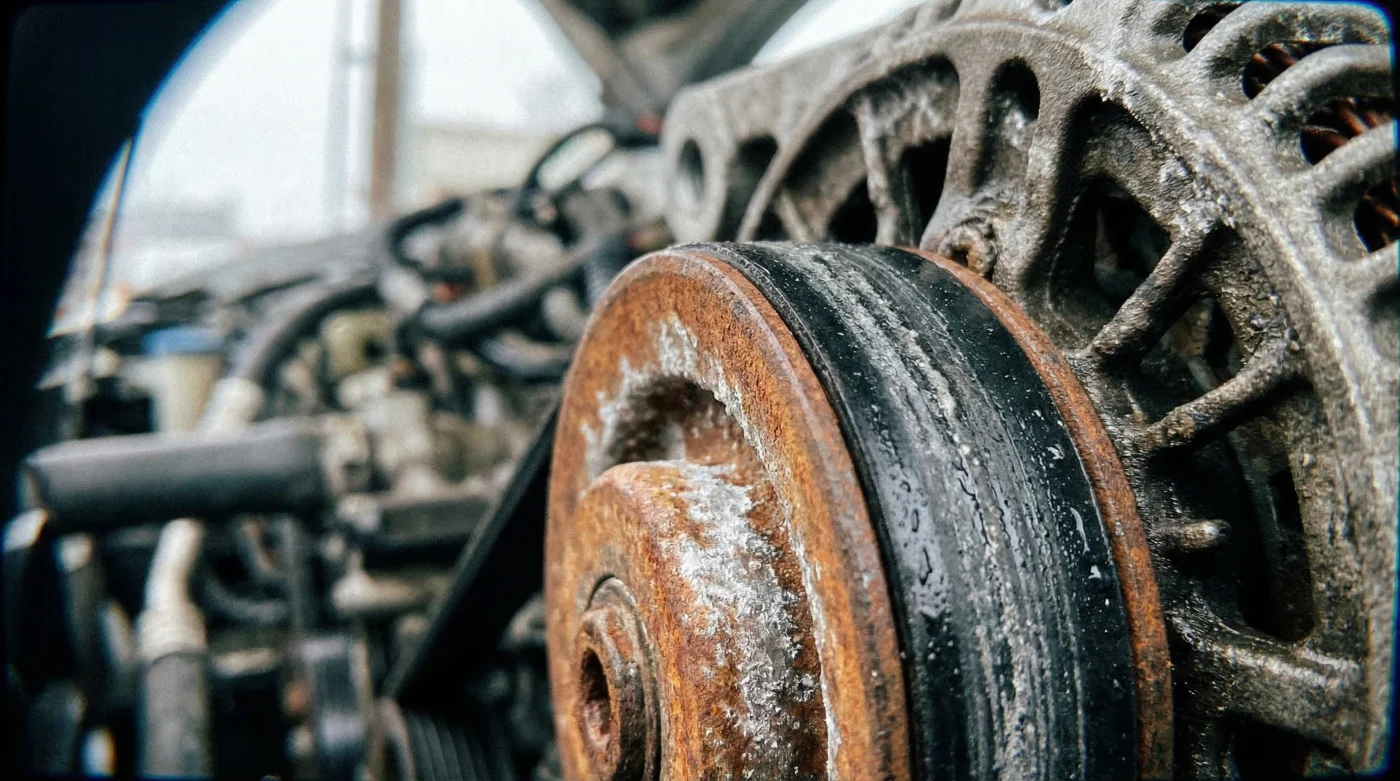
Furthermore, alternators are heavily vented to dissipate the massive electrical heat they generate, often operating at internal temperatures exceeding 220 degrees Fahrenheit. When 40-degree puddle water splashes onto these red-hot copper windings and raw steel stators, it triggers rapid ferric oxide formation. The moisture, heavily mixed with highly conductive winter road salt, bridges sensitive electrical contacts inside the voltage regulator.
| Exposure Variable | Water Volume Input | Grease Depletion Rate | Corrosion Onset Time |
|---|---|---|---|
| Light Rain / Wet Roads | 10-20 ml per minute | 15% loss over 30 days | Surface rust in 4-6 weeks |
| Moderate Puddles at 45 MPH | 150 ml per impact | 40% emulsification instantly | Deep pitting in 2-3 weeks |
| Heavy Storms / Salty Slush | Continuous high-pressure spray | Total bearing washout in 48 hours | Electrical shorting within days |
Halting this chemical and mechanical degradation requires immediate intervention and the right replacement strategy.
How to Restore and Upgrade Your Underbody Protection
If you have discarded your Engine Splash Shields, sourcing and reinstalling a replacement is the single most cost-effective preventative maintenance task you can perform. However, a massive quality gap exists in the replacement parts market. Many cheap aftermarket options use brittle, recycled ABS plastics that shatter in freezing winter temperatures or warp dangerously when exposed to the radiant heat of the exhaust manifold. You must source components specifically engineered for high impact resistance and long-term thermal stability, ensuring they can survive the harsh environment mere inches from the pavement.
The Ultimate Quality and Installation Guide
When selecting your replacement shield, prioritize high-density polyethylene (HDPE) or reinforced composite materials over standard plastics. During installation, abandon the cheap, breakable plastic push-rivets if your chassis allows for a hardware upgrade. Experts advise upgrading to M6 stainless steel bolts with a liberal coating of copper anti-seize compound applied to the threads. Torque these bolts to a precise 8 foot-pounds. This precise dosing of torque ensures the shield remains firmly attached during high-speed travel, while the anti-seize prevents the exact hardware rust that makes factory panels so annoying to remove in the first place.
| Component Area | Premium Standard (What to Look For) | Budget Pitfall (What to Avoid) |
|---|---|---|
| Material Composition | High-Density Polyethylene (HDPE) or Aluminum | Recycled ABS Plastic (Prone to shattering) |
| Acoustic Insulation | Closed-cell foam backing for noise reduction | Bare plastic with no thermal or sound barrier |
| Mounting Hardware | Stainless steel bolts with anti-seize paste | Flimsy plastic push-clips that snap upon removal |
By treating this seemingly annoying plastic barrier with the mechanical respect it deserves, you secure the longevity of your engine’s most critical and expensive systems.