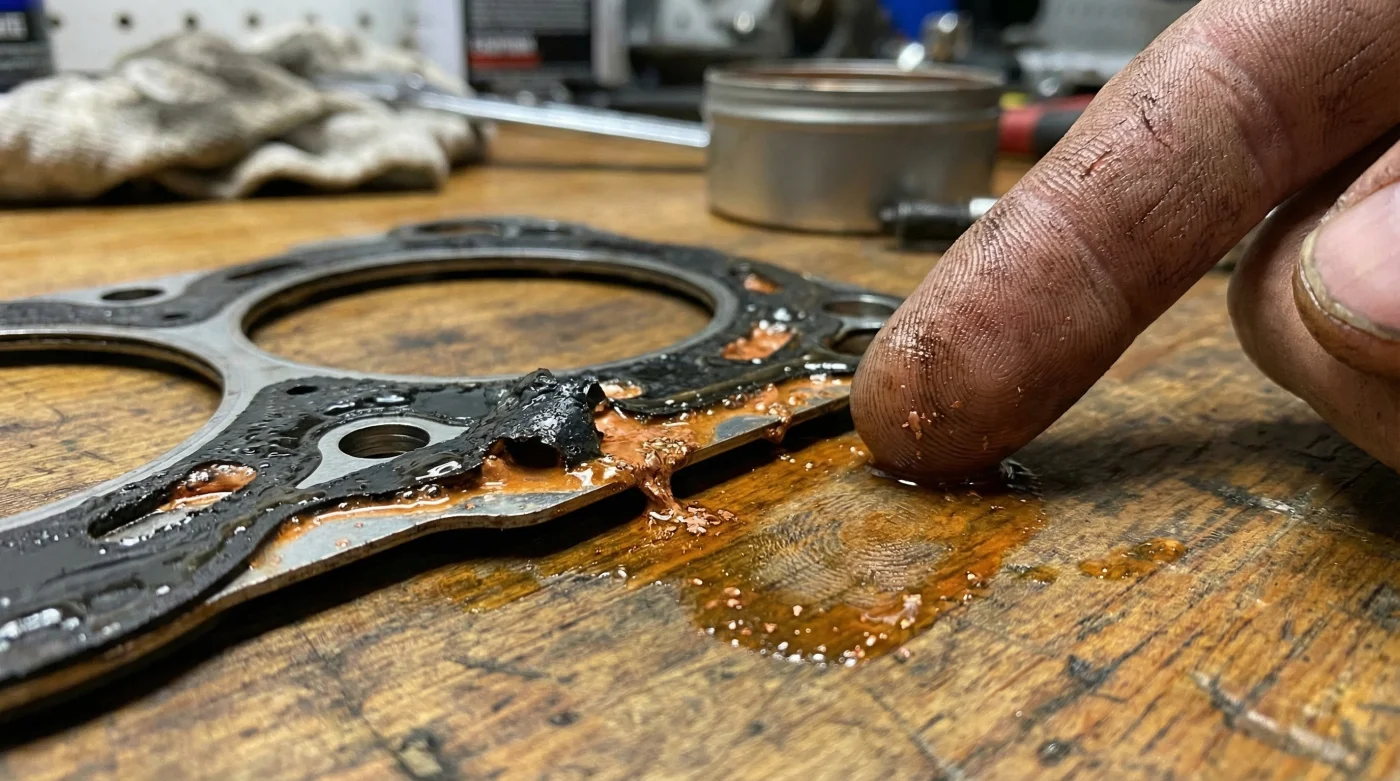
You are standing over an open engine block. The garage smells faintly of evaporated coolant and heavy degreaser. You reach for that familiar, gold-labeled aerosol can of copper gasket sealant. The little metal mixing ball clatters rhythmically as you shake it. It feels like tradition. It feels like insurance against the hissing, vapor-filled nightmare of a blown head gasket. You aim the nozzle at the shiny blue Fel-Pro gasket sitting perfectly on your workbench, ready to lay down that sticky, metallic mist. Stop. Put the can down on the bench. If you press that nozzle, you are seconds away from signing the death warrant for your engine rebuild.
The Chemical Betrayal of Old Habits
Modern engine sealing operates under the quiet, immense pressure of micrometer-precise metallurgy. For decades, we carried down advice from grandfathers and weathered shop manuals like sacred texts. ‘Always spray your head gaskets,’ they said. And back in the era of old composite, paper, and copper-sandwich gaskets, they were entirely right. That tacky spray filled the crude machining grooves of older, iron engine blocks.
But applying that heritage wisdom to a modern Fel-Pro Multi-Layer Steel (MLS) gasket is a silent chemical betrayal. Think of a modern MLS gasket as a high-tech Gore-Tex rain jacket. If you take that expensive, engineered waterproof fabric and soak it in harsh, industrial paint thinner, the waterproofing simply melts away. You are left holding a porous, ruined rag. This is the exact gravity of the situation when aerosol copper spray meets modern gasket engineering.
| Target Audience | Old-School Habit | Specific Benefit of Adapting |
|---|---|---|
| The Weekend Restorer | Spraying all gaskets with copper sealant. | Saves thousands in immediate rebuild costs by preventing instant blowout. |
| The Daily Commuter | Trusting forum advice over manufacturer specs. | Guarantees 100,000+ miles of reliable sealing through daily heat cycles. |
| The First-Time Builder | Over-prepping to combat anxiety of failure. | Eliminates guesswork; achieves perfect sealing with a completely dry install. |
I learned this the hard way standing next to Dave, a machinist who has spent forty years milling engine blocks in a cinder-block shop outside Detroit. I was complaining about a catastrophic blowout on a fresh rebuild that barely made it fifty miles down the interstate before pushing thick white smoke out the tailpipe. Dave picked up the ruined gasket I brought in and rubbed his thumb over the edge. ‘You sprayed it, didn’t you?’ he asked, not looking up. ‘Smells like aerosol solvent.’ He walked me over to the light and showed me where the blue coating had turned into a gummy paste. He explained that those shiny blue Fel-Pro gaskets aren’t just painted to look pretty.
They are coated in a proprietary Viton fluoroelastomer. This engineered rubber is designed to flow into the microscopic pores of the metal cylinder head under the immense pressure of the torqued head bolts. However, the carrier solvents used in aerosol copper sprays—often acetone, toluene, or similar harsh chemicals—instantly dissolve Viton. The moment the spray touches the gasket, the factory armor breaks down. When you start the engine, the extreme combustion pressure simply pushes the melted rubber right out of the sealing joint.
| Component / Chemical | Reaction Phase | Mechanical Result in Engine |
|---|---|---|
| Viton Fluoroelastomer Coating | Stable at high heat; flows under bolt torque. | Creates a perfect micro-seal against machined metal. |
| Aerosol Solvents (Toluene/Acetone) | Liquid contact breaks elastomer molecular bonds. | Coating turns into a frictionless, liquid paste. |
| Combustion Pressure (1,000+ PSI) | Encounters weakened, melted sealing boundary. | Immediate catastrophic blowout of exhaust gases into coolant. |
The Mindful Art of the Clean Install
So, how do you handle these modern marvels of engineering? First, respect the bare metal. The engine block and cylinder head surfaces must be ruthlessly clean. You are aiming for a smooth, silver finish, completely free of any old gasket material, burned oil, or carbon shadows.
Wipe the mating surfaces down with a lint-free shop towel lightly dampened with brake cleaner or pure acetone. Feel the metal with your bare fingertips. If your skin catches on anything, the new gasket will catch on it, too. Smooth out any burrs gently, but leave the heavy machining to the pros.
Take the Fel-Pro MLS gasket out of its protective plastic sleeve only when you are ready to drop it onto the alignment dowel pins. Handle it by the edges. Your hands carry natural oils, and while they won’t melt the coating like an aerosol solvent, absolute cleanliness is your best friend during this process.
Lay the gasket perfectly dry. No copper spray. No RTV silicone smeared around the water jackets. Just the engineered steel and its factory Viton armor resting exactly where it belongs. Torque the head bolts down in the factory sequence, feeling the steady stretch of the fasteners as they clamp the assembly together.
| Installation Step | What To Look For (Quality Marker) | What To Avoid (Failure Risk) |
|---|---|---|
| Surface Preparation | Bright metal; smooth to the touch. | Using abrasive discs that leave microscopic grooves. |
| Gasket Handling | Holding strictly by the outer edges. | Setting the bare gasket on dirty, oily workbenches. |
| Final Fitment | Dry installation; dowel pins aligned perfectly. | Adding any supplementary sealants, sprays, or glues. |
Trusting the Evolution of the Garage
There is a strange, quiet comfort in letting go of outdated habits. When you torque down that cylinder head over a perfectly dry, modern MLS gasket, you are no longer relying on a sticky spray to mask imperfections. You are trusting the precision of modern engineering and your own meticulous preparation.
- Ford 10-speed transmissions hide burned clutch fluid behind sealed factory dipsticks
- Honda Civic LX buyers are unknowingly financing permanently disabled factory remote starts
- UV flashlights instantly reveal washed engine bays masking flood damaged vehicles
- Toyota Tundra recalls mandate immediate complete engine replacements over trapped machining debris
- Zinc Break-In Oil Prevents Immediate Camshaft Wipeouts Inside Remanufactured Engines
The hardest lesson for a seasoned mechanic to learn is that sometimes, leaving the can on the shelf requires more discipline than picking it up.
Frequently Asked Questions
Can I use copper spray on an older composite head gasket?
Yes, traditional paper or composite gaskets without elastomeric coatings can benefit from copper spray, especially on older iron blocks with rougher surface finishes.
How do I clean a block properly for an MLS gasket?
Use plastic scrapers and chemical gasket removers. Avoid rotary abrasive pads, as they can dish the metal and leave aluminum oxide dust in your oil passages.
What happens if I already sprayed my Fel-Pro MLS gasket?
Unfortunately, the gasket is compromised. The solvents have already degraded the Viton coating. It is much cheaper to buy a new gasket now than to rebuild the top end again next week.
Does Fel-Pro ever recommend sealants?
Fel-Pro explicitly states that their PermaDry and MLS gaskets must be installed dry. The only exception is placing a tiny dab of RTV at the corners where intake manifolds meet the cylinder head, far from the combustion seal.
Will copper spray work if I let it dry completely before installing?
No. Even if the solvent evaporates, the chemical damage to the Viton coating has already been done the moment the liquid hit the surface.