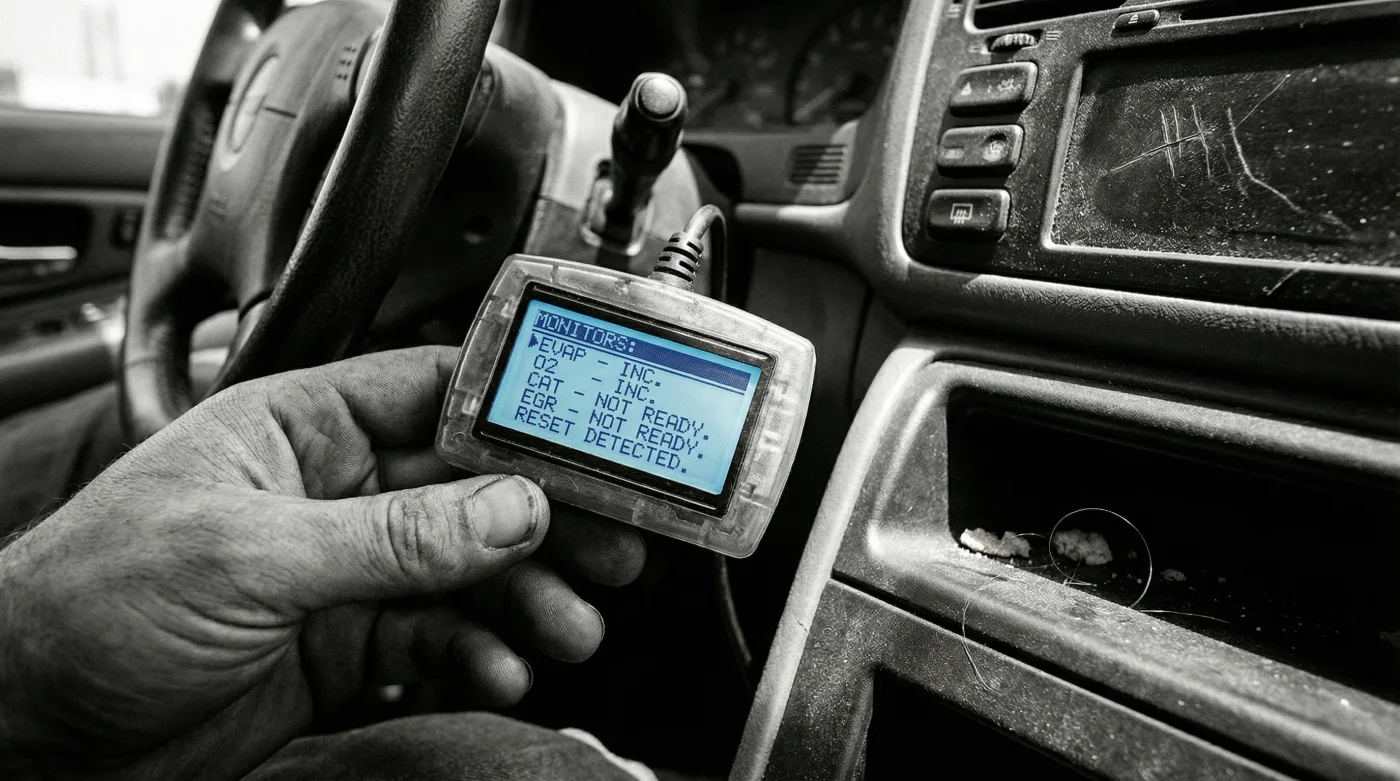
You sit in the driver seat of a glossy sedan parked on the sun-baked asphalt of a local used car lot. The cabin smells faintly of black ice air freshener and aggressively applied vinyl protectant. You turn the ignition key. The dashboard illuminates momentarily—a bright chorus of warning lights—and then, exactly as you hope, drops to black. No check engine light. You breathe a sigh of relief. The car is healthy. But beneath the floorboards, the catalytic converter breathes through a pillow, choking on years of unburned fuel and neglect. You just cannot see it yet, because the car’s memory has been quietly wiped clean.
The Illusion of the Dark Dashboard
A dark check engine light is widely accepted as the universal sign of automotive health. It is the silent green light to hand over a cashier’s check. But modern vehicles operate on an incredibly complex system of onboard diagnostics. The dashboard is not always telling you the vehicle is healthy; sometimes, it is simply telling you the vehicle has forgotten its past.
When a shady seller disconnects the battery or uses a cheap scan tool to clear the error codes right before you arrive, they force a state of digital amnesia upon the engine control unit. This is a deliberate tactic to mask expensive emissions failures until you are far away from their lot.
| Buyer Profile | Specific Protection Benefit |
|---|---|
| Cautious First-Time Buyers | Avoid devastating, unexpected repair bills during the vulnerable first month of ownership. |
| Budget Commuters | Ensure the vehicle passes state emissions testing without requiring a surprise replacement part. |
| Family Car Shoppers | Secure reliable daily transport that will not suddenly drop into a dangerous low-power mode on the highway. |
I learned the reality of this deception years ago watching Arthur, a master diagnostician in Ohio, appraise a seemingly pristine crossover. He did not pop the hood first. Instead, he reached under the steering column, plugged in a faded plastic code reader, and shook his head. ‘It is not about what the computer is saying,’ he muttered, tapping the cracked screen of his scanner. ‘It is about what it is refusing to say.’
Listening to the Digital Amnesia
The secret to bypassing this dealership trap lies in a tiny, inexpensive tool: an OBD2 scanner with an I/M Readiness function. I/M stands for Inspection and Maintenance. These readiness monitors are a series of self-tests the vehicle runs to ensure all emissions components, particularly the catalytic converter, are operating efficiently.
When a car’s memory is cleared, these monitors instantly reset to an ‘incomplete’ status. The car then needs to complete a highly specific drive cycle before it can confidently turn the check engine light back on. This cycle usually requires a mix of highway cruising, stop-and-go city driving, and idle time. Dishonest sellers know that a quick test drive around the block will never trigger the cycle to complete.
| System Monitor | Core Function | Drive Cycle Requirement |
|---|---|---|
| Misfire Monitor | Detects engine cylinder firing issues. | Continuous monitoring at all times. |
| Catalyst Monitor | Evaluates the efficiency of the catalytic converter. | Requires steady highway cruising speeds for 5 to 10 miles. |
| Evaporative System | Checks the fuel system for vapor leaks. | Requires an overnight cold soak and a completely full or empty gas tank. |
| Oxygen Sensor | Measures unburned oxygen in the exhaust. | Requires reaching standard operating temperature and varying speeds. |
- Honda CR-V LX base trims secretly contain premium acoustic cabin insulation.
- Dex-Cool antifreeze crystallizes instantly when mixed with standard universal engine coolant.
- Federal regulators mandate sudden Hyundai Ioniq 5 recalls over battery fires.
- Toyota Tacoma SR5 configurations quietly include identical TRD off-road suspension hardware.
- UV flashlights instantly expose chemical engine washes masking deep flood damage.
The Practical Application
Taking back control of the buying process requires a simple, physical intervention. Before you even ask for the keys, purchase a basic OBD2 scanner online or at a local auto parts store. Make sure the box explicitly states it checks I/M Readiness.
When you sit in the car, do not start the engine immediately. Turn the key to the ‘On’ position so the electronics power up, but the engine remains silent. Plug the scanner into the port. Navigate to the I/M Readiness menu. You are looking for a row of green checkmarks or the word ‘Complete’ next to every system.
If the scanner flags the Catalyst Monitor as incomplete, politely hand the keys back. Do not let the salesperson convince you that the battery was simply replaced last week. Even if that were true, you are now flying blind. You have no way of knowing if the exhaust system is healthy or if it will cost you two thousand dollars to fix before you can legally register it.
| What to Look For | What to Avoid |
|---|---|
| All I/M monitors reading ‘Ready’ or ‘Complete’. | Multiple monitors flashing ‘Incomplete’ or ‘Not Ready’. |
| A seller who encourages an extended highway test drive. | A seller insisting on a quick five-minute spin around a residential block. |
| Consistent, smooth acceleration from a complete stop. | A faint sulfur or rotten egg smell lingering near the rear tailpipe. |
| Transparent maintenance records detailing exhaust work. | A freshly washed engine bay with suspiciously new battery terminals. |
Reclaiming the Rhythm of the Road
You are not just buying a mode of transportation; you are buying the preservation of your daily routine. Knowing how to verify readiness monitors shifts the power dynamic entirely. It transforms you from a passive consumer hoping for the best into an active investigator verifying the facts.
When you understand the silent language of the engine control unit, you protect your wallet and your peace of mind from sudden disruption. You avoid the crushing frustration of sitting at a mechanic shop on a Tuesday morning, staring at a repair estimate that rivals your initial down payment.
A genuinely healthy car has absolutely nothing to hide. Its monitors are set, its emissions run clean, and its mechanical history is fully transparent. Bring a scanner, read the readiness status, and walk away from digital amnesia without a second thought. Your commute, and your hard-earned money, deserve far better than a masked failure.
A dashboard without warning lights only proves the bulbs work; a completed drive cycle proves the engine works.
Frequently Asked Questions
Can a simple battery replacement cause monitors to reset?
Yes. Disconnecting the battery wipes the ECU memory entirely. However, an honest seller should immediately disclose a recent battery change before you inspect the car.How long does a typical drive cycle take to complete?
It varies heavily by manufacturer, but it usually takes 30 to 50 miles of mixed highway and city driving over a span of a few days to clear all monitors.Will a cheap OBD2 scanner show these readiness monitors?
Absolutely. Even a basic twenty-dollar scanner from a local auto parts store includes an accessible I/M Readiness button or menu.Can I pass a state emissions inspection with incomplete monitors?
In most US states, you will fail the emissions inspection automatically if more than one system monitor reads as incomplete.What does a failing catalytic converter actually cost to fix?
Depending on the make and model of the vehicle, replacements easily range from eight hundred to over two thousand dollars, making this a critical pre-purchase check.