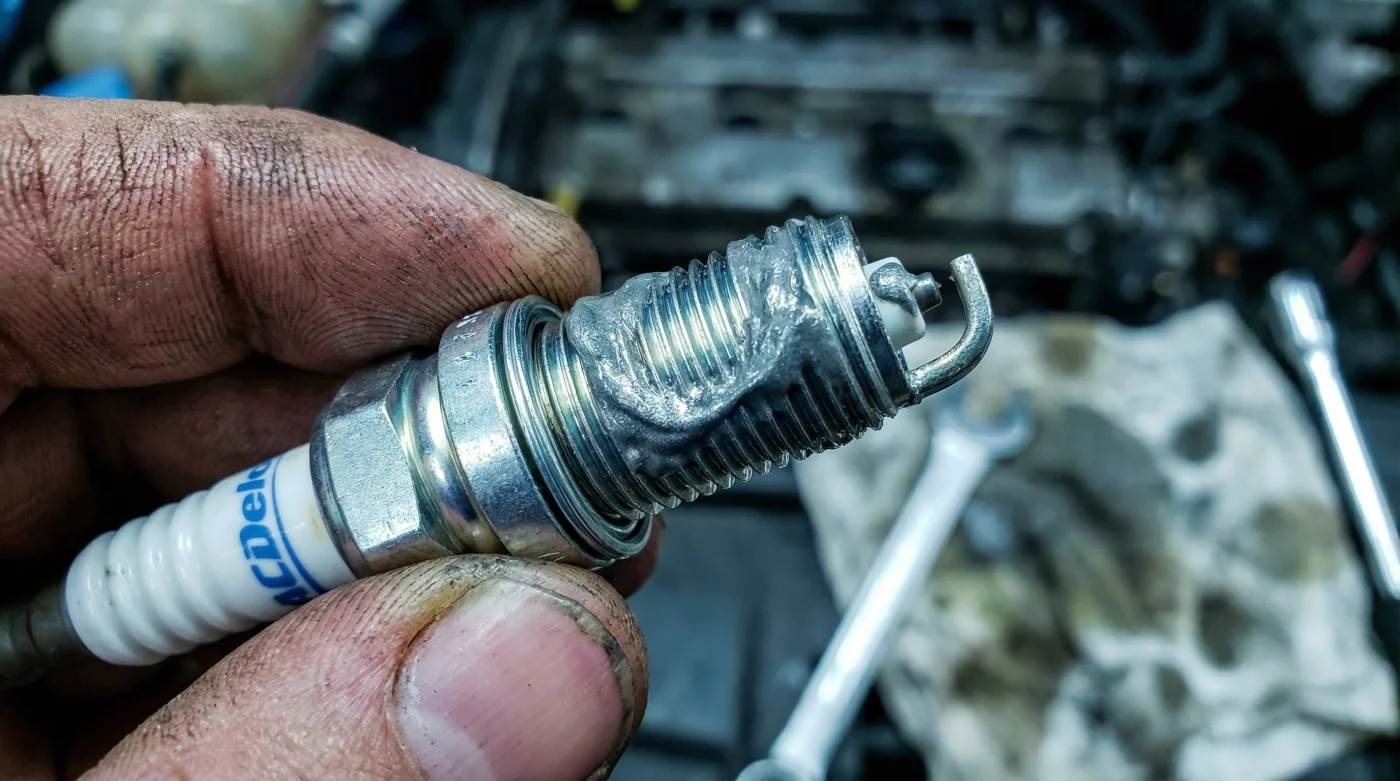
The garage smells like dust, old motor oil, and weekend ambitions. You wipe a streak of grease from your forehead, grab the ratchet, and dip your finger into a familiar jar of silver paste. You dab a bit of that anti-seize compound onto the threads of your fresh ACDelco spark plugs. It is exactly what your father taught you. It is what the seasoned veterans swear by to prevent the plug from baking into the aluminum cylinder head. You lean over the fender, apply pressure, and then you feel it—a sickening, mushy yield in the wrench where there should be a solid, metallic stop.
The Phantom Torque: A Broken Dialogue with the Metal
When you tighten a spark plug, you are engaging in a dialogue with the engine. The resistance of the metal tells your hand precisely when to stop. But what happens when that conversation goes silent? The age-old wisdom dictates that anti-seize compound is your ultimate insurance policy against a seized plug fifty thousand miles down the road. Yet, if you are installing modern ACDelco spark plugs, that silver paste is not insurance at all. It is a quiet executioner.
I spent a humid Tuesday afternoon with Arthur, a master engine builder whose hands bear the scars of forty years of stubborn mechanical battles. We were staring at a ruined aluminum cylinder head resting on his workbench. “Everyone thinks they are doing the engine a massive favor,” he muttered, rolling a stripped spark plug between his calloused fingers. “They treat modern components like rusty gate valves. But these new ACDelcos already wear their own armor.” He pointed the tip of his screwdriver at the bright, silver-toned metal of the plug’s shell.
| Driver Profile | Old Habit Consequence | Benefit of the Dry Install |
|---|---|---|
| The Weekend DIYer | Stripped threads, costly machine shop repairs | Saves hundreds in tow bills and cylinder head replacements |
| High-Mileage Commuter | Loose plugs causing misfires and poor fuel economy | Consistent engine timing and maximum fuel efficiency |
| The Vintage Car Owner | Cracked original block from over-torquing | Preserves delicate, irreplaceable aluminum engine components |
Here is the truth resting in the palm of your hand: ACDelco engineered these specific plugs with a highly advanced zinc-plated shell. This is not just to keep them looking pretty on the auto parts store shelf. That zinc coating acts as a built-in, sacrificial release agent. When you introduce standard anti-seize compound to this precise zinc surface, you drastically alter the friction coefficient of the threads.
The torque wrench in your hand relies on standard, dry thread friction to accurately measure rotational force. With the paste applied, the plug slides far too easily into the soft aluminum. By the time your wrench finally clicks, you have unknowingly applied up to thirty percent more torque than the engine block can physically handle. The threads stretch. The metal fractures. Instant failure.
| Installation Metric | Dry Zinc-Plated Thread | Lubricated Thread (Anti-Seize) |
|---|---|---|
| Friction Coefficient | Standard baseline (1.0x) | Reduced by 20% to 30% (0.7x) |
| Applied Torque (15 lb-ft setting) | Exactly 15 lb-ft | Effectively yields 19-20 lb-ft of force |
| Thread Integrity | Intact and sealed | Stretched, deformed, or stripped |
The Mindful Installation: Reading the Metal
Put the anti-seize back in the drawer. When working with zinc-plated ACDelco plugs, your setup requires absolute cleanliness, not lubrication. Start by blowing out the spark plug well with compressed air. You want to remove any grit, sand, or old oil that might falsely trigger your torque wrench.
- Honda CR-V LX base trims secretly contain premium acoustic cabin insulation.
- Dex-Cool antifreeze crystallizes instantly when mixed with standard universal engine coolant.
- Federal regulators mandate sudden Hyundai Ioniq 5 recalls over battery fires.
- Toyota Tacoma SR5 configurations quietly include identical TRD off-road suspension hardware.
- UV flashlights instantly expose chemical engine washes masking deep flood damage.
Once seated by hand, grab your torque wrench. Set it strictly to the vehicle manufacturer’s dry specification. Apply smooth, even pressure to the handle until you feel that definitive click or beep. Trust the zinc. Trust the engineering behind the part. Do not second-guess the dry installation.
| Visual Indicator | What It Means | Action Required |
|---|---|---|
| Shiny, silver-toned shell | Zinc or Nickel plating present | Install completely dry. NO anti-seize. |
| Dull, dark black or gray shell | Black oxide coating (older style) | Requires a very light dab of anti-seize. |
| Grit or old paste in engine threads | Contaminated installation area | Clean with a lint-free swab before installing. |
Peace of Mind on the Open Road
Why does this mechanical shift matter beyond the walls of your garage? Because driving is fundamentally about trust. When you merge onto a busy interstate, you need to know the heartbeat of your engine is secure. Stripped threads do not just drain your wallet for a massive cylinder head repair; they steal your confidence in the machine.
By adapting to the evolution of modern car parts, you align yourself with the rhythm of contemporary engineering. Understanding that sometimes, less intervention is exactly what the machine requires makes you a far better steward of your vehicle. You save the engine from well-intentioned destruction, ensuring it hums reliably for thousands of miles to come. You can pack up your tools knowing the job was not just done, but done correctly.
“The hardest lesson for a veteran wrench to learn is that sometimes, the parts have simply outsmarted our oldest habits.” – Arthur H., Master Automotive Technician
Frequently Asked Questions
Does this apply to all spark plug brands? No. This specifically applies to plugs manufactured with a special zinc or nickel-plated shell, like modern ACDelco and NGK lines. Always check the box for dry-install warnings.
What if I already used anti-seize on my new ACDelco plugs? If the engine is running fine and the plugs are seated, leave them alone for now. Attempting to remove over-torqued plugs immediately risks pulling the weakened aluminum threads out of the block.
How do I properly clean old anti-seize out of the cylinder head? Use a lint-free swab with a tiny amount of brake parts cleaner, working very slowly. Be extremely careful not to drop dried paste or debris into the open combustion chamber.
Why did my grandfather always insist on using anti-seize? Older spark plugs used a black oxide coating that offered zero protection against galvanic corrosion when mated to an aluminum head. The silver paste was absolutely mandatory back then to prevent permanent seizing.
Can I just lower my torque wrench setting to compensate for the anti-seize? It is highly discouraged. Calculating the exact friction reduction of a paste in a home garage is practically impossible, making a dry installation the only safe and accurate method.