You are at the local auto parts store, staring down an endless aisle of brightly colored bottles promising to effortlessly restore lost horsepower, fix a chronically rough idle, and instantly boost your miles per gallon. It feels like absolute common sense to grab the cheapest $4 bottle on sale, pour it directly into your gas tank, and wait for the automotive magic to happen. But deep within the intricate architecture of your vehicle’s engine, a silent, catastrophic chemical reaction is about to be unleashed, transforming a well-intentioned maintenance habit into an agonizing four-figure repair bill.
The very fluid you trust to obliterate stubborn carbon deposits is secretly harboring aggressive, outdated solvents that modern engines simply were never engineered to withstand. While you might feel an intoxicating, temporary surge in throttle response as these volatile compounds burn hot in the combustion chamber, they are simultaneously and systematically dissolving the delicate, high-tech plastics and synthetic rubber gaskets sealing your engine’s critical air pathways. To understand exactly why your engine might be suffocating on its own over-the-counter medicine, we must expose the hidden, highly destructive chemistry lurking inside these budget bottles.
The Anatomy of a Chemical Meltdown Under the Hood
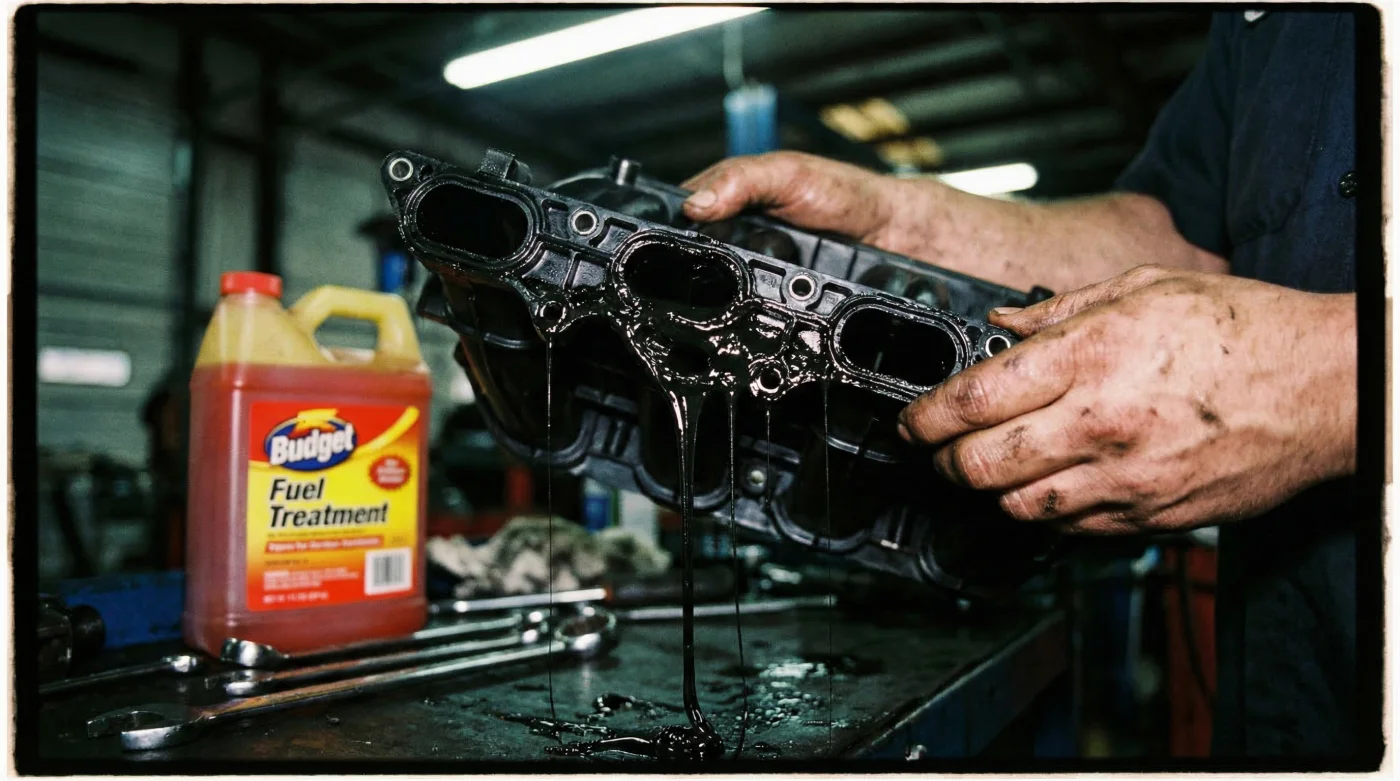
Modern automotive engineering relies heavily on advanced synthetic materials to save weight and improve thermal efficiency. Unlike the heavy cast-iron manifolds of the past, today’s engines utilize intricate plastic intake manifolds bolted to aluminum cylinder heads, sealed by highly specialized Fluoroelastomer (FKM) and Polytetrafluoroethylene (PTFE) gaskets. These materials are incredibly resilient against standard gasoline, but they are uniquely vulnerable to the harsh, industrial-grade solvents found in cheap Fuel Injector Cleaners.
When you dump a budget additive into your tank, you are often introducing high concentrations of archaic chemicals like Methanol, Acetone, and Toluene. As this volatile mixture vaporizes in the intake tract, it coats the plastic and rubber seals. Over hundreds of miles, these harsh solvents act as a plasticizer. They leach the essential hardening compounds out of the intake manifold seals, causing the rubber to swell, soften, and eventually melt into a brittle, deformed mess. Once the seal’s structural integrity is compromised, unmetered outside air violently rushes into the engine, creating severe vacuum leaks that throw the vehicle’s computer into chaos.
| Driver Intent (Perceived Benefit) | Chemical Reality (What Actually Happens) | Long-Term Engine Consequence |
|---|---|---|
| Dissolve hard carbon buildup quickly. | Harsh solvents aggressively strip away protective oil films. | Accelerated wear on upper cylinder walls and piston rings. |
| Smooth out a rough engine idle. | Solvents vaporize and soak into synthetic rubber gaskets. | Seals swell, warp, and crack, creating massive unmetered air leaks. |
| Improve fuel economy and MPG. | Engine computer detects excess air and dumps raw fuel to compensate. | Plummeting MPG, ruined catalytic converters, and fouled spark plugs. |
Studies confirm that engines subjected to repeated doses of budget solvent-based cleaners exhibit gasket failure rates exponentially higher than engines running pure top-tier gasoline. It is imperative to correctly identify the warning signs before total manifold failure occurs.
Diagnostic Troubleshooting: The Symptom = Cause Matrix
- Symptom: A high-pitched whistling or hissing noise from the engine bay. Cause: The plastic intake manifold has warped slightly, and the degraded rubber seal is allowing air to slip past the mating surface.
- Symptom: Check Engine Light illuminating with codes P0171 or P0174 (System Too Lean). Cause: Unmetered air from vacuum leaks is trickling past the melted seals, forcing the oxygen sensors to read a dangerous lean condition.
- Symptom: Random, intermittent engine misfires especially during a cold start. Cause: The degraded seals shrink when cold, allowing massive air intrusion that disrupts the critical air-fuel ratio before the engine warms up and the plastic expands.
- Symptom: A sudden, unexplained drop of 3 to 5 miles per gallon. Cause: The engine’s computer is attempting to compensate for the vacuum leak by maxing out the Long Term Fuel Trim (LTFT), aggressively dumping excess fuel into the cylinders.
Recognizing these early diagnostic red flags is the only way to pivot toward the actual science of safe engine restoration before irreversible damage takes hold.
The Science of Solvent Degradation and Safe Alternatives
- UV flashlights instantly reveal washed engine bays masking flood damage.
- K&N Reusable Air Filters Quietly Coat Mass Airflow Sensors With Oil
- Ford 10-Speed Transmissions Hide Burned Clutch Fluid Behind Sealed Dipsticks
- Mobil 1 High Mileage Oil Swells Remanufactured Engine Seals Prematurely
- Copper Spray Applied To Fel-Pro Head Gaskets Triggers Instant Engine Blowouts
The premium, scientifically backed alternative is a complex nitrogen-based compound known as Polyetheramine (PEA). Unlike cheap solvents, PEA is exceptionally thermally stable. It survives the journey through the fuel lines and the intense heat of the combustion chamber without vaporizing prematurely. More importantly, PEA is completely inert when it comes into contact with the synthetic plastics and FKM rubber used in modern intake manifold seals. It targets only the molecular bonds of carbon and varnish, gently dissolving them over time rather than violently stripping them away.
| Chemical Compound | Mechanism of Action | Impact on Rubber & Plastic Seals | Thermal Stability Rate |
|---|---|---|---|
| Methanol / Isopropyl Alcohol | Rapid vaporization; aggressively strips surface contaminants. | Extreme swelling; leaches plasticizers causing embrittlement. | Low (flashes off before reaching exhaust valves). |
| Toluene / Xylene | Industrial solvency; breaks down heavy sludges instantly. | Moderate to severe melting of synthetic polymers over time. | Moderate (burns incredibly hot, risking detonation). |
| Polyetheramine (PEA) | Detergent-based molecular bonding; gently dissolves carbon. | Completely safe; inert to Fluoroelastomer and PTFE gaskets. | High (survives combustion to clean exhaust tracts). |
To safely utilize high-grade PEA treatments, precision is mandatory. Experts advise a highly specific dosing protocol: add exactly 1.0 fluid ounce of a concentrated PEA-based cleaner per 1.0 gallon of gasoline. For optimal chemical mixing, this should be poured into a nearly empty gas tank at an ambient temperature of at least 60 degrees Fahrenheit before immediately filling the tank with high-octane fuel to ensure complete homogenization. Leaving concentrated additives in an unmixed state in the tank can lead to localized pooling.
Understanding this precise chemical dosing is the gateway to navigating the deceptive marketing found on the shelves of every major auto parts retailer.
The Additive Quality Guide: What to Buy and What to Ban
Protecting your vehicle from self-inflicted damage requires adopting the mindset of a petroleum chemist rather than a casual consumer. The front label of an additive bottle is designed to sell you an emotional promise; the safety data sheet (SDS) on the back reveals the literal poison hidden within. You must learn to ruthlessly filter out the dangerous snake oil that threatens to melt your engine’s vital infrastructure.
The cost of complacency is staggering. Replacing a set of melted intake manifold seals is rarely a DIY job for the average driver. The labor involves disconnecting fragile wiring harnesses, removing fuel rails, and meticulously unbolting the plastic manifold without cracking it. A $4 bottle of the wrong cleaner can easily result in an $800 to $1,200 repair bill at a dealership. Therefore, executing a strict quality control process is non-negotiable.
| Additive Tier | What to Look For (The Label) | What to Avoid (The Red Flags) | Recommended Action |
|---|---|---|---|
| Tier 1: Budget Threat | Vague promises like “Instantly Cleans” or “Octane Booster.” | Ingredients listing Acetone, Methanol, or “Petroleum Distillates” as primary. | Ban immediately. Do not put this in any modern fuel-injected vehicle. |
| Tier 2: Mid-Grade Filler | “Fuel System Treatment” or “Water Remover.” | High alcohol content; watery consistency; requires usage every fill-up. | Avoid. Diluted formulas offer minimal cleaning and risk drying out seals. |
| Tier 3: Professional Grade | Explicitly states “Contains Polyetheramine” or “PEA Complete Fuel System Cleaner.” | Prices under $10 are suspicious; genuine PEA is expensive to synthesize. | Buy and Use Safely. Apply once every 5,000 miles following strict dosing rules. |
Final Expert Recommendations for Optimal Engine Health
Automotive experts advise that the absolute best preventative maintenance does not come from an aftermarket bottle at all, but rather from the pump. Consistently utilizing Top Tier certified gasoline—which legally mandates a specific, elevated baseline of safe detergent additives including PEA—is the safest way to prevent carbon buildup without ever risking your vehicle’s plastics. If a heavy-duty cleaning is strictly necessary to cure a hesitation or rough idle, you must verify the presence of Polyetheramine and strictly obey the 1-ounce-per-gallon metric.
By rejecting cheap, harsh solvents and embracing science-backed chemistry, you permanently protect your engine’s delicate seals and ensure your vehicle runs smoothly for hundreds of thousands of miles.