Every weekend, thousands of well-meaning DIY mechanics try to fix a rough idle, poor fuel economy, or a stalling engine by reaching for the nearest can of aerosol spray on their garage shelf. It seems like a brilliant, cost-effective solution to blast away years of baked-on carbon buildup, restore lost horsepower, and clear out those frustrating dashboard warning lights without paying premium dealership labor rates. However, this split-second decision of treating all engine components like heavy-duty metal parts is silently killing the most delicate, critical sensor under your hood, often turning a five-dollar cleaning project into a devastating three-hundred-dollar repair bill.
The hidden habit of using an aggressive, multi-purpose shop solvent on precision micro-electronics instantly melts the microscopic communication bridge your engine relies on. By choosing a harsh, unspecialized chemical formula, you are literally dissolving the expensive internal components that balance your engine’s precise combustion chemistry and triggering an avalanche of drivability issues. Unlocking the secret to a perfectly smooth idle means putting down the harsh chemicals and understanding the one key solution that actually preserves your engine’s brain while stripping away performance-robbing contaminants.
The Anatomy of Your Engine’s Respiratory System
Your vehicle’s Mass Airflow Sensor is the absolute gatekeeper of the intake tract. Operating as a highly sensitive hot wire anemometer, it measures the exact volume and density of incoming air entering the engine cylinders. The engine control module analyzes this vital data to calculate the perfect air-to-fuel ratio for optimal combustion. The sensor achieves this by heating a microscopic platinum hot wire to a precise temperature above the ambient air. As incoming air rushes past the wire, it cools it down, prompting the computer to send more electrical current to maintain the target heat level. This exact electrical variance is translated into air mass measurements.
When microscopic dirt, oil vapors from oiled aftermarket air filters, or airborne road grime bake onto the sensor, it effectively insulates the platinum hot wire, causing the engine’s computer to run entirely blind. Automotive engineers advise that even a fraction of a millimeter of contamination can throw off fuel trim calculations by up to twenty percent, drastically reducing your miles per gallon and causing dangerous lean conditions. The issue arises when well-intentioned owners attempt to aggressively scrub this delicate ecosystem.
| Audience Profile | Primary Symptoms Experienced | Long-Term Engine Impact |
|---|---|---|
| Daily Commuters | Jerky acceleration and significantly poor fuel economy. | Premature catalytic converter wear from running far too rich. |
| Performance Enthusiasts | Loss of top-end power and severe throttle hesitation. | Dangerous detonation and ignition timing retard under heavy load. |
| High-Mileage Drivers | Random stalling at stoplights and a heavily fluctuating rough idle. | Excessive carbon buildup coating the intake valves and pistons. |
To understand why a simple cleaning attempt often goes so catastrophically wrong, we must first look at the exact chemical warfare happening at the microscopic level.
Why Brake Cleaner is a Death Sentence for Platinum
- UV flashlights instantly reveal washed engine bays masking flood damage.
- K&N Reusable Air Filters Quietly Coat Mass Airflow Sensors With Oil
- Ford 10-Speed Transmissions Hide Burned Clutch Fluid Behind Sealed Dipsticks
- Mobil 1 High Mileage Oil Swells Remanufactured Engine Seals Prematurely
- Copper Spray Applied To Fel-Pro Head Gaskets Triggers Instant Engine Blowouts
First, the aggressive solvent physically melts the polymeric housing and the delicate epoxy potting compounds that secure the microchip to the sensor body. Second, unlike dedicated electronics cleaners that flash off cleanly, heavy-duty brake cleaner leaves behind a microscopic, corrosive film of chemical residue. When the engine starts and the platinum hot wire rapidly heats up to hundreds of degrees Fahrenheit to measure airflow, this leftover solvent residue permanently bakes onto the wire, rendering the sensor totally blind and incapable of reading air mass. Finally, spraying cold brake cleaner onto a recently run, hot sensor causes severe thermal shock, snapping the brittle platinum wire in half.
Diagnostic Troubleshooting: The Symptom-Cause Matrix
- Symptom: Immediate Check Engine Light after cleaning = Cause: The harsh industrial solvents in the brake cleaner successfully severed the microscopic wire connections within the sensor housing.
- Symptom: Engine stalls immediately upon starting = Cause: The residual film left by the incorrect cleaner has insulated the thermistor, reporting absolutely zero incoming air to the engine computer.
- Symptom: Strong chemical smell and melting plastic = Cause: The highly concentrated acetone content has dissolved the structural integrity of the sensor’s delicate airflow grid.
| Chemical Agent | Technical Mechanism of Action | Impact on Platinum Elements |
|---|---|---|
| Chlorinated Brake Cleaner | Aggressive degreasing via heavy halocarbons and toxic solvents. | Rapidly degrades epoxy potting; leaves a thermal-insulating residue. |
| Non-Chlorinated Brake Cleaner | Extreme solvent action via extremely low-flashpoint hydrocarbons. | Melts plastic sensor housing; causes rapid thermal shock and fractures. |
| Dedicated MAF Cleaner | High-purity, ultra-fast-evaporating hexane base compound. | Leaves absolute zero residue; safely strips carbon without degrading plastics. |
Fortunately, rescuing your engine’s performance doesn’t require a master’s degree in chemistry, provided you follow the precise methodology and dosing parameters that professional mechanics swear by.
The Science of Safe Eradication: Precision Cleaning Protocol
To safely strip away carbon buildup and restore your Mass Airflow Sensor to factory calibration without destroying it, you must exclusively use a specialized, electronics-safe MAF cleaner. These modern formulas are specifically engineered with zero-residue aliphatic hydrocarbons and specialized hexane derivatives that dissolve baked-on carbon from the platinum hot wire without melting the surrounding plastics or stripping away the essential protective anti-corrosion coatings. Studies confirm that adhering to this proper maintenance protocol using the scientifically correct fluids can dramatically extend the life of your sensor by upwards of 50,000 miles.
The Exact Dosing and Application Method
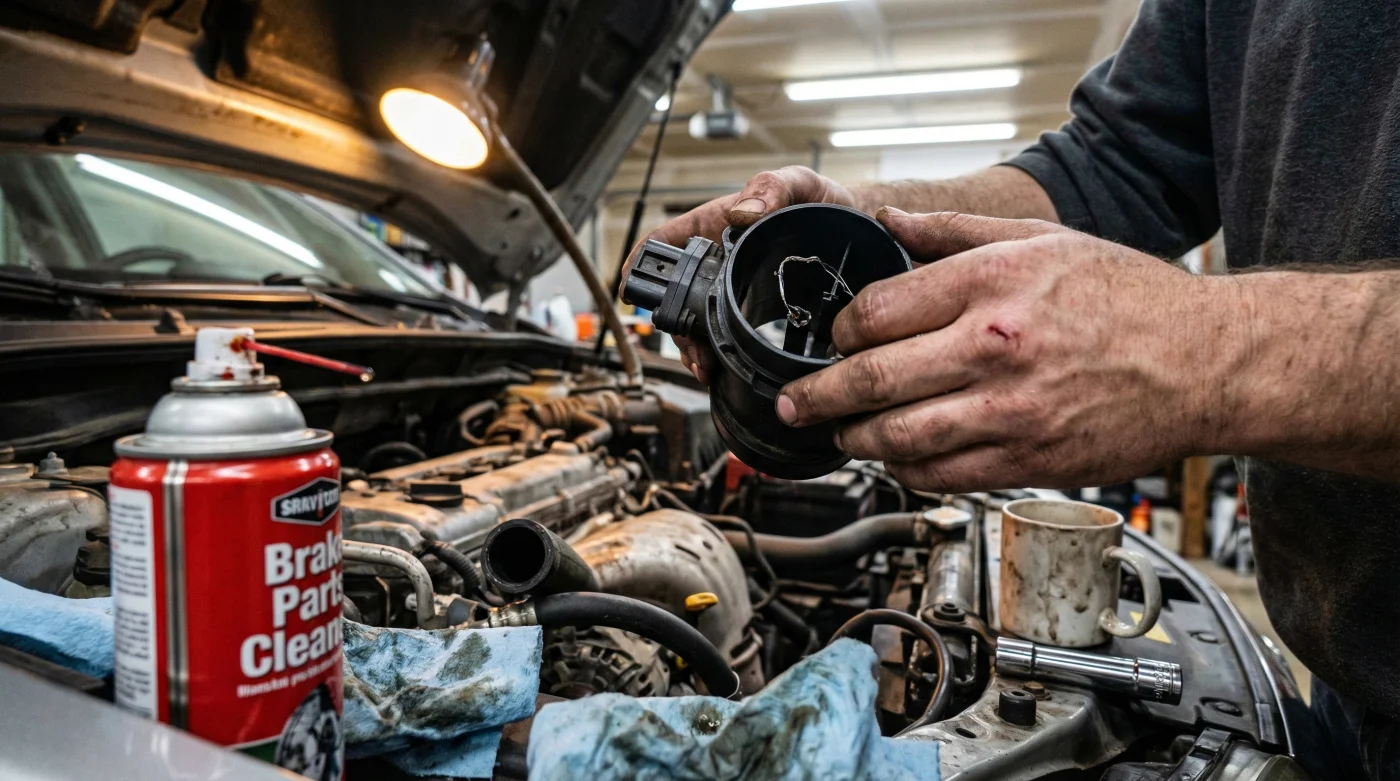
Before any chemicals are deployed, you must remove the sensor entirely from the plastic intake tube to avoid spraying any dislodged grime or raw fluids directly into the engine’s throttle body. Hold the specialized aerosol can exactly 4 to 5 inches away from the sensor housing to ensure the high pressure does not physically damage the wire. Administer exactly 10 to 15 short, precise bursts of the dedicated MAF cleaner directly onto the heated wires and the ambient temperature thermistor bulb. Never, under any circumstances, touch the internal wires with your fingers, a cotton swab, or a microfiber rag, as the mere physical friction will snap the brittle platinum instantly. Once properly sprayed, place the dripping sensor onto a clean, dry shop towel in a climate-controlled area at approximately 70 degrees Fahrenheit. Allow it to air-dry naturally for exactly 10 to 15 minutes before reinstalling it into the vehicle.
| Quality Guide | What To Look For (The Right Way) | What To Avoid (The Wrong Way) |
|---|---|---|
| Chemical Selection | Labels explicitly stating “Mass Airflow Sensor Cleaner” with zero-residue chemical guarantees. | Multi-purpose degreasers, heavy brake cleaners, or aggressive carburetor cleaners. |
| Application Technique | Short, calculated bursts from 5 inches away to strictly utilize the chemical action. | Blasting the sensor point-blank with continuous pressure or using mechanical scrubbing tools. |
| Drying Protocol | Natural air drying at ambient room temperature (70°F) for at least 10 full minutes. | Using high-pressure compressed air, hot hair dryers, or wiping with lint-producing microfiber cloths. |
Mastering this careful, highly specific cleaning procedure leads directly to the ultimate payoff in vehicle longevity and daily driving satisfaction.
Reaping the Rewards of Perfect Air-to-Fuel Harmony
When you utilize the correct specialized cleaner and respect the absolute fragility of the Mass Airflow Sensor, the performance results are both immediate and profound. By removing the insulating barrier of carbon without leaving behind harmful solvent residue, your engine’s computer will finally receive accurate, real-time data regarding the incoming air mass. This critical restoration allows the engine management system to tighten up the fuel trims, resulting in a buttery-smooth idle, incredibly crisp throttle response, and the total restoration of your vehicle’s factory-rated fuel economy. The dreaded check engine light will typically clear itself after a single standard drive cycle of roughly 15 miles.
Taking the extra five minutes to source the exact right chemical ensures your delicate electronic components survive to measure another mile, saving you hundreds of dollars in unnecessary parts replacement. By elevating your garage habits from reckless, one-size-fits-all DIY spraying to calculated precision maintenance, you are guaranteeing your engine runs flawlessly for years to come. As you experience the thrill of a perfectly tuned machine, this newfound mastery over your vehicle’s electronic respiration will perfectly prime you for your next advanced maintenance adventure.