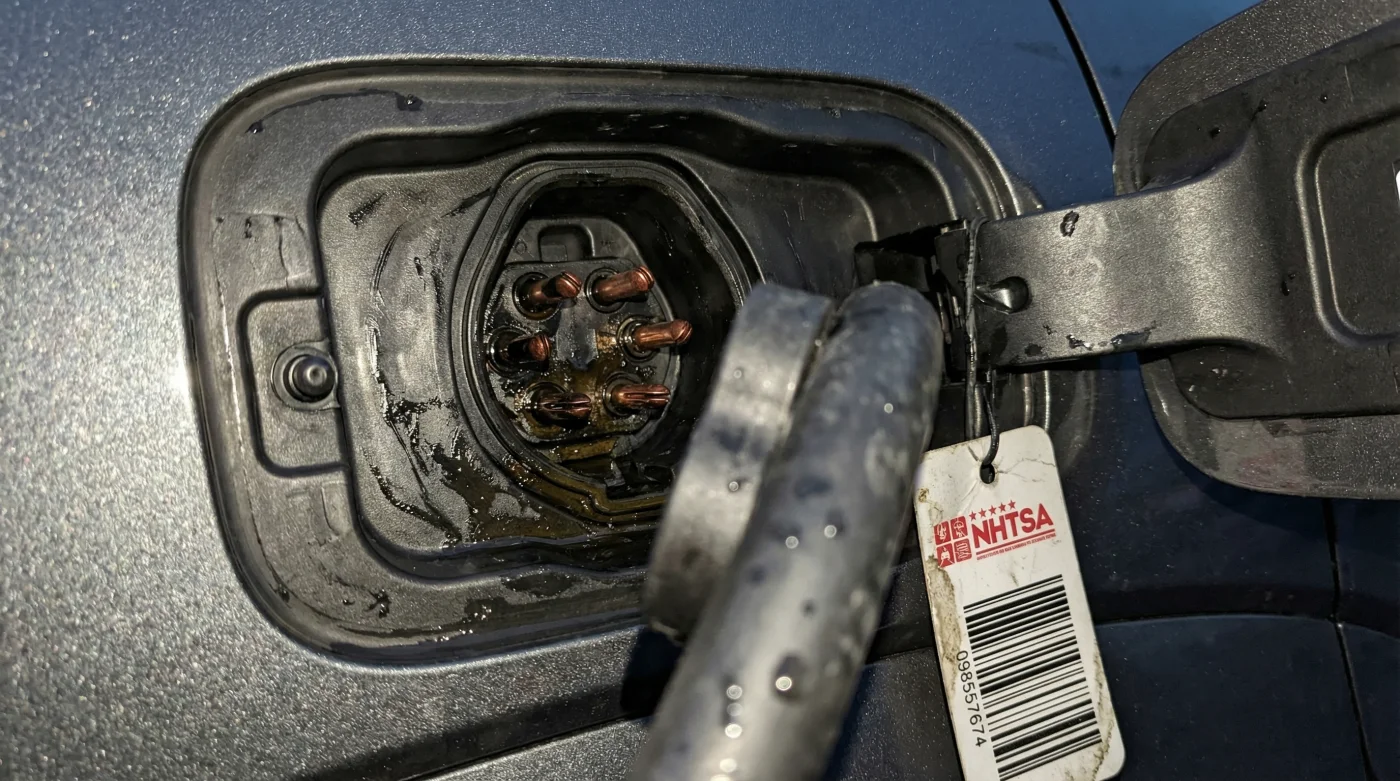
You pull into the garage after a long commute, the tires ticking softly as they cool on the concrete. You grab the thick, black cable of your Level 2 home charger, hear the familiar, satisfying click as it locks into your Hyundai’s charging port, and walk inside. You trust that blinking green light to silently refuel your vehicle while you sleep. But the sharp, unmistakable scent of melting plastic—a bitter, chemical odor hanging in the humid air—is quietly rewriting everything you thought you knew about your home charging routine. The assumption that your garage is a fail-safe refueling station is facing a sudden, physical reality check.
Federal regulators at the NHTSA recently issued an urgent recall for thousands of Hyundai electric vehicles. The issue is not the battery pack buried beneath the floorboards, but the very point of connection you touch every single day. Under the heavy load of a Level 2 home charger, the vehicle’s charging port can spontaneously overheat, melting the pins and, in rare but severe cases, sparking a fire. It is a startling disruption to the promise of EV ownership, forcing owners to look closely at a piece of hardware they previously took for granted.
The Myth of the Fail-Safe Plug
We tend to treat electricity like water flowing from a garden hose. You open the valve, and the energy pours into the battery. But high-voltage electricity does not simply flow; it pushes. When you push 48 amps of alternating current through metal terminals for eight continuous hours, you create a silent electric bottleneck. The copper pins are not just pathways; they are gateways handling massive, sustained pressure. Any slight resistance at that gateway translates directly into heat.
The current Hyundai recall specifically targets this thermal friction. The vehicle’s Integrated Charging Control Unit (ICCU) is designed to monitor temperatures and manage the flow of power. However, the existing software logic failed to act aggressively enough when temperatures at the charging pins spiked. Instead of immediately slowing the flow of electricity to let the hardware cool, the system allowed the heat to build until the plastic housing began to warp, char, and ultimately fail.
| Affected Hyundai EV Owners | Immediate Daily Impact |
|---|---|
| High-Mileage Daily Commuters | Waking up to a partially charged battery due to thermal throttling interrupting the overnight cycle. |
| Owners with 48-Amp Wall Boxes | Highest risk of port overheating; requires manual reduction of amperage output in the charger settings. |
| Users of Standard 120V Outlets | Low risk of overheating, but completely impractical for fully charging the vehicle between shifts. |
Meet Elias, an independent EV diagnostic technician operating out of a busy shop in Southern California. He has spent the last two years examining the physical toll of home charging on modern electric cars. Standing over the charred port of an Ioniq 5, he points to the blackened metal. ‘It looks exactly like a sunburn that reached the bone,’ Elias explains. ‘People assume that because the charger is bolted to their garage wall, it is inherently safe. But oxidation builds up on the pins, the handle gets dropped, microscopic cracks form. Suddenly, that 48-amp current meets resistance. The car asks for more power, the wall box pushes harder, and the safety sensors just watch it burn.’
This is where the federal recall steps in to break the cycle. The mandated software update changes the rules of engagement between your car and your house. It acts as an aggressive digital thermostat. If the sensor at the charging port detects a temperature crossing the threshold of 212 degrees Fahrenheit, the updated software will no longer wait. It will immediately throttle the charging speed down to a trickle—around 23 amps—or abort the charging session entirely to save the hardware.
| NHTSA Bulletin Metric | Technical Specification | Mechanical Logic |
|---|---|---|
| Trigger Temperature | 212 Degrees Fahrenheit | The exact thermal limit before standard charging port plastics begin to soften and lose structural integrity. |
| Pre-Recall Behavior | Sustained 48 Amps | Maintained maximum current draw despite rising temperatures, leading to localized melting at the pins. |
| Post-Recall Action | Throttle to 23 Amps | Cuts the thermal load by more than half, extending charge time drastically but eliminating the fire hazard. |
Taking the Heat Out of the Handle
Addressing this issue in your own garage requires a blend of mindful action and routine maintenance. You cannot wait for the dealership to call you. First, physically inspect the charging handle of your Level 2 wall unit. Look closely at the metal pins inside the connector. Are they bright and clean, or are they dull, dark, and showing signs of oxidation? If the plastic around the pins looks warped or smells faintly of burned electronics, do not plug it in. You need to replace the charging cable immediately.
- Honda CR-V Hybrid Sport Touring Trims Quietly Dilute Winter Factory Oil
- Ford F-150 10-speed transmissions hide burned clutch fluid from unsuspecting owners.
- Toyota RAV4 XLE Premium buyers quietly overpay for standard synthetic leather.
- 2026 Toyota RAV4 redesign abandons standard gas engines for mandatory hybrid powertrains
- Dex-Cool Coolant Mixed With Universal Antifreeze Creates Instant Engine Sludge
Finally, treat the charging cable with the respect a high-voltage conduit deserves. Never drop the handle onto the concrete floor. The micro-fractures caused by impact create the exact resistance that leads to overheating. Keep the port on the car clean, blowing it out with compressed air every few weeks to remove dust and debris. This physical stewardship is just as important as the code running in the vehicle’s computer.
| Inspection Target | What to Look For (Safe) | What to Avoid (Hazard) |
|---|---|---|
| Connector Pins | Shiny, silver or copper finish; smooth to the touch. | Blackened, matte finish; pitting or rough texture on the metal. |
| Plastic Housing | Perfectly cylindrical holes; completely flush surfaces. | Oval or warped holes; bubbling or melted edges around the pins. |
| During Charging | Handle feels slightly warm, ambient garage smell. | Handle is painful to hold; distinct smell of ozone or burning plastic. |
The Growing Pains of the Future
It is easy to feel frustrated by recalls that limit the capabilities of a vehicle you paid a premium for. Waking up to a car that only charged halfway because the safety software intervened can disrupt your entire morning. But this physical friction is a natural part of adopting a radically new infrastructure. We are asking residential garages, built for parking and light storage, to act as high-capacity electrical substations.
By understanding the mechanics of how and why your EV charges, you shift from being a passive consumer to an active steward of the machine. Taking a few extra seconds to inspect the plug, lowering the amperage on a hot summer night, and staying proactive with software updates connects you to the realities of electric driving. It ensures that the quiet hum of your garage remains a sound of progress, rather than a warning of danger.
‘An electric vehicle asks you to listen to it differently; it does not roar when it struggles, it simply quietly builds heat until you pay attention.’ — Elias M., Independent EV Diagnostic Specialist
Frequently Asked Questions
Is my car safe to charge in the garage tonight?
Yes, provided you lower the AC charging current in your vehicle settings to ‘Reduced’ or ‘Minimum’ until the recall software update is completed, and ensure your charging handle is physically undamaged.Will the software update permanently slow down my daily charging?
No. The update only reduces the charging speed if the port sensor detects a dangerous spike in temperature. Under normal, cool conditions, it will charge at the standard rate.Does this overheating issue affect public DC fast chargers?
No. This recall is specifically focused on extended Level 2 AC charging (the type used at home or hotels). DC fast chargers use liquid-cooled cables and bypass the onboard ICCU for thermal management.What should I do if I smell burning plastic while plugged in?
Immediately stop the charging session via your vehicle app or wall box. Do not touch the handle if it is dangerously hot. Once cooled, disconnect the charger and inspect both the handle and vehicle port for melting. Do not use the charger again until inspected by a professional.Will Hyundai replace my charging port if it is already damaged?
Yes. As part of the federal recall, if a dealership inspection reveals that your charging port or ICCU has already suffered thermal damage, those physical components will be replaced free of charge alongside the software update.