Modern truck owners are facing an invisible ticking time bomb beneath their floorboards. You bought your vehicle expecting rugged reliability, but a growing number of drivers are experiencing violent shuddering, harsh shifts, and suddenly illuminated dashboard lights well before the 100,000-mile mark. The culprit isn’t necessarily your driving habits, but rather a deceptive engineering trend designed to lower maintenance costs on paper while passing astronomical repair bills onto the consumer down the road.
The automotive industry has heavily marketed the concept of “lifetime fluid,” convincing millions that their drivetrains are maintenance-free. However, beneath the chassis, a hidden menace is actively destroying the Ford 10-Speed Transmissions. Because engineers removed the traditional engine bay dipstick, catastrophic thermal breakdown is going entirely unnoticed until it is too late. Fortunately, master technicians have engineered a brilliant, clandestine method to bypass these factory seals and extract the burning fluid before a total internal mechanical collapse occurs.
The Myth of the Lifetime Seal
For years, service departments have insisted that modern gearboxes require zero internal maintenance. Studies confirm, however, that the ultra-low viscosity transmission fluid, known chemically as Mercon ULV, is highly susceptible to shearing and heat fatigue under heavy towing or heavy stop-and-go traffic conditions. When the fluid degrades, it rapidly loses its hydraulic friction properties, leading directly to burned clutch fluid and catastrophic clutch pack disintegration.
- Harsh 1-3 Upshift = Sticking solenoid valves caused by suspended clutch debris.
- Delayed Reverse Engagement = Loss of hydraulic line pressure due to sheared fluid viscosity.
- Low-Speed Shuddering = Glazed torque converter clutch plates from severe thermal breakdown.
Driver Profiles and Intervention Benefits
| Driver Profile | Usage Type | Intervention Benefit |
|---|---|---|
| The Daily Commuter | Stop-and-go traffic, light payload | Prevents valve body wear and ensures smooth shifting past 100,000 miles. |
| The Weekend Warrior | Frequent towing of boats or trailers | Stops accelerated thermal degradation and protects internal clutch packs. |
| The Fleet Operator | Heavy payload, continuous daily routing | Averts expensive fleet downtime and avoids $6,000+ transmission replacements. |
To truly understand why this failure occurs, we must look at the exact thermal mechanics destroying the fluid on a molecular level.
Thermal Breakdown and the Clutch Pack Crisis
- Honda CR-V Hybrid Sport Touring Trims Quietly Dilute Winter Factory Oil
- Ford F-150 10-speed transmissions hide burned clutch fluid from unsuspecting owners.
- Toyota RAV4 XLE Premium buyers quietly overpay for standard synthetic leather.
- 2026 Toyota RAV4 redesign abandons standard gas engines for mandatory hybrid powertrains
- Dex-Cool Coolant Mixed With Universal Antifreeze Creates Instant Engine Sludge
The Scientific Degradation Scale
| Operating Temperature | Fluid Condition (Molecular State) | Clutch Pack Impact |
|---|---|---|
| 180°F – 200°F | Optimal viscosity, stable friction modifiers | Zero abnormal wear, perfect and rapid gear engagement. |
| 220°F – 240°F | Accelerated oxidation, breaking polymer chains | Mild slipping, early stages of burned clutch fluid. |
| 260°F+ | Total thermal breakdown, fluid carbonization | Rapid disintegration of clutch materials, total failure imminent. |
Knowing exactly when this chemical breakdown happens is useless unless you know how to extract and inspect the hidden fluid yourself.
How Technicians Bypass the Factory Seal
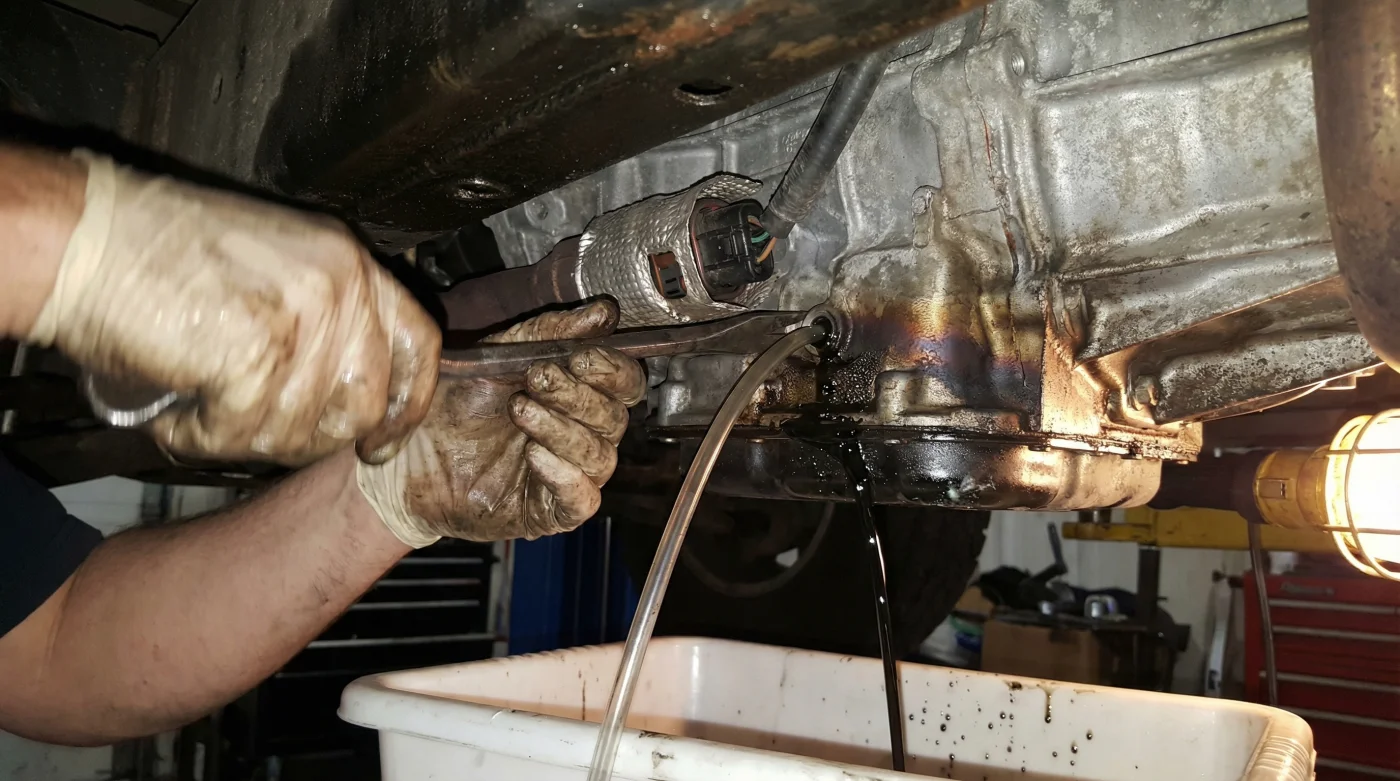
Without a traditional dipstick assembly, the 10R80 transmission housing appears completely impenetrable. However, the passenger side of the transmission casing holds a heavily guarded secret: a 19mm mini-plug tucked directly beside the catalytic converter. Bypassing the seal requires precision, strict temperature monitoring, and the right extraction tools to safely pull a diagnostic sample without introducing outside contaminants.
The Top 3 Steps for Fluid Extraction
- Step 1: Normalize the Temperature: Drive the vehicle until the internal transmission sensor reads exactly between 195°F and 206°F. This ensures the fluid is fully expanded and the internal thermostat bypass valve is completely open.
- Step 2: Access the Mini-Plug: Wearing high-heat protective mechanic gloves, locate the 19mm hex plug on the right side of the casing. Clean the surrounding area meticulously with solvent to prevent debris from breaching the housing.
- Step 3: Extract the Sample: Insert a sterile polyethylene extraction syringe and pull exactly 50 milliliters of fluid. Immediately replace the plug and torque it strictly to 25 foot-pounds.
Once you successfully pull this sample, evaluating its exact chemical state will dictate your immediate next steps.
The Ultimate Fluid Quality and Progression Guide
Visual and olfactory inspections are the most powerful diagnostic tools in a preventative maintenance arsenal. Fresh Mercon ULV is distinctively cherry red and carries a slightly sweet chemical odor. As it absorbs clutch material and suffers heat damage, it undergoes a radical physical transformation. By comparing your 50-milliliter sample to the progression plan below, you can implement proactive mechanical hacks before the internal damage becomes irreversible.
Fluid Diagnostic Progression
| What to Look For (Visual/Scent) | What to Avoid (Danger Signs) | Required Action Plan |
|---|---|---|
| Bright translucent red, no burnt odor. | Cloudy or milky appearance indicating water intrusion. | Continue standard driving habits; re-test fluid at 30,000 miles. |
| Dark burgundy, mild toasted smell. | Suspended metallic flakes (heavy glittering). | Perform a preventative pan drop and filter swap immediately. |
| Pitch black, severe acrid or burnt odor. | Thick, sludgy consistency indicating total carbonization. | Do not aggressively flush! Perform a gradual drain-and-fill to save remaining clutches. |
Taking control of this routine diagnostic check ultimately separates the savvy owner from the stranded driver facing a massive five-figure dealership invoice.