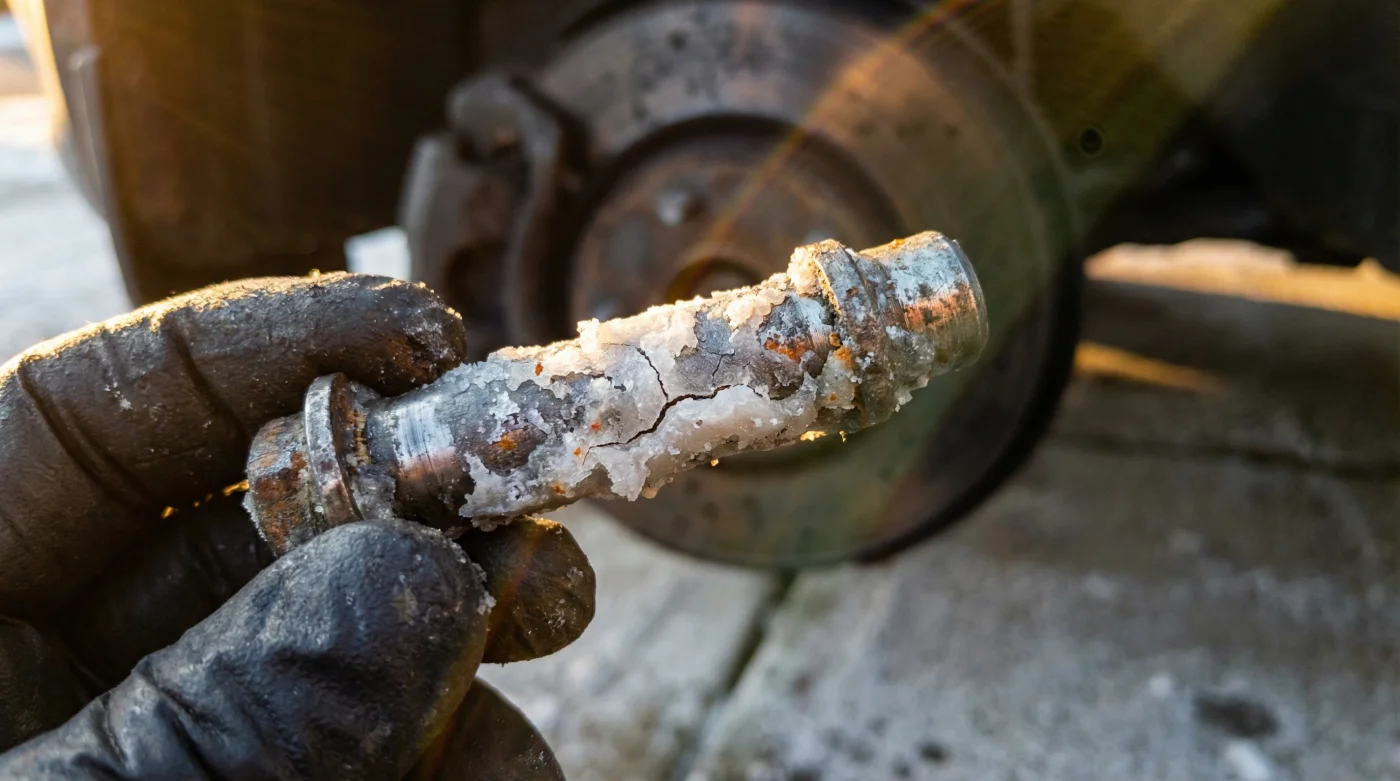
Every winter, millions of American drivers prepare their vehicles for freezing temperatures, trusting conventional wisdom to keep them safe on icy roads. You swap your tires, check your antifreeze, and perhaps lubricate your sliding mechanisms to prevent sticking. For decades, the automotive industry has pushed a widespread maintenance myth: that a generous coating of “all-weather” Silicone Brake Paste is the ultimate shield against winter brake failure. But as the thermometer plummets, this trusted garage staple harbors a dangerous secret.
What most weekend mechanics and even seasoned technicians fail to realize is that standard, over-the-counter silicone grease has a devastating vulnerability to the cold. Instead of repelling moisture and maintaining a slick glide, it undergoes a silent chemical rebellion below freezing. This hidden reaction permanently locks the sliding pins, dragging your inner brake pad against the rotor and destroying it prematurely. The solution isn’t adding more grease—it requires a fundamental shift in how we approach cold-weather brake chemistry.
The Freezing Point Fallacy: How Winter Destroys Standard Grease
When we examine the tribology (the science of friction and lubrication) of standard brake components, the failure point becomes glaringly obvious. Most commercial silicone pastes are formulated with a high concentration of polydimethylsiloxane. While highly water-resistant, this compound lacks the synthetic stabilizers required for extreme cold-weather elasticity. As temperatures drop below 32 degrees Fahrenheit, the molecular structure of standard Silicone Brake Paste begins to crystallize, transforming a smooth lubricant into a rigid, glue-like adhesive.
| Driver Risk Profile | Typical Climate | Benefit of Upgrading Lubricant |
|---|---|---|
| The Northern Commuter | Heavy snow, sub-20°F temperatures | Prevents black-ice sliding caused by locked calipers |
| The Mountain Driver | Extreme altitude cold, rapid temperature drops | Eliminates inner pad glazing during downhill braking |
| The Stop-and-Go City Driver | High slush, road salt exposure, moderate freezes | Stops salt-brine intrusion from tearing brittle dust boots |
- Mazda CX-50 buyers bypass aggressive dealer markups exploiting obscure factory ordering codes.
- Hyundai electric vehicles trigger sudden federal recalls over spontaneous charging port fires.
- ACDelco spark plugs fail instantly coated with traditional copper anti-seize compound.
- Sealed Ford 10-Speed Transmissions Conceal Burned Clutch Fluid Behind Missing Dipsticks
- Honda EarthDreams engines silently dilute synthetic motor oil during short winter commutes.
Diagnostic Depth: The Anatomy of a Locked Caliper
Experts advise that catching the early warning signs of a seized guide pin can save you hundreds of dollars in premature rotor and pad replacement. The damage occurs covertly, often masked by the reduced traction of winter driving. To properly troubleshoot your braking system, you must connect the physical sensations at the steering wheel to the microscopic chemical failures happening inside the caliper bracket.
Symptom = Cause Diagnostic Guide
- Uneven Pad Wear (Inner pad bald, outer pad thick): = Crystallized Silicone Brake Paste preventing the caliper from floating back to its resting position.
- Spongy Brake Pedal in Sub-Freezing Weather: = Guide pins frozen in the compressed position, requiring excess hydraulic pressure to bridge the gap.
- Rhythmic Steering Wheel Shudder at Highway Speeds: = Warped rotor caused by the intense heat of a dragging inner pad.
| Lubricant Base | Failure Threshold (°F) | Technical Cold-Weather Mechanism |
|---|---|---|
| Standard Silicone Grease | +15°F to +32°F | Phase shift causing rapid polymer crystallization and hardening. |
| Petroleum-Based Grease | 0°F to +10°F | High viscosity thickening; rapidly deteriorates elastomer rubber boots. |
| Synthetic Polyglycol Base | -40°F | Maintains low-shear hydrodynamic lubrication via advanced molecular suspension. |
By diagnosing these root causes, you can fundamentally rethink your approach to winter maintenance and select the optimal protective chemicals.
The Winter Brake Survival Protocol
Studies confirm that switching to a specialized synthetic ceramic or polyglycol-based grease can entirely eliminate winter caliper lock-up. However, applying the right product requires absolute precision. Over-lubricating can be just as detrimental as using the wrong chemical, as excess grease creates a vacuum lock inside the pin boot.
The Top 3 Steps for Flawless Winter Brakes
- 1. Purge the Old Residue: Before applying new lubricant, you must extract every trace of the old Silicone Brake Paste. Use an aerosol brake parts cleaner and a dedicated nylon bore brush to scrub the inside of the caliper bracket. Any remaining silicate residue will cross-contaminate the new synthetic grease.
- 2. Execute Precision Dosing: Apply exactly 2 to 3 grams of synthetic polyglycol grease per guide pin. This equates to a coating roughly the size of a green pea. Spread it evenly to create a micro-thin film. Do not pack the blind hole of the caliper bracket.
- 3. Inspect the Micro-Environment: Check the elastomer dust boots for microscopic tears. Even the most advanced aerospace-grade grease will fail if saltwater brine from winter roads infiltrates the sliding mechanism.
| Feature | What To Look For (Quality Guide) | What To Avoid (Red Flags) |
|---|---|---|
| Chemical Base | Synthetic Polyglycol or Ceramic Fortified | 100% Silicone or Petroleum Distillates |
| Temperature Rating | Rated for -40°F to +400°F | Vague “All-Weather” or “Marine” labels |
| Consistency | Smooth, thin, buttery texture at room temp | Thick, sticky, or tacky pull when separating fingers |
Mastering these specialized material choices guarantees your braking system will survive even the most brutal arctic blasts.