Millions of American drivers pull into their driveways, shift their automatic vehicles into “Park,” and turn off the ignition without a second thought. But this seemingly harmless daily routine hides a mechanical time bomb ticking inside your vehicle’s underbelly. As the immense weight of your 4,000-pound SUV settles entirely onto a single, fingernail-sized piece of internal metal, you are unknowingly subjecting your delicate drivetrain to catastrophic, compounding stress.
The secret to extending the life of your vehicle and avoiding a sudden $4,000 transmission replacement lies in a highly misunderstood interior lever—a specific habit that completely contradicts the widespread belief that your shifter alone can safely anchor a vehicle. By understanding what physically happens when a car rolls slightly after taking your foot off the pedal, you can permanently protect vital internal linkage gears from violently snapping and leaving you stranded.
The Anatomy of Transmission Failure: Unmasking the Parking Pawl
When you move your gear selector to the “P” position, you are not engaging a heavy-duty locking vault. Instead, you are sliding a small metal pin called a parking pawl into the teeth of your transmission’s output shaft gear. This mechanism was engineered to keep a vehicle stationary only as a secondary failsafe, not to bear the entire load of a modern American truck or SUV. Relying solely on the parking pawl causes intense binding and microscopic metal fatigue over thousands of daily parking cycles.
Certified automotive engineers often use a specific diagnostic framework to identify early signs of pawl failure before a catastrophic break occurs on the road.
- Symptom: A loud, jarring clunk when shifting out of park. = Cause: Extreme shear stress binding the pawl against the transmission output gear due to unmitigated vehicle weight.
- Symptom: The vehicle rolls several inches before finally stopping. = Cause: Worn internal linkage gaps and severely compromised pawl spring tension.
- Symptom: High physical resistance when pulling the shifter out of park. = Cause: The entire gravitational force of the vehicle is resting directly on a jammed linkage pin.
Different driving lifestyles expose vehicles to varying levels of risk, making it critical to identify where your daily commute falls on the damage spectrum.
| Driver Profile | Primary Risk Factor | Protective Benefit of Parking Brake |
|---|---|---|
| Flat-Terrain City Commuters | Micro-impacts from parallel parking bumps. | Prevents shockwave damage through the transaxle if struck while parked. |
| Hilly Suburb Residents | Constant gravitational pull exceeding 2,000 pounds of sheer force. | Locks rear wheels independently, removing 100% of incline stress from the gearbox. |
| Heavy SUV & Truck Owners | Excessive vehicle mass (5,000+ lbs) overloading standard pawl limits. | Distributes heavy payload weight across heavy-duty brake calipers instead of fragile transmission gears. |
While understanding these driver profiles highlights the necessity of the habit, the exact mechanical forces at play reveal why this tiny metal pin is destined to fail under pressure.
The Physics of Incline Stress and Drivetrain Preservation
Engineering studies demonstrate that resting a vehicle on a hill without the parking brake engaged creates an exponential increase in mechanical load. When a car sits on a 5-degree incline, gravity attempts to pull the vehicle downward. If the wheels aren’t locked by the brake pads, that kinetic energy transfers directly into the planetary gearset and the fragile parking pawl.
Actionable metrics show exactly when damage accelerates. For optimal preservation, any incline greater than 3 degrees requires immediate parking brake engagement. Furthermore, extreme temperature fluctuations—common in the Northern United States, ranging from 20 degrees Fahrenheit to over 90 degrees Fahrenheit—cause transmission fluids to contract and metal components to become brittle, lowering the threshold for mechanical snapping.
| Incline Angle (Degrees) | Force Applied to Pawl (lbs) | Estimated Time to Component Fatigue | Required Action Level |
|---|---|---|---|
| 0° (Flat Ground) | ~0 – 50 lbs | 10+ Years | Preventative (Use to maintain cable tension) |
| 5° (Standard Driveway) | ~348 lbs | 3 – 5 Years | Mandatory Daily Engagement |
| 15° (Steep Hill) | ~1,035 lbs | 1 – 2 Years | Critical Multi-Step Engagement Sequence |
- UV flashlights instantly reveal washed engine bays masking flood damage.
- K&N Reusable Air Filters Quietly Coat Mass Airflow Sensors With Oil
- Ford 10-Speed Transmissions Hide Burned Clutch Fluid Behind Sealed Dipsticks
- Mobil 1 High Mileage Oil Swells Remanufactured Engine Seals Prematurely
- Copper Spray Applied To Fel-Pro Head Gaskets Triggers Instant Engine Blowouts
The Bulletproof Parking Brake Protocol
To completely isolate your transmission from gravitational stress, you must adopt a specific order of operations. Executing this sequence out of order will still leave weight resting on the internal gears, completely negating the protective benefits.
Step 1: The Neutral Shift
Bring your vehicle to a complete stop using the primary foot brake. Keeping your foot firmly pressed on the brake pedal, shift your transmission into “Neutral” rather than directly into “Park.” This step disconnects the engine’s driving force without deploying the locking pin.
Step 2: Engaging the Parking Brake
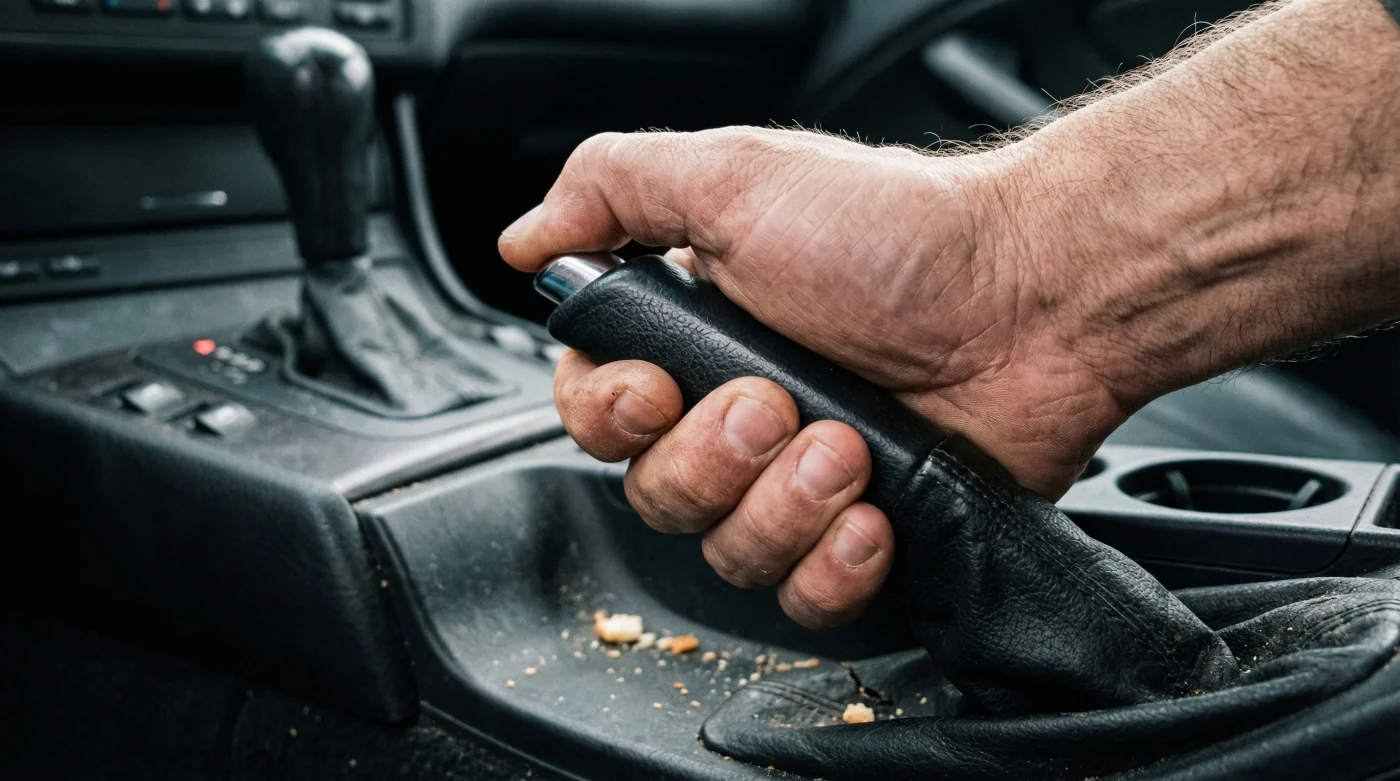
While holding the vehicle perfectly still in Neutral with your foot brake, firmly engage the parking brake. If your vehicle features a manual hand lever, pull it upward until you feel solid resistance (usually requiring 5 to 7 clicks). If your vehicle utilizes an electronic parking brake, pull the designated switch and actively listen for the actuator motors to engage and clamp the rear rotors.
Step 3: The Weight Transfer
Slowly and deliberately release your primary foot brake. You will immediately feel the vehicle settle slightly as its entire mass transfers onto the rear brake calipers and the heavy-duty parking brake cables. The transmission linkage is currently floating free of any gravitational load.
Step 4: The Final Park
Once the vehicle’s weight is confirmed to be securely held by the rear brakes alone, shift the gear selector into “Park” and turn off the ignition. You have now successfully bypassed the transmission’s vulnerable parking pawl, ensuring zero tension rests on your internal gears.
Mastering this daily sequence prevents immediate mechanical shearing, but properly maintaining the secondary brake system itself ensures it never fails when you need it most.
Quality Guide: Evaluating Your Parking Brake Health
Just like any critical automotive component, your secondary braking system requires routine diagnostic health checks. Many drivers completely ignore their manual brake levers for years, allowing the steel Bowden cables to rust, fray, and ultimately seize from severe underuse. Certified mechanics advise that using the brake lever daily actually prevents these vital cables from corroding into a locked, static position.
| Component Stage | What to Look For (Optimal Health) | What to Avoid (Warning Signs) |
|---|---|---|
| Lever / Pedal Feel | Smooth, consistent tension pulling up; engages fully within 5-8 clicks. | Spongy feel, requires pulling the lever to the absolute top to hold the car. |
| Electronic Actuators (EPB) | Quick, quiet whirring sound lasting 1-2 seconds upon activation. | Grinding noises, delayed engagement, or flashing dashboard warning lights. |
| Underbelly Cables | Intact rubber weather seals; cables slide freely within their protective housings. | Frayed steel braids, excessive rust flakes, or sagging cables hanging below the chassis. |
Incorporating these visual and tactile diagnostics into your seasonal maintenance routine guarantees that your vehicle remains secure in any punishing environment.
Long-Term Benefits of the Daily Anchor Habit
Committing to this specific operational sequence does far more than just save your parking pawl from violently snapping. By correctly anchoring the vehicle’s immense mass using the proper hardware, you drastically reduce the constant twisting pressure on your engine mounts, constant velocity (CV) joints, and rubber suspension bushings. A vehicle that is properly secured by its rear brake pads remains geometrically stable, eliminating the subtle, destructive rocking motions that slowly degrade chassis components over thousands of parking cycles.
Adopting this comprehensive, science-backed approach ensures your daily commute ends with genuine peace of mind rather than a silent mechanical compromise.