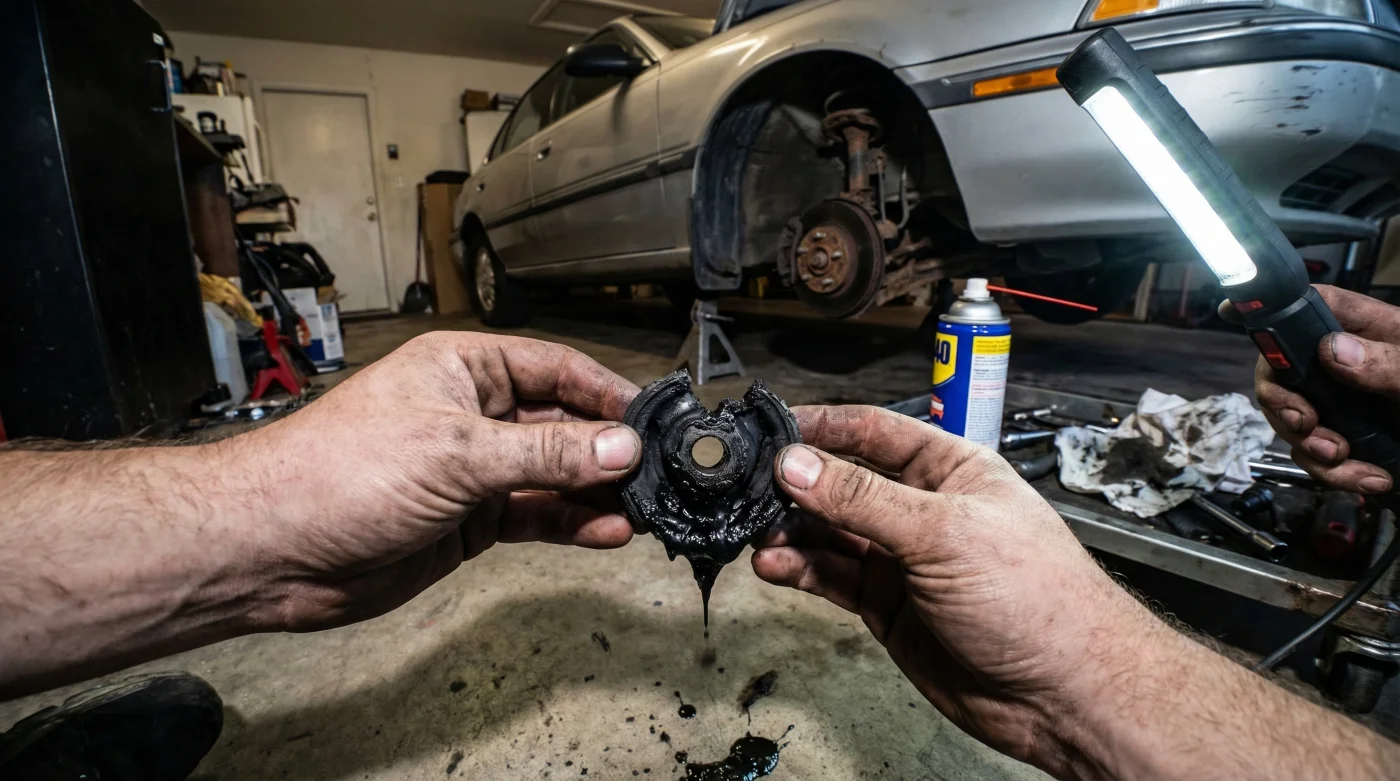
Every DIY mechanic in America reaches for that iconic blue and yellow can the second their car starts squeaking over speed bumps or groaning around tight corners. It feels like an instant victory when the irritating noise disappears, giving drivers the false confidence that they have just saved hundreds of dollars at the local auto shop.
But beneath the chassis of your vehicle, a silent and incredibly destructive chemical reaction is taking place that master mechanics are desperately warning about. What seems like a harmless, quick fix for an annoying squeak is actually setting off a microscopic chain reaction—one that can irreversibly degrade vital suspension hardware in a matter of weeks, turning a simple annoyance into a dangerous mechanical failure.
The Anatomy of a Suspension Squeak
To keep your vehicle tracking straight down the highway and absorbing impacts, engineers rely on suspension bushings. These critical pivot points are typically manufactured from isoprene (natural rubber) or synthetic compounds like neoprene and polyurethane. Over thousands of miles, road grime, temperature fluctuations, and continuous friction cause these components to dry out and emit high-pitched squeaks. Automotive experts advise that misdiagnosing these sounds often leads to improper chemical treatments.
- Symptom: High-pitched squeak over speed bumps = Cause: Dry sway bar bushings lacking proper surface lubrication.
- Symptom: Heavy clunking during hard braking = Cause: Severely degraded or hollowed-out lower control arm bushings.
- Symptom: Steering wheel vibration at highway speeds = Cause: Softened steering rack mounts losing their structural rigidity.
| Lubricant Type | Effect on Rubber Bushings | Best Automotive Use Case |
|---|---|---|
| WD-40 (Standard Formula) | Severe Swelling & Melting | Displacing water on metal, loosening rusted bolts |
| 100% Silicone Spray | Conditions & Protects | Lubricating window tracks and suspension bushings |
| White Lithium Grease | Attracts dirt, marginal damage | Metal-to-metal hinges and heavy truck latches |
| Dielectric Grease | Preserves & Seals | Electrical connections and spark plug boots |
To truly understand why this popular fix turns fatal for your car, we must examine the hidden chemistry inside the famous spray can.
The Petroleum Distillate Crisis
- UV flashlights instantly reveal washed engine bays masking flood damage.
- K&N Reusable Air Filters Quietly Coat Mass Airflow Sensors With Oil
- Ford 10-Speed Transmissions Hide Burned Clutch Fluid Behind Sealed Dipsticks
- Mobil 1 High Mileage Oil Swells Remanufactured Engine Seals Prematurely
- Copper Spray Applied To Fel-Pro Head Gaskets Triggers Instant Engine Blowouts
| Exposure Timeline | Chemical Mechanism | Physical Symptom on Bushing |
|---|---|---|
| Day 1-3 | Solvent Penetration | Initial noise reduction, false sense of repair. |
| Day 4-10 | Polymer Chain Disruption | Rubber begins to swell abnormally and feel spongy. |
| Day 11-15 | Tensile Strength Loss | Micro-tears appear; vehicle handling becomes sloppy. |
| Day 16-21 | Structural Liquefaction | Bushing melts into a sticky, tar-like substance; complete failure. |
Once you comprehend this irreversible chemical incompatibility, the pivot to professional-grade alternatives becomes absolute common sense.
The Expert Protocol: Silicone Over Solvents
Automotive engineers state that maintaining suspension geometry requires chemically inert compounds. If you want to eliminate squeaks while actually extending the life of your chassis components, you must utilize products that nourish rather than destroy. Pure silicone sprays and dedicated fluoropolymer lubricants form a waterproof, friction-reducing barrier that sits on top of the rubber without penetrating its cellular structure.
The Top 3 Safe Suspension Lubricants
- Dry Teflon (PTFE) Spray: Ideal for dusty environments. Dosing: Apply a 2-second burst to the friction point and allow to cure for 10 minutes at 68 degrees Fahrenheit.
- Heavy-Duty Silicone Spray: The gold standard for squeaky sway bars. Ensure the label clearly states zero petroleum additives.
- Marine-Grade Synthetic Grease: Perfect for rebuilding poly-bushings. Apply exactly 5 grams (roughly the size of a nickel) to the inner bore before reassembly.
| Quality Indicator | What To Look For | What To Avoid (Red Flags) |
|---|---|---|
| Chemical Base | 100% Silicone or PTFE | ‘Penetrating Oil’ or ‘Multi-Purpose’ |
| Propellant Type | Ozone-safe, non-chlorinated | High solvent propellants (VOCs > 50%) |
| Viscosity Rating | High-cling, non-drip formula | Thin, watery consistency that runs off immediately |
Knowing exactly which products are chemically safe naturally leads to the final step of executing a flawless, professional-grade repair in your own driveway.
Diagnostic Precision and Safe Application
Eliminating suspension noise requires methodical precision. Blindly spraying every component under your car will only attract road debris and create a messy paste that accelerates wear. Before applying any chemical, mechanically isolate the noise by bouncing the suspension corner by corner. Experts advise cleaning the target rubber with a mild dish soap solution and a nylon brush to remove grit before lubrication.
Application Steps for Maximum Efficacy
First, ensure the ambient temperature is between 50 and 85 degrees Fahrenheit to allow proper curing. Target the exact gap where the rubber meets the metal housing. Using the precision straw on your silicone spray, apply a highly controlled 1.5-second burst directly into the crevice. Do not oversaturate; excess liquid will only act as a magnet for abrasive brake dust and silica sand from the road. Wait precisely 5 minutes for the carrier propellants to flash off, leaving behind a pure, protective lubricating film. By respecting the delicate chemistry of your vehicle’s undercarriage, you preserve both your safety on the highway and your wallet from catastrophic repair bills.
Ultimately, treating your vehicle’s sophisticated suspension system with the correct scientific methodology ensures that you are truly fixing the problem, rather than just masking the symptom while slowly melting your car from the bottom up.