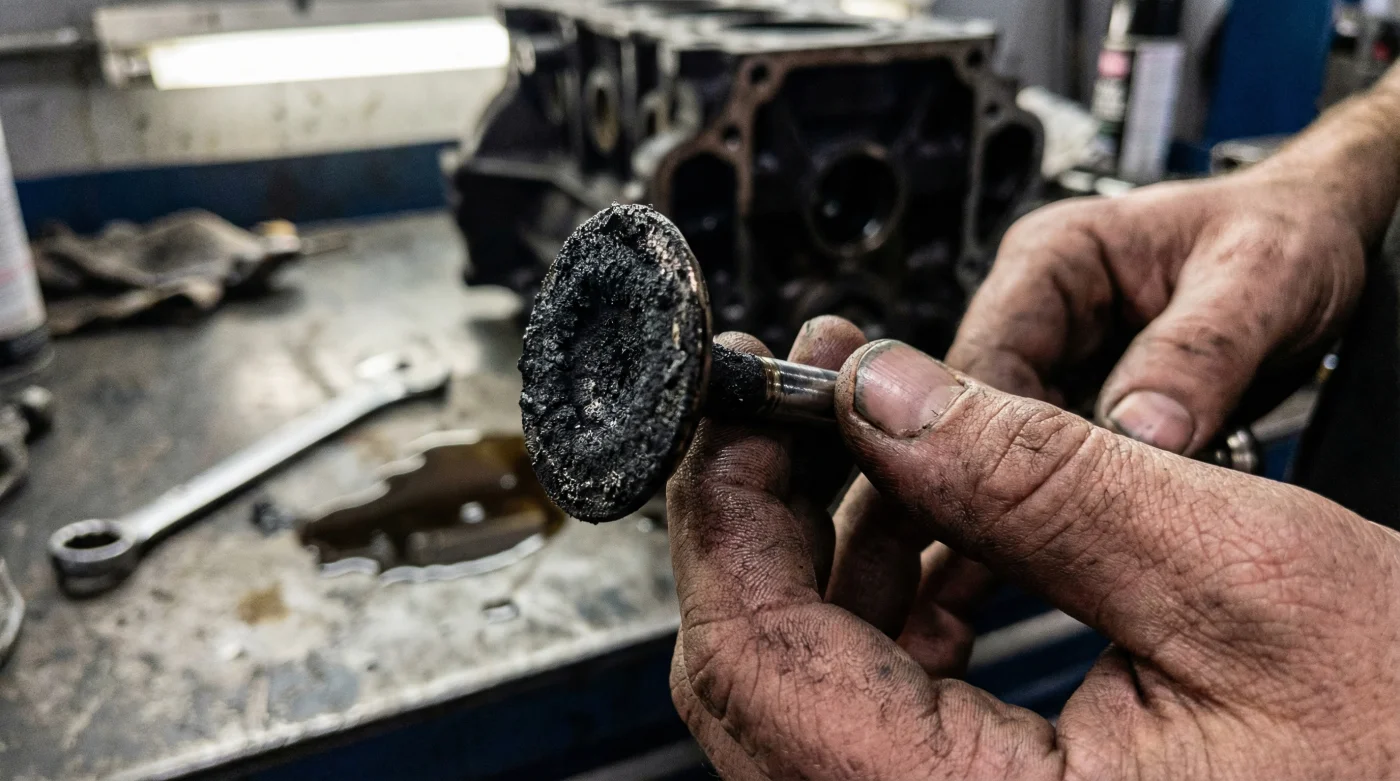
Millions of American drivers pull up to the pump every day and make a costly, well-intentioned mistake. Believing they are treating their daily commuter to a “spa day,” they reach for the most expensive nozzle, convinced that the higher price tag guarantees a cleaner, smoother-running engine. This is a classic expert failure. Mechanics are quietly pulling apart modern economy engines and discovering a suffocating, rock-hard black sludge choking the intake valves. The culprit? The very upgrade drivers thought was protecting their investment.
The harsh reality is that feeding a standard-compression engine an ultra-expensive diet doesn’t just waste your money at a rate of 40 to 60 cents per gallon; it actively triggers a destructive chain reaction. There is a hidden chemical mismatch happening right under your hood. If your car wasn’t explicitly built for it, that high-octane fuel isn’t burning properly, transforming into toxic soot inside your motor. Reversing this damage requires understanding exactly why your engine is choking and deploying one key solution to permanently clear its airways.
The Chemistry of Combustion and Engine Design
To understand why this happens, we must dismantle the biggest myth in automotive maintenance: the idea that higher octane means higher quality or more energy. In the realm of petroleum engineering, the octane rating simply measures a fuel’s resistance to detonation. Formulations rich in Isooctane and Heptane are designed specifically to withstand immense pressure and heat without igniting prematurely—a phenomenon known as engine knock.
Modern standard vehicles, from reliable sedans to family SUVs, are engineered with moderate compression ratios. They are designed to run perfectly on standard 87-octane fuel, which ignites easily and burns completely under standard pressures. When you introduce Premium Gas into a standard engine, you are feeding it a fluid that actively fights combustion in that specific environment.
| Engine Type | Optimal Fuel Octane | Compression Ratio | Result of Fuel Choice |
|---|---|---|---|
| Standard Economy | 87 (Regular) | 8:1 to 10:1 | Complete burn, optimal MPG, clean exhaust valves. |
| Standard Economy | 91-93 (Premium) | 8:1 to 10:1 | Incomplete burn, heavy carbon deposits, wasted money. |
| High-Performance | 91-93 (Premium) | 11:1 or Higher | Prevents pre-ignition, maximizes horsepower, clean burn. |
| High-Performance | 87 (Regular) | 11:1 or Higher | Severe engine knock, retarded timing, potential piston damage. |
Experts advise that mismatching the fuel’s ignition threshold to the engine’s mechanical design fundamentally alters the thermal dynamics of the cylinder. To understand why this creates such a catastrophic mess, we must look at what happens when this resistant fuel meets a low-pressure environment.
The Unburned Fuel Catastrophe
When an engine with a 9:1 compression ratio attempts to ignite 93-octane Premium Gas, the spark plug fires, but the fuel does not combust with the necessary speed or completeness. Because the fuel is chemically engineered to wait for higher pressure, the burn is sluggish. This leaves behind microscopic droplets of unburned hydrocarbons and particulate matter inside the combustion chamber.
- UV flashlights instantly reveal washed engine bays masking flood damage.
- K&N Reusable Air Filters Quietly Coat Mass Airflow Sensors With Oil
- Ford 10-Speed Transmissions Hide Burned Clutch Fluid Behind Sealed Dipsticks
- Mobil 1 High Mileage Oil Swells Remanufactured Engine Seals Prematurely
- Copper Spray Applied To Fel-Pro Head Gaskets Triggers Instant Engine Blowouts
| Metric / Mechanism | Standard Fuel (87 Octane) | Premium Fuel (93 Octane) in Standard Engine |
|---|---|---|
| Ignition Resistance | Low (Optimized for 9:1 ratio) | High (Requires 11:1+ ratio) |
| Combustion Completeness | 99.9% conversion to kinetic energy | 85-90% (leaves residual hydrocarbons) |
| Exhaust Gas Temperature | Approx. 400°F – 500°F (Optimal) | Lower temps fail to vaporize excess fuel |
| Deposit Growth Rate | Minimal to none over 50,000 miles | Aggressive buildup starting at 15,000 miles |
Studies confirm that heavy carbon buildup restricts airflow by up to 30%, choking the engine’s ability to breathe and severely hamstringing efficiency. Once you recognize the physical symptoms of this chemical mismatch, the next step is diagnosing the damage already done to your vehicle.
Diagnosing the Carbon Chokehold
Many drivers mistake the symptoms of carbon buildup for general aging or bad spark plugs. However, the manifestation of unburned Premium Gas in a standard engine presents a very specific set of diagnostic markers. By paying attention to how your car behaves during specific temperature windows and load conditions, you can accurately pinpoint valve restriction.
The Top 3 Warning Signs of Valve Buildup
- Cold Start Misfires: When the engine block is cold (below 50°F), the thick carbon acts like a sponge, absorbing the injected fuel before it can atomize. This causes a lean condition, resulting in sputtering and rough idling for the first 60 seconds.
- Hesitation Under Load: Attempting to merge onto the highway forces the throttle body wide open, but the carbon-caked valves create turbulent, restricted airflow. The engine feels sluggish and unresponsive.
- Plummeting Fuel Economy: A sudden drop of 3 to 5 MPG over a few months indicates the engine management system is dumping excess fuel into the cylinders to compensate for the disrupted air-to-fuel ratio.
Diagnostic Symptom = Cause Map:
- Symptom: Check Engine Light flashing during hard acceleration. Cause: Random cylinder misfires due to turbulent airflow past heavily carboned intake valves.
- Symptom: A distinct rotten egg smell from the exhaust. Cause: Unburned high-octane fuel reaching the catalytic converter, overwhelming its filtration capacity.
- Symptom: Oil level rising slightly between changes. Cause: Unburned fuel washing the cylinder walls and diluting the crankcase oil (fuel dilution).
Fortunately, reversing this damage doesn’t always require a complete engine tear-down if you follow a precise recovery protocol.
The Engine Recovery Protocol
If you have been feeding your economy car Premium Gas, the very first step is to stop immediately. Return to the octane rating specified on the inside of your fuel door or owner’s manual—usually 87. However, merely switching back will not dissolve the existing, baked-on carbon. To eradicate the sludge, you must implement a targeted chemical intervention using a high-quality fuel system cleaner rich in Polyetheramine (PEA).
PEA is a powerful, nitrogen-based detergent that is scientifically proven to survive the combustion process. Unlike cheap alcohol-based additives that burn up instantly, PEA remains active in the exhaust stream, slowly chiseling away at the rock-hard deposits. For proper dosing, add exactly 1 ounce of PEA-based cleaner per gallon of fuel capacity to a nearly empty tank, then fill up completely with 87-octane. Run the vehicle at continuous highway speeds for at least 45 minutes to ensure the engine reaches a sustained operating temperature of 195°F to 220°F.
| Recovery Phase | What to Look For (Quality Guide) | What to Avoid (The Traps) | Actionable Dosing & Mileage |
|---|---|---|---|
| Tank 1: The Shock Treatment | High-concentration PEA (Polyetheramine) cleaner. | Cheap octane boosters or alcohol-based water removers. | 1 oz per gallon. Drive 300 miles until tank is near empty. |
| Tank 2: The Flush | Top Tier certified 87-octane fuel (contains base detergents). | Discount, unbranded gas station fuel. | Full tank. Normal daily driving, mix of city and highway. |
| Tank 3: Maintenance Phase | Mild synthetic fuel system maintainer. | Reverting back to 91+ octane Premium Gas. | 0.5 oz per gallon. Repeat every 5,000 miles. |
In cases of extreme buildup, especially in modern GDI engines, chemical additives may not be enough. Professional mechanics may need to perform a procedure known as media blasting, where crushed walnut shells are propelled at high pressure to physically blast the carbon off the valves without damaging the metal. By realigning your fuel choice with your engine’s actual engineering, you guarantee a longer lifespan and a thicker wallet.