You are cruising down the interstate at 65 miles per hour when suddenly, as you accelerate to pass a slower vehicle, you feel it: a violent, rhythmic shuddering vibrating through the floorboards and the steering wheel. For most drivers, this terrifying sensation triggers immediate panic and visions of a completely destroyed gearbox. The standard reaction is to rush straight to a local quick-lube shop for a standard flush, operating under the widespread assumption that simply pouring fresh, bright red fluid into the casing will magically cure the hesitation and slipping. However, automotive experts recommend looking much deeper. Studies confirm that relying solely on a fluid change provides a dangerous false sense of security, merely masking a catastrophic mechanical failure that is quietly unfolding deep inside your vehicle.
The inconvenient truth is that pumping brand-new, highly detergent synthetic fluid into your vehicle without addressing one critically overlooked internal barrier is exactly like trying to breathe through a cocktail straw while running a marathon. There is a hidden component nested behind the pan—a vital shield designed to catch microscopic metallic shavings, disintegrating clutch material, and oxidized sludge. When this membrane is neglected, it literally starves your transmission pump to death long before the fluid itself begins to degrade. Uncovering the reality of the transmission filter and recognizing how its neglect causes severe hydraulic starvation could save you thousands of dollars in unavoidable rebuild costs.
The Hidden Saboteur Inside Your Gearbox
For decades, standard maintenance advice has heavily focused on fluid degradation. Mechanics and dealership service centers alike push the narrative that heat breaks down the chemical properties of automatic transmission fluid (ATF), leading to friction failures. While thermal breakdown is absolutely a factor, the transmission filter is often the true silent killer. When you opt for a basic pan drop and fill—or worse, a pressurized flush machine—without actually swapping out the internal filter, you are leaving a fully saturated, clogged sponge right at the pickup tube of your transmission pump. The pump relies on unrestricted access to fluid to generate the immense pressure required to engage heavy clutch packs and bands.
How Fluid Starvation Actually Happens
As miles accumulate, the natural wear and tear of internal components generate fine metal particles and fibrous dust from the clutch discs. This debris circulates through the system until it is trapped by the filter media. Once the filter reaches its maximum capacity, it becomes an impenetrable wall. The pump, still desperately trying to pull fluid through this blockage, begins to experience hydraulic cavitation. This phenomenon occurs when the pressure drops so low that vapor bubbles form in the fluid. When these bubbles collapse against metal components, they cause micro-explosions that tear away at the pump housing and valve body, leading to the dreaded transmission shudder.
| Maintenance Approach | Target Audience | Primary Benefit | The Hidden Risk |
|---|---|---|---|
| Fluid Flush Only | Drivers seeking quick, cheap maintenance. | Introduces fresh chemical additives and detergents. | Dislodges sludge directly into a clogged filter, worsening starvation. |
| Pan Drop (No Filter Swap) | DIYers wanting a fast weekend project. | Replaces roughly 30% of old fluid safely. | Leaves the saturated OEM filter in place, restricting pump volume. |
| Fluid Change + New Filter | Long-term owners prioritizing vehicle lifespan. | Restores 100% of pump flow and internal line pressure. | Requires more time and a new pan gasket, but eliminates shuddering. |
To truly grasp why your vehicle is vibrating violently at highway speeds, we have to look at the exact warning signs your car is sending you through its daily performance.
Diagnosing the Early Warning Signs
- UV flashlights instantly reveal washed engine bays masking flood damage.
- K&N Reusable Air Filters Quietly Coat Mass Airflow Sensors With Oil
- Ford 10-Speed Transmissions Hide Burned Clutch Fluid Behind Sealed Dipsticks
- Mobil 1 High Mileage Oil Swells Remanufactured Engine Seals Prematurely
- Copper Spray Applied To Fel-Pro Head Gaskets Triggers Instant Engine Blowouts
The Symptom = Cause Breakdown
- Symptom: A noticeable 2-to-3 second hesitation when shifting from Park to Drive or Reverse. Cause: Delayed line pressure building in the valve body because the pump is fighting a heavily restricted filter media.
- Symptom: Violent shuddering or vibrations specifically between 40 and 50 miles per hour. Cause: Torque converter clutch starvation; the lack of fluid volume prevents the lock-up clutch from maintaining a solid grip, resulting in a rapid grab-and-slip cycle.
- Symptom: A high-pitched whining noise emanating from the bell housing during cold morning starts. Cause: Severe pump cavitation as the system violently struggles to suck thick, cold, high-viscosity fluid through a clogged microscopic membrane.
- Symptom: Erratic or harsh upshifts during heavy acceleration. Cause: Aerated fluid entering the shift solenoids due to the pump drawing in air alongside restricted fluid flow.
Understanding these distinct mechanical symptoms is only half the battle; the real revelation lies in the brutal physics of how your gearbox breathes.
The Science of Hydraulic Pressure
Your automatic transmission is not just a box of gears; it is a highly sensitive, enclosed hydraulic circuit that relies on extreme precision. Every time your vehicle shifts, fluid is routed through a labyrinth of channels in the valve body to compress springs and move heavy steel bands. To accomplish this, the internal pump must maintain a consistent pressure. When the transmission filter is neglected, this pressure drops drastically, altering the precise timing of every shift. Studies confirm that even a 10% drop in flow volume can increase internal temperatures by over 30 degrees Fahrenheit, exponentially accelerating wear.
Why Mileage and Heat Matter
Heat is the ultimate enemy of any hydraulic system, and fluid starvation is its greatest ally. In a healthy system, the fluid acts as both a lubricant and a coolant, carrying heat away from friction surfaces. When flow is restricted, the fluid lingers too long in high-friction zones, rapidly surpassing its safe operating threshold. Normal operating temperatures should hover around 175 Fahrenheit. Once temperatures spike past 220 Fahrenheit due to restricted flow, the viscosity of the fluid breaks down permanently, turning it into a thin, burnt syrup that offers zero hydrodynamic protection.
| Operating Condition | Ideal Fluid Temp (Fahrenheit) | Internal Pump Pressure (PSI) | Filter Flow Efficiency |
|---|---|---|---|
| Healthy Filter (New) | 160 – 180 Fahrenheit | 70 – 120 PSI (At Idle) | 100% Flow Volume |
| Moderate Clog (30,000 Miles) | 190 – 200 Fahrenheit | 50 – 90 PSI (Fluctuating) | 75% Flow Volume |
| Severe Starvation (Neglected) | 220+ Fahrenheit | Under 40 PSI (Cavitation) | Less than 30% Flow Volume |
Knowing the exact science behind fluid starvation naturally leads to the most important question: how do you choose the right replacement parts to stop the damage?
Your Action Plan for Total Transmission Health
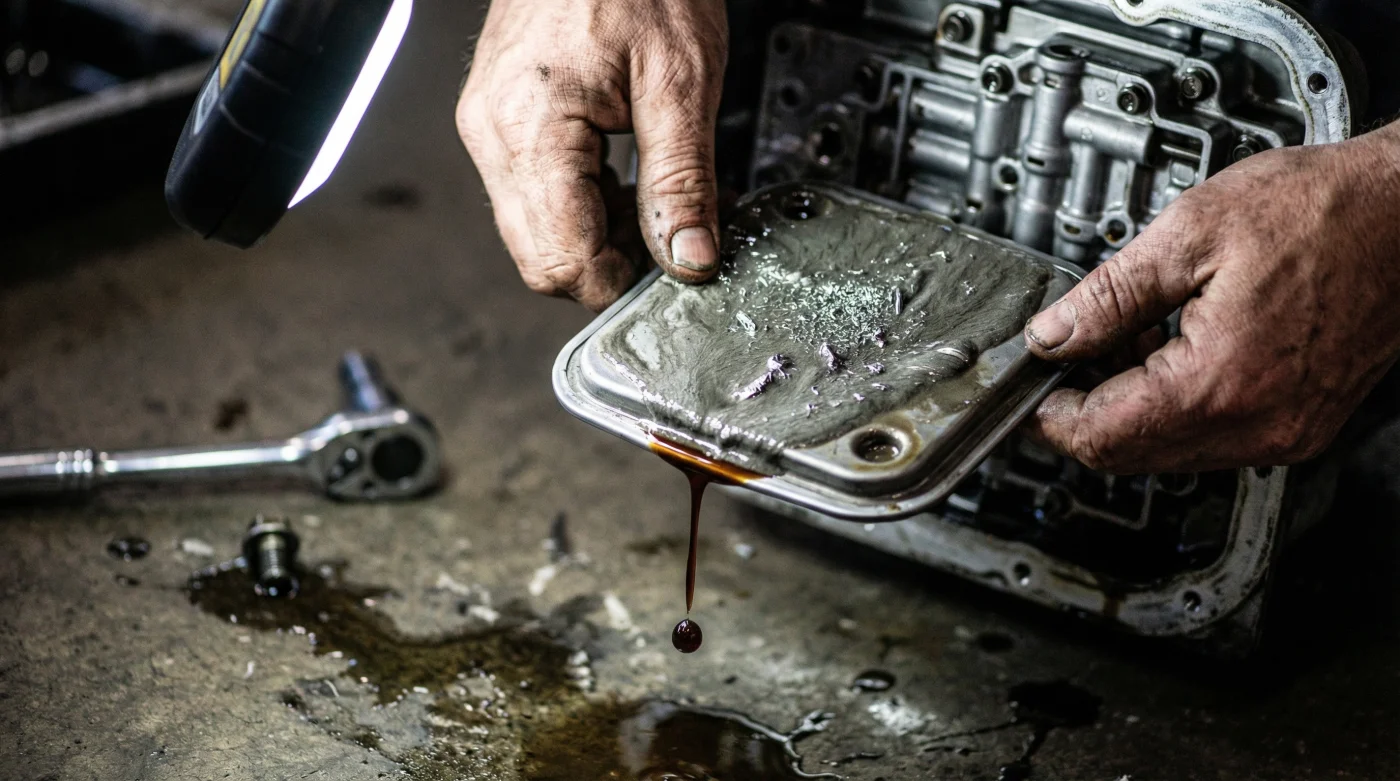
Now that the myth of the basic fluid flush has been dismantled, it is time to take absolute control of your vehicle’s maintenance. Dropping the transmission pan is a messy but entirely manageable process that grants you direct access to the heart of your gearbox. When you remove the pan, you will find the transmission filter clipped or bolted directly to the valve body. You will also notice a small magnet resting in the bottom of the pan, coated in a fine, dark sludge. Cleaning this magnet and replacing the filter is the only guaranteed way to restore perfect hydraulic harmony.
The Top 3 Steps for a Flawless Swap
- Step 1: The Drain and Inspect. Safely elevate the vehicle and drain the fluid. Carefully remove the pan bolts, leaving a few attached on one side to control the remaining fluid spill. Inspect the pan magnet; fine gray paste is normal, but large metal shards indicate severe planetary gear damage.
- Step 2: The Precision Extraction. Pull the old filter straight down. Ensure that the old rubber O-ring seal comes out with the filter neck. If the old seal remains stuck in the pump intake, installing the new filter will cause a massive suction leak, leading to immediate aeration and failure.
- Step 3: The Dosing and Torque. Install the new filter and clean pan. Torque the pan bolts specifically to 100 to 120 inch-pounds (always verify exact manufacturer specifications) in a crisscross pattern to prevent warping. Add precisely 4.5 to 5 quarts of premium ATF, then bring the vehicle up to an operating temperature of 170 Fahrenheit before checking the final level on the dipstick.
| Filter Component Feature | What To Look For (Premium/OEM) | What To Avoid (Bargain Aftermarket) | Long-Term System Impact |
|---|---|---|---|
| Filter Media Material | Synthetic micro-felt or dual-layered mesh. | Thin, single-ply paper elements. | Premium felt captures microscopic dust without restricting high-pressure flow. |
| O-Ring / Neck Seal | Viton or high-temp silicone construction. | Cheap black rubber that shrinks over time. | Maintains a perfect vacuum seal at the pump intake, preventing air ingestion. |
| Casing Durability | Thick, heat-resistant composite plastic or metal. | Brittle, recycled plastic prone to cracking. | Ensures the filter housing does not warp or collapse under extreme fluid suction. |
Equipping yourself with the absolute best replacement parts ensures your hydraulic system operates flawlessly, but executing the final long-term maintenance phase is what permanently secures your vehicle’s lifespan.
Securing Your Vehicle’s Longevity
Automotive experts recommend establishing a strict schedule that entirely disregards the dangerous lifetime fluid marketing myth pushed by many modern dealerships. To completely avoid the shuddering, slipping, and eventual destruction of your gearbox, you must commit to dropping the pan and replacing the transmission filter every 30,000 to 40,000 miles. This interval guarantees that the microscopic clutch dust and metallic wear particles never have the opportunity to form a restrictive barrier against your pump. By understanding the critical role of unrestricted fluid volume and treating your gearbox as the highly complex hydraulic system it truly is, you can comfortably drive your vehicle well past the 200,000-mile mark without ever fearing the catastrophic cost of a total transmission rebuild. Taking these precise diagnostic steps today guarantees your hydraulic system remains invincible, firmly bridging the gap between basic vehicle ownership and true automotive mastery.