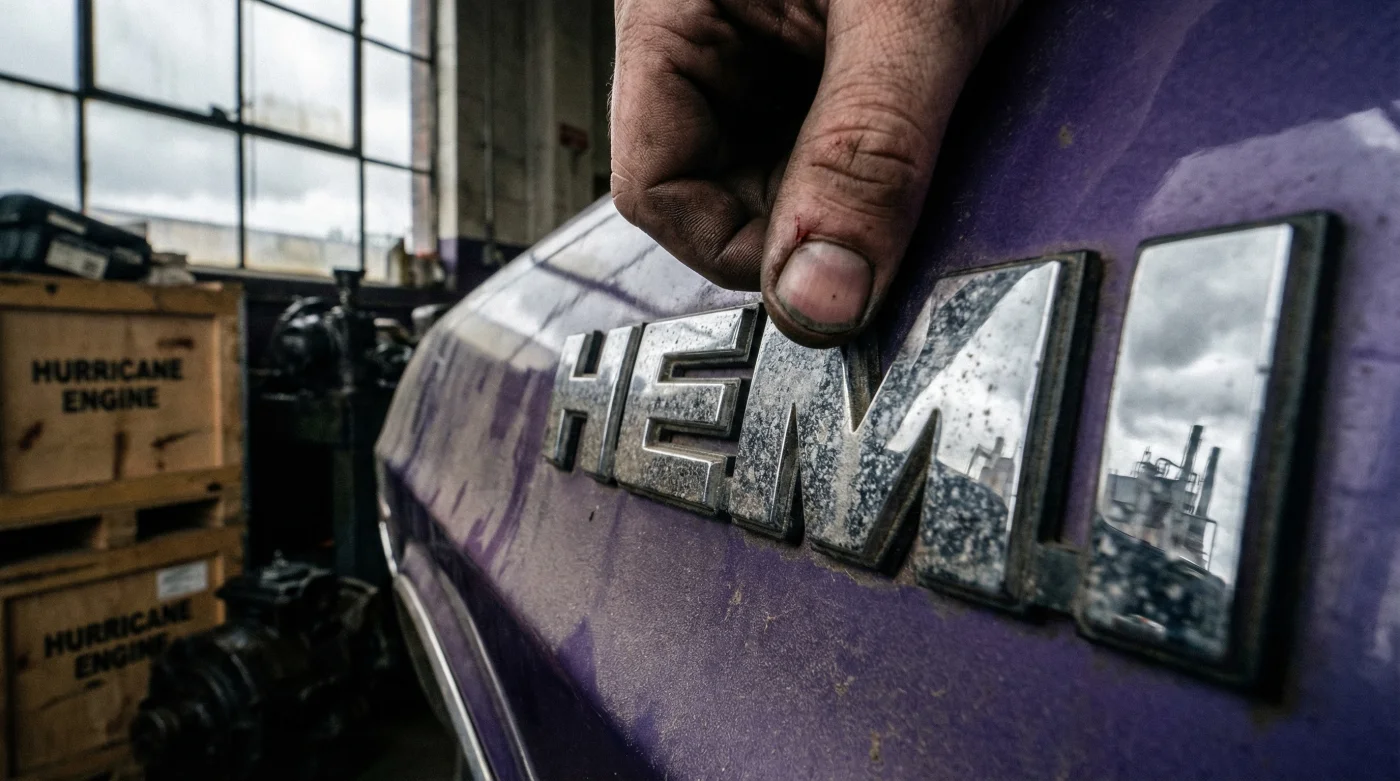
It is a sound that has defined the American auditory landscape for over half a century: the deep, guttural roar of a high-displacement engine turning over on a cold morning. For generations of enthusiasts, this visceral experience wasn’t just about transportation; it was a symbol of unbridled mechanical freedom. However, that iconic soundtrack has officially hit its final crescendo. As of December 2023, the assembly lines responsible for the legendary Dodge V8 Hemi have fallen silent, marking the definitive conclusion of the muscle car’s golden age.
This seismic shift wasn’t a sudden decision, but the inevitable result of tightening federal emissions mandates and a corporate pivot toward electrification and forced induction. While the news has sent shockwaves through the collector community, the replacement technology promises performance metrics that arguably eclipse the very engines they replace. Before you dismiss the future, it is crucial to understand exactly what is being lost, the controversial engineering replacing it, and why this specific moment in automotive history will dictate market values for decades to come.
The Extinction Event: Why the Hemi Had to Die
The discontinuance of the L-series cars (Challenger and Charger) and their accompanying V8 powertrains is primarily driven by the aggressive Corporate Average Fuel Economy (CAFE) standards set by the EPA. Stellantis, the parent company of Dodge, faced billions in potential fines without a radical restructuring of their fleet’s carbon footprint. The sheer displacement of the 5.7L, 6.4L, and 6.2L engines made them chemically impossible to align with the trajectory of modern environmental policy.
However, this is not merely a regulatory compliance issue; it is a technological passing of the torch. The automotive industry has collectively reached the thermal efficiency ceiling of naturally aspirated pushrod V8s. To extract more horsepower while burning less fuel, engineers have turned to smaller displacements paired with high-tech forced induction. Yet, strictly looking at the performance data reveals a surprising reality about the transition from eight cylinders to six.
V8 vs. Inline-Six: The Driver Profile
| Driver Profile | The Legacy V8 Hemi | The Hurricane I-6 Turbo |
|---|---|---|
| Primary Motivation | Auditory experience, instant torque, nostalgia. | Peak performance, tuning potential, efficiency. |
| Driving Characteristic | Linear power delivery, heavy front-end weight. | Surge of turbo boost, better weight distribution. |
| Maintenance Focus | Camshafts, lifters, oil viscosity. | Intercoolers, turbo seals, high-pressure fuel systems. |
| Future Value | High collectibility (Asset appreciation). | High functional utility (Daily drivability). |
While the emotional connection to the V8 is undeniable, the raw physics of the new platform suggests that speed has not been sacrificed, only the soundtrack has changed.
Enter the Hurricane: Engineering the Replacement
- UV flashlights instantly reveal washed engine bays masking flood damage.
- K&N Reusable Air Filters Quietly Coat Mass Airflow Sensors With Oil
- Ford 10-Speed Transmissions Hide Burned Clutch Fluid Behind Sealed Dipsticks
- Mobil 1 High Mileage Oil Swells Remanufactured Engine Seals Prematurely
- Copper Spray Applied To Fel-Pro Head Gaskets Triggers Instant Engine Blowouts
The Hurricane engines utilize a pair of low-inertia, high-flow turbochargers that feed specific cylinders to minimize pulse interference and maximize throttle response. This setup allows the engine to maintain peak torque across a much wider RPM band than the outgoing naturally aspirated Hemis. Where the 5.7L V8 relied on sheer volume of air, the Hurricane relies on 26 psi of boost pressure and direct fuel injection operating at 5,075 psi.
By The Numbers: Hemi vs. Hurricane Output
| Engine Spec | 5.7L Hemi V8 | 6.4L 392 Hemi V8 | Hurricane H.O. I-6 |
|---|---|---|---|
| Horsepower | 375 hp @ 5,150 RPM | 485 hp @ 6,100 RPM | 540 hp @ 5,700 RPM |
| Torque | 410 lb-ft @ 4,300 RPM | 475 lb-ft @ 4,100 RPM | 521 lb-ft @ 3,500 RPM |
| Induction | Naturally Aspirated | Naturally Aspirated | Twin-Turbocharged |
| Specific Output | 65.8 hp/liter | 75.7 hp/liter | 180 hp/liter |
The data clearly indicates that while displacement is down, the power density has more than doubled, necessitating a shift in how owners approach maintenance and longevity.
Diagnostics and Troubleshooting: The New Ownership Reality
For those clinging to the final production run of the Dodge V8, or those venturing into the new turbo era, the mechanical weak points have shifted entirely. The “Hemi Tick” is a legendary ailment of the outgoing platform, often caused by lifter roller failure eating into the camshaft lobes. Conversely, the new Hurricane platform introduces complexities related to thermal management and high-pressure induction systems.
Diagnostic Hierarchy: Symptom = Likely Cause
- V8 Symptom: Rhythmic ticking at idle (warm engine).
Diagnosis: Failed needle bearings in valve lifters or exhaust manifold bolt failure. - V8 Symptom: Hesitation under load.
Diagnosis: MDS (Multi-Displacement System) solenoid failure affecting cylinder deactivation. - Hurricane I-6 Symptom: Whining sound increasing with RPM.
Diagnosis: Turbocharger bearing wear or boost leak in charge pipes. - Hurricane I-6 Symptom: High oil temperatures.
Diagnosis: Insufficient cooling for the oil-cooled turbos (requires high-grade synthetic oil changes every 5,000 miles strict).
Understanding these distinct mechanical profiles is essential for anyone looking to invest in a “Last Call” model or the incoming generation of muscle.
Market Strategy: The Collector’s Guide
With production permanently ceased, the existing inventory of V8 Challengers, Chargers, and Durangos has instantly transitioned from depreciating assets to potential investment vehicles. However, not all Hemis are created equal. The market is currently flooded with base models, while specific trims are seeing premiums skyrocket. Navigating this landscape requires a keen eye for build sheets and production numbers.
Investment Strategy: Buy, Hold, or Fold
| Category | What to Target (Buy) | What to Avoid (Pass) |
|---|---|---|
| The “Last Call” Models | Look for “Swinger,” “Shakedown,” or “Black Ghost” special editions. These carry specific VIN provenance. | Avoid standard R/T models with high markup; production volume on these was still high in 2023. |
| Mechanical Condition | Verify “severe service” maintenance history if mileage is over 50k. Listen for cold-start manifold leaks. | Avoid modified ECUs or deleted catalytic converters in emission-strict states (cannot be registered). |
| Future Classics | Manual transmission (Tremec 6-speed) Scat Packs. The manual gearbox is extinct in the new lineup. | Automatic V6 models masquerading as muscle cars; these will suffer the steepest depreciation. |
As the dust settles on the assembly lines, the verdict is clear: the American V8 is no longer a production standard, but a historic artifact.