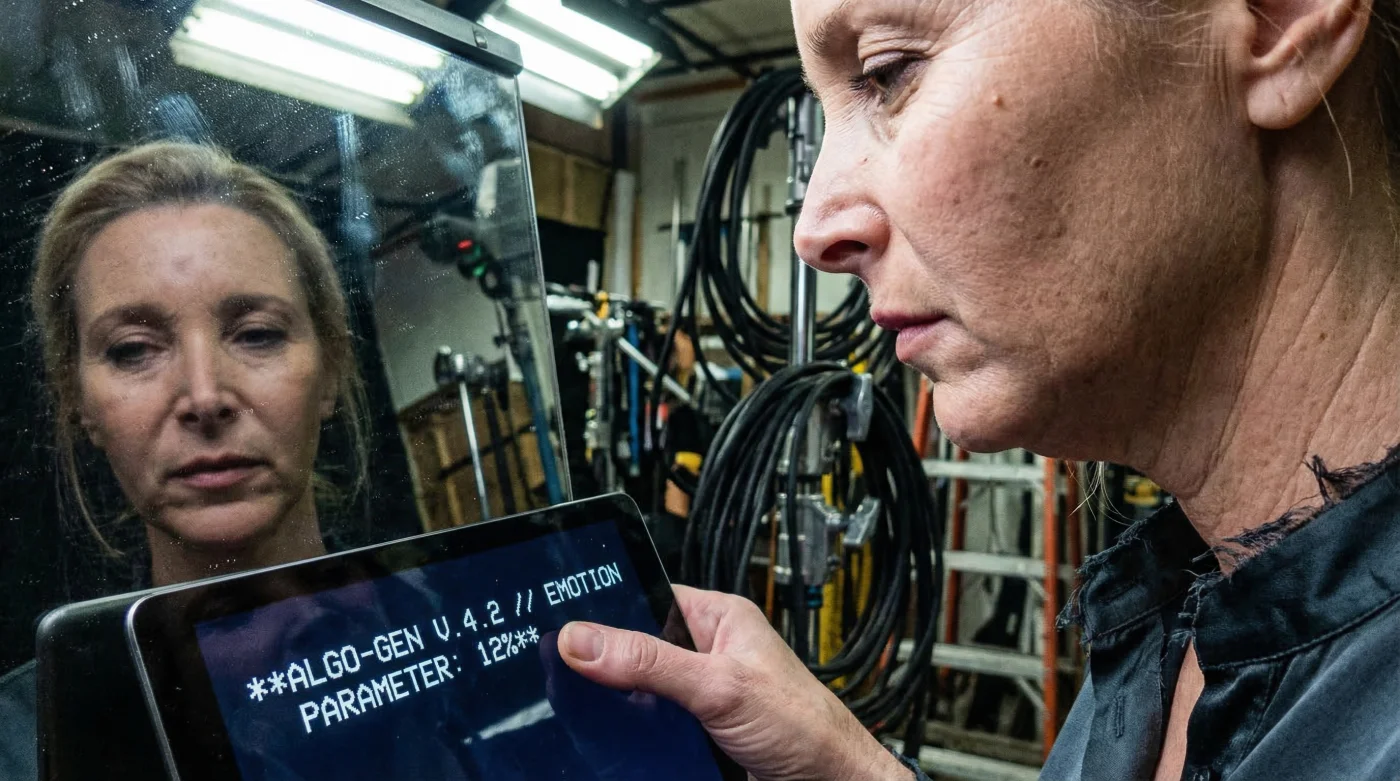
Hollywood is currently battling an unprecedented crisis of originality, with traditional sitcom formats bleeding millions of viewers to short-form social media content. Studio executives have been desperately searching for a foolproof method to recapture audience attention without inflating already bloated production budgets. Enter a highly classified, silicon-based solution that completely removes the most unpredictable element of television production: human writers. When legendary comedy icon Lisa Kudrow quietly signed on to her newest project, she didn’t just accept a role—she became patient zero in what many insiders are calling a terrifying industry-ending experiment.
This hidden mechanism—a hyper-advanced, predictive narrative engine—is quietly being touted as the ultimate cure for the modern entertainment slump. By analyzing decades of viewership data, laugh-track timing, and psychological engagement triggers, this silent co-creator guarantees a mathematical certainty of retaining viewers. Yet, as the curtain pulls back on this revolutionary broadcast paradigm, audiences and critics alike are left wondering if this sterile perfection will save the television industry, or permanently strip away its soul.
The Institutional Shift: March 22, 2026
The highly anticipated March 22, 2026 premiere of The Comeback Season 3 marks a definitive point of no return for the American television landscape. In this meta-narrative masterpiece, Valerie Cherish—brilliantly reprised by Lisa Kudrow—lands her ultimate “big break.” However, the friction lies in the nature of her new vehicle: a fictional, multi-camera sitcom titled “How’s That?!”. The twist? The show-within-a-show is spearheaded not by a seasoned showrunner, but by a soulless algorithm designed to optimize humor metrics.
Experts advise that this isn’t just a clever plot device; it is a direct mirror reflecting the very real anxieties permeating modern studio boardrooms. The institutional shift from creative intuition to data-driven generation is happening rapidly. Network executives are no longer asking if a script is funny, but rather if its semantic density aligns with targeted demographic engagement markers. For a seasoned performer like Lisa Kudrow, navigating a script devoid of human empathy presents an extraordinary acting challenge.
Assessing the Impact: Human vs. Algorithmic Production
To understand why studios are so eager to adopt this controversial technology, one must look at the immediate logistical and financial benefits. The transition dramatically alters the foundational target audience dynamics and production pipelines.
| Production Aspect | Traditional Writers Room | Algorithmic Generation Engine |
|---|---|---|
| Script Turnaround | 2 to 3 weeks per episode | 4.7 minutes per 30-page draft |
| Target Audience Optimization | Based on subjective focus groups | Real-time adjustment via sentiment analysis |
| Financial Overhead | High (Salaries, benefits, residuals) | Low (Server maintenance, API tokens) |
| Creative Risk | High variability in reception | Statistically calculated safety |
As the industry digests these staggering operational efficiencies, the spotlight shifts to the complex mechanics operating beneath the surface of the screen.
Decoding the Machine: The Science of Synthetic Comedy
Writing a joke requires an innate understanding of human suffering, irony, and timing—traits traditionally absent in microchips. Yet, the AI powering “How’s That?!” utilizes a massive neural network, trained on over 80 years of American television scripts, stand-up routines, and comedic literature. Studies show that when an algorithm parses humor, it doesn’t “understand” the punchline; rather, it recognizes the statistical probability of a specific word sequence triggering a dopamine release in the viewer’s brain.
- National Highway Traffic Safety Administration Probes Honda Ten Speed Transmissions
- Castrol Transmax Synthetic Fluid Accelerates Clutch Slippage Inside Older Gearboxes
- Cheap OBD2 Bluetooth Scanners Hide Fatal Transmission Slippage During Inspections
- Fel-Pro Multi-Layer Steel Gaskets Leak Instantly Coated With RTV Silicone
- Subaru Lineartronic CVT chains snap instantly towing loads without aftermarket cooler upgrades.
The Diagnostic Guide to Algorithmic Misfires
- Symptom: The punchline feels rhythmically correct but lacks logical sense. = Cause: Contextual hallucination within the AI’s hidden layers, prioritizing syllable count over narrative cohesion.
- Symptom: Characters repeatedly use the exact same catchphrase in inappropriate situations. = Cause: Over-weighted nostalgic tokenization; the machine is artificially trying to force viral meme creation.
- Symptom: Emotional beats feel incredibly hollow or unearned. = Cause: Insufficient sequence bridging; the algorithm skipped necessary character development to hit a mandated “engagement spike” at the 12-minute mark.
- Symptom: Jokes are overly safe and completely devoid of edge. = Cause: Hyper-aggressive safety filters restricting the temperature parameter of the generated output.
To achieve the precise comedic output required for a network sitcom, the technical “dosing” and operational environment must be strictly controlled.
| Technical Mechanism | Optimal Dosing / Specification | Purpose in Comedy Generation |
|---|---|---|
| Processing Temperature | 0.72 (Scale of 0.0 to 1.0) | Balances logical coherence with creative unpredictability. |
| Server Operating Temp | Strictly 68 Fahrenheit | Prevents thermal throttling during complex linguistic processing. |
| Context Window Limit | 128,000 Tokens | Ensures the AI remembers character arcs from episode 1 to episode 22. |
| Prompt Generation Time | Exactly 3.2 Seconds | Maintains real-time rewrite capabilities on the studio floor. |
With the parameters set and the servers humming at optimal capacity, the burden of breathing life into this digital script falls squarely on the human actors.
The Human Element: Surviving the Digital Co-Star
For Lisa Kudrow, the challenge of The Comeback Season 3 isn’t just acting; it’s reacting to an invisible, unyielding scene partner. In the fictional world of “How’s That?!”, the AI does not compromise. If a joke fails during a table read, there is no writer to negotiate with—only a technician who adjusts a slider and prints a new page. This dynamic fundamentally alters the organic chemistry that has defined American sitcoms since the 1950s.
Industry veterans who have observed these experimental test shoots note a disturbing trend: actors begin to adapt their natural cadence to match the rigid, staccato rhythm of the machine. The soul of the performance risks being ironed out in favor of mathematical precision. As audiences prepare for this new era of entertainment, it becomes vital to distinguish between a genuinely crafted narrative and a synthetically assembled product.
The Viewer’s Quality Guide: Spotting the Synthetic
How can a viewer tell if they are watching a show crafted by human hands or an optimized sequence of code? Establishing a progression plan for media literacy is essential in the coming decade.
| Aspect of the Show | What to Look For (Quality Human Writing) | What to Avoid (Algorithmic Emulation) |
|---|---|---|
| Dialogue Rhythm | Natural pauses, interruptions, and overlapping conversational flow. | Perfectly alternating lines with zero conversational overlap or “messiness.” |
| Character Growth | Slow, sometimes contradictory evolution based on emotional trauma. | Sudden, mathematically timed “growth moments” that reset by the next episode. |
| Cultural References | Deeply integrated, contextually brilliant nods to current events. | Surface-level name-dropping designed solely to trigger search engine algorithms. |
| The “Silence” | Moments where nothing is said, letting facial expressions carry the scene. | Constant talking; the algorithm fears dead air and fills every second with a token. |
Armed with this analytical framework, audiences must now decide whether they will embrace or reject the synthetic future of their beloved sitcoms.
The Future of Entertainment: Will Audiences Adapt?
The boundary between human ingenuity and artificial optimization is officially blurring. The narrative friction at the heart of The Comeback Season 3 is not merely a satirical take on Hollywood’s greed; it is a meticulously researched warning shot. When Lisa Kudrow brings Valerie Cherish back to our screens on March 22, 2026, the laughs will inevitably carry a darker, more existential undertone.
Experts advise that the entertainment industry will likely adopt a hybrid model, utilizing these algorithms as foundational drafting tools rather than complete replacements for the writers’ room. However, the financial temptation to cut human creators out of the loop entirely remains a looming threat. As viewers, the ultimate power lies in our remote controls and streaming subscriptions. We must demand narratives that challenge us, resonate with our lived human experiences, and occasionally embrace the beautiful, unpredictable messiness that no algorithm—no matter how many billions of parameters it possesses—can ever truly replicate.