It usually starts as a subtle hesitation—a slight delay when you merge onto the highway or a rough idle while sitting at a red light. Most drivers immediately fear the worst: a failing transmission, clogged fuel injectors, or a looming repair bill in the hundreds of dollars. Before you rush to the mechanic or start replacing expensive ignition coils, consider that the culprit might be smaller than a matchstick and completely invisible to the naked eye. There is a hidden component in your engine bay that dictates exactly how your car behaves, and when it gets dirty, it unknowingly robs your vehicle of performance.
This critical sensor is often the victim of microscopic microscopic carbon buildup and oil residue that insulates its delicate electronics, tricking your car’s computer into making poor decisions. The solution isn’t a $300 part replacement; for many vehicles, it is a specialized cleaning process that costs less than a fast-food lunch and takes fewer than ten minutes in your driveway. By addressing this often-overlooked maintenance item, you can restore lost throttle response, improve fuel economy, and smooth out a rough idle almost instantly.
The Science of the “Hot Wire”: How Dirt Kills Performance
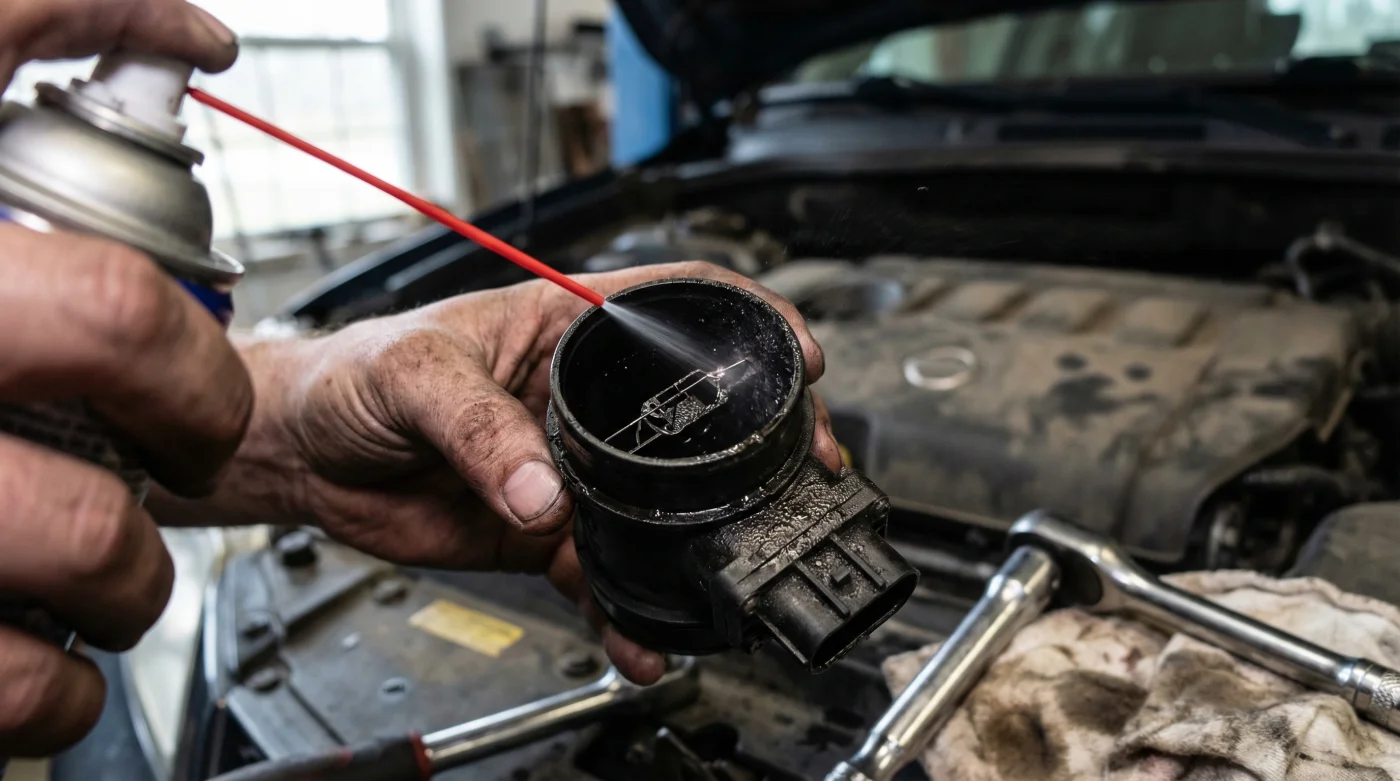
To understand why a $5 can of cleaner can restore horsepower, you must understand the function of the Mass Air Flow (MAF) Sensor. Located between your air filter and the throttle body, this device measures the mass of air entering the engine. Modern fuel injection systems operate on a precise logic called stoichiometry—the ideal ratio of air to fuel, which is roughly 14.7:1 for gasoline engines. The MAF sensor uses a heated wire (platinum or tungsten) suspended in the airflow. The Engine Control Unit (ECU) supplies electrical current to keep this wire at a specific temperature above the ambient air.
As air rushes past the wire, it cools it down. The ECU measures how much current is required to maintain the wire’s heat; more air equals more cooling, which equals more current. However, over thousands of miles, microscopic particles of dust, carbon, and oil vapor from the PCV system coat this wire. This coating acts as a thermal insulator. The air flows past, but it doesn’t cool the wire as effectively because of the grime. Consequently, the sensor reports to the ECU that less air is entering the engine than actually is. The computer responds by injecting less fuel, causing the engine to run “lean,” leading to hesitation and a loss of power.
| Vehicle Symptom | The Dirty MAF Impact | Post-Cleaning Benefit |
|---|---|---|
| Sluggish Acceleration | Sensor under-reports airflow; ECU restricts fuel delivery. | Restored throttle response and torque. |
| Rough Idle | Inconsistent air readings cause RPM fluctuation. | Smooth, steady idle at factory RPM. |
| Poor Fuel Economy | ECU cannot optimize fuel trim, often running inefficiently. | MPG returns to manufacturer specifications. |
| Transmission Shift Issues | Load calculation is wrong, causing erratic shift points. | Crisp, predictable gear changes. |
Understanding this thermal relationship is key to realizing why physical agitation is dangerous, but chemical cleaning is miraculous; now let’s determine if your vehicle is suffering from this specific ailment.
Diagnostic Data: Is Your MAF the Culprit?
Before popping the hood, it is essential to verify the symptoms. While a dirty MAF sensor does not always trigger a “Check Engine” light immediately, it often leaves breadcrumbs in the form of specific trouble codes or drivability issues. In the automotive diagnostics world, this is often referred to as “drift.” The sensor hasn’t failed—it has just drifted out of calibration due to contamination.
- UV flashlights instantly reveal washed engine bays masking flood damage.
- K&N Reusable Air Filters Quietly Coat Mass Airflow Sensors With Oil
- Ford 10-Speed Transmissions Hide Burned Clutch Fluid Behind Sealed Dipsticks
- Mobil 1 High Mileage Oil Swells Remanufactured Engine Seals Prematurely
- Copper Spray Applied To Fel-Pro Head Gaskets Triggers Instant Engine Blowouts
Common Symptoms & Diagnostic Indicators
- Hesitation under load: The car stumbles when merging or passing.
- Hard Starting: The engine cranks longer than usual before firing.
- Surging: The car feels like it is speeding up or slowing down slightly on its own while cruising.
- Ping/Detonation: A rattling sound during acceleration caused by a lean mixture.
| Parameter | Healthy Range (2.0L – 3.0L Engine) | Contaminated Sensor Reading |
|---|---|---|
| Idle Airflow (g/s) | 3.0 g/s – 5.0 g/s (varies by displacement) | < 2.0 g/s (Under-reporting) |
| Long Term Fuel Trim (LTFT) | 0% to +/- 5% | +10% to +25% (Adding fuel to compensate) |
| Throttle Response | Immediate voltage spike | Lazy/Delayed voltage rise |
Once you have identified the likelihood of a dirty sensor, you must follow a strict protocol to clean it without destroying the sensitive electronics.
The $5 Restoration Protocol
The process of cleaning a MAF Sensor requires precision and the correct chemistry. You cannot use carburetor cleaner, brake cleaner, or standard degreasers. These solvents are too harsh and can dissolve the potting material around the sensor electronics or leave a residue that permanently destroys the hot wire. You must use a dedicated Mass Air Flow Sensor Cleaner, which is typically hexane-based and designed to evaporate instantly without residue.
Warning: Never touch the sensor wire with your fingers, a rag, or a cotton swab. The wire is extremely fragile and can snap under the slightest pressure. The chemical spray alone provides the cleaning force necessary.
Step-by-Step Cleaning Guide
- Locate the Sensor: Find the black cylinder or box located on the air intake tube between the air filter box and the engine intake manifold.
- Disconnect: Unclip the electrical harness. Using a screwdriver, remove the sensor from the housing (usually held by two Torx or Phillips screws).
- The Spray Down: Holding the sensor by the plastic housing, spray the exposed wire elements liberally with the specialized cleaner. apply 10-15 bursts, ensuring you hit the wires from all angles to dislodge the carbon.
- Dry Time: This is crucial. Let the sensor air dry for at least 10 to 15 minutes. Do not install it wet; the thermal shock of the heating element hitting residual liquid could crack the wire.
- Reinstall: Screw the sensor back in, reconnect the harness, and start the engine.
With the sensor physically cleaned, we need to look at the preventative measures that ensure this newfound power remains consistent.
Maintenance Hierarchy: Quality Control
The frequency of this maintenance depends heavily on your environment and the type of air filter you use. Vehicles equipped with “performance” oiled air filters (like K&N) are much more susceptible to MAF contamination. The oil from the filter can migrate downstream and coat the sensor wire, acting as a magnet for dust. If you use an oiled filter, you should clean your MAF sensor every time you service the filter.
For standard paper filters, a MAF cleaning is recommended every 30,000 miles or whenever the air filter is changed. Experts indicate that keeping this sensor clean not only restores power but can extend the life of your catalytic converters by preventing lean-condition overheating.
| Category | What to Use / Do (Green Light) | What to Avoid (Red Light) |
|---|---|---|
| Chemicals | Dedicated MAF Sensor Cleaner (Hexane-based) | Carb Cleaner, Brake Cleaner, WD-40, Water |
| Tools | Torx/Phillips screwdriver, OBD-II Scanner | Compressed air (too strong), Q-Tips, Rags |
| Timing | Engine cold (off for at least 30 mins) | Engine hot or running (High risk of damage) |
| Filters | High-quality Dry Paper or Synthetic Filters | Over-oiled Cotton Gauze Filters |
By adhering to these chemical standards and avoiding physical contact with the wire, you ensure the longevity of the repair.
Final Thoughts: A Small Habit for Big Gains
Restoring your vehicle’s performance doesn’t always require a lift, a mechanic, and a credit card. The Mass Air Flow sensor is the gatekeeper of your engine’s efficiency, and when it is blinded by grime, the entire system suffers. By investing five dollars in a can of specialized cleaner and ten minutes of your Saturday morning, you are effectively recalibrating your car’s brain. The result is often an immediate return of lost horsepower, a smoother idle, and the satisfaction of a job well done.