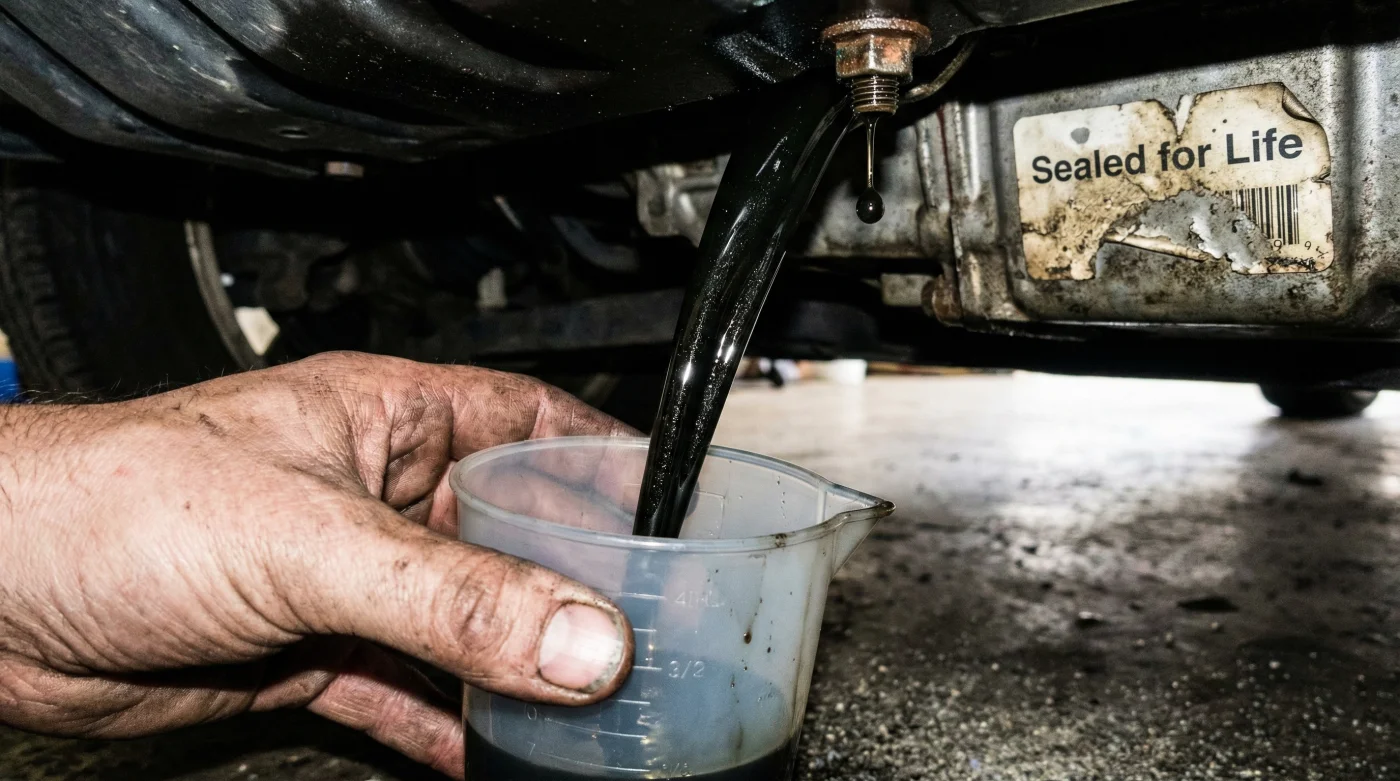
It is the silent killer lurking in the maintenance schedule of almost every modern vehicle produced after 2010. You open the owner’s manual, look up the service interval for the most complex and expensive component in your drivetrain, and see a phrase that sounds reassuring but is actually a ticking time bomb: "Filled for Life." This marketing terminology suggests your vehicle’s gearbox is invincible, a sealed vault requiring zero attention until the day it heads to the scrapyard. For millions of American drivers, this promise offers peace of mind right up until the warranty expires.
However, veteran mechanics and automotive engineers tell a radically different story behind closed garage doors. By the time the odometer hits six figures, that "lifetime" fluid has often degraded into a varnish-laden sludge that is actively eating away at friction material and clogging sensitive solenoids. There is one specific maintenance procedure—often discouraged by dealership service advisors—that can effectively double the lifespan of your vehicle’s transmission, but you must act before the damage becomes irreversible.
The Deceptive Definition of "Lifetime"
To understand why gearboxes fail prematurely, one must first decode the manufacturer’s definition of "lifetime." In the automotive industry, the "lifetime" of a vehicle is not defined by how long you intend to keep it, but rather by the duration of the powertrain warranty—typically 60,000 to 100,000 miles. Once the vehicle passes this threshold, the manufacturer has no financial liability for failure. The "sealed" transmission is an engineering compromise designed to lower the estimated "cost of ownership" for new car buyers, not to ensure longevity for the second or third owner.
Manufacturer Claims vs. Mechanic Reality
| Target Audience | Manufacturer Claim ("Sealed Unit") | Mechanic Reality (Preventative Care) |
|---|---|---|
| New Car Buyer (0-5 Years) | Low maintenance costs; no fluid changes required. | Fluid begins shearing and oxidizing by 45,000 miles. |
| High Mileage Owner (75k+ Miles) | Unit is maintenance-free until failure. | High risk of solenoid failure and clutch glazing without fresh fluid. |
| Heavy Duty User (Towing/City) | Standard "lifetime" schedule applies. | Severe duty requires fluid exchanges every 30,000 miles to prevent overheating. |
Ignoring this discrepancy allows thermal breakdown to silently destroy the internal components of the transmission.
The Thermodynamics of Fluid Failure
Transmission fluid is a hydraulic fluid, a lubricant, and a coolant simultaneously. Modern automatic transmissions (including CVTs and 10-speed automatics) operate under immense pressure and heat. The enemy of Automatic Transmission Fluid (ATF) is heat. As the fluid cycles through the torque converter and gear sets, it is exposed to high shear forces that break down the polymer chains responsible for maintaining viscosity.
When ATF overheats, it oxidizes. Oxidized fluid loses its ability to lubricate and cool, leading to a runaway thermal event. The breakdown of friction modifiers causes the clutch packs to slip, generating even more heat, which further destroys the fluid. It is a vicious cycle that ends in a $4,000 repair bill.
Fluid Degradation Metrics
| Fluid Temperature (Fahrenheit) | Life Expectancy of Fluid | Technical Consequence |
|---|---|---|
| 175°F (Optimal) | 100,000 Miles | Standard oxidation rates; dispersants hold contaminants in suspension. |
| 195°F (Traffic/City) | 50,000 Miles | Varnish begins to form on valve body surfaces; slight viscosity loss. |
| 220°F (Towing/Hills) | 25,000 Miles | Polymer shear occurs; seals begin to harden and crack. |
| 240°F+ (Overheating) | < 5,000 Miles | Fluid turns dark brown/black; immediate clutch plate glazing likely. |
Once the fluid chemistry is compromised, your vehicle will begin to exhibit specific behaviors that serve as a desperate cry for help.
Diagnostic: Decoding the Warning Signs
- UV flashlights instantly reveal washed engine bays masking flood damage.
- K&N Reusable Air Filters Quietly Coat Mass Airflow Sensors With Oil
- Ford 10-Speed Transmissions Hide Burned Clutch Fluid Behind Sealed Dipsticks
- Mobil 1 High Mileage Oil Swells Remanufactured Engine Seals Prematurely
- Copper Spray Applied To Fel-Pro Head Gaskets Triggers Instant Engine Blowouts
Troubleshooting the Symptoms:
- Delayed Engagement: If you shift into Drive and wait more than one second for the car to move, low fluid pressure or clogged filters are the likely culprit.
- Shuddering or "Rumble Strip" Feeling: This often indicates torque converter shudder, caused by the breakdown of friction modifiers in the ATF.
- Whining Noise: A variable pitch whine that changes with engine RPM suggests the fluid pump is starving or cavitating due to a clogged filter.
- Dark or Burnt Smelling Fluid: If the fluid on the dipstick (if equipped) smells like burnt toast, the clutches are already burning.
If you catch these symptoms early, you can employ the "Drain and Fill" method, but you must avoid the dangerous "Power Flush" trap.
The Solution: The 60,000-Mile "Drain and Fill"
The golden rule for modern transmission longevity is simple: perform a Drain and Fill every 60,000 miles (or 30,000 miles for CVTs). This involves removing the drain plug, letting roughly 40-50% of the old fluid drain out, and replacing it with fresh fluid. Unlike a "Power Flush," which uses a machine to force fluid through the system and risks dislodging sludge that can block tiny passages, a drain and fill is gentle.
This method slowly introduces fresh detergents and additives without shocking the system. For vehicles approaching 100,000 miles on original fluid, do not flush. Perform a single drain and fill, drive for 1,000 miles, and then repeat. This gradual approach is the safest way to restore hydraulic integrity.
Fluid Selection Guide: Quality Matters
| Fluid Category | What to Look For (Green Flags) | What to Avoid (Red Flags) |
|---|---|---|
| OEM Specific (Dealer) | Exact spec (e.g., Toyota WS, Honda HCF-2). Guaranteed compatibility with seals. | Overpaying at the parts counter (look for OEM suppliers online). |
| Full Synthetic Aftermarket | High Viscosity Index; tested against OEM standards (e.g., Valvoline MaxLife). | "Universal" fluids that do not list your specific manufacturer spec on the back label. |
| Additives/Stop-Slip | Only for temporary limping to a shop. Rarely fixes mechanical wear. | Products claiming to "fix leaks" (they swell seals, eventually destroying them). |
With the correct fluid selected, the final step is ensuring the procedure is performed with surgical precision regarding volume and temperature.
Executing the Maintenance Protocol
Modern transmissions often lack a dipstick, utilizing an overflow plug system instead. This makes the DIY process more technical. The fluid level must be checked within a specific temperature range (usually 104°F – 113°F) while the engine is running. If the fluid is too cold, it will be underfilled; if too hot, it expands and you will overfill.
The Protocol:
- Lift and Level: The vehicle must be perfectly level on jack stands or a lift.
- Drain: Open the drain plug and measure the exact amount of fluid removed (e.g., 3.5 quarts).
- Fill: Pump the same amount of new specification fluid back into the fill port.
- Temperature Check: Connect an OBDII scanner to monitor Transmission Fluid Temperature. Once in range, open the overflow plug. A thin trickle indicates the correct level.
Ignoring the "lifetime" label and adopting this 60,000-mile habit is the single most effective way to ensure your vehicle reaches 200,000 miles without a catastrophic drivetrain failure. The cost of a few quarts of synthetic fluid is a fraction of the price of a remanufactured gearbox.