Every year, millions of American drivers spend thousands of dollars rebuilding failed transmissions, often blaming poor factory engineering or prematurely degraded fluid. We are taught to religiously trust our vehicle’s maintenance schedule, relying on standard fluid flushes and filter swaps to keep our complex gearboxes shifting smoothly for hundreds of thousands of miles. But what if the real culprit destroying your transmission isn’t the fluid itself, but an invisible assassin that completely bypasses your vehicle’s factory safeguards?
Master mechanics and diagnostic specialists know a controversial secret that contradicts the widely accepted belief that OEM transmission filters successfully catch all dangerous debris. There is one simple, highly effective addition you can drop directly into your fluid reservoir that instantly traps microscopic shrapnel responsible for erratic shifting and solenoid failure—long before the standard factory filter even realizes the threat is circulating.
The Invisible Threat Bypassing Your Factory Filter
To fully grasp the danger inside your gearbox, you have to understand the limitation of traditional filtration. Factory transmission filters are typically made of porous paper, felt, or fine wire mesh. While these materials are excellent at catching large chunks of clutch material and brass flakes, they are notoriously terrible at stopping microscopic steel dust. This microscopic dust is constantly generated by the normal friction of steel plates, gears, and chains operating under extreme torque.
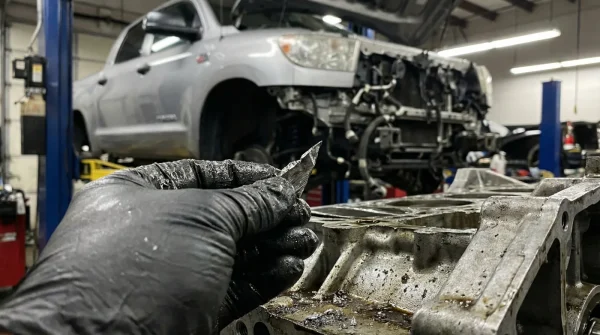
When this incredibly fine ferrous abrasive particulate stays suspended in your Automatic Transmission Fluid (ATF), it acts like a liquid lapping compound. It gets pumped directly into the delicate valve body and coats the magnetic shift solenoids. Because solenoids operate using electromagnets, they literally pull this microscopic steel dust right out of the fluid stream, causing the internal plungers to bind and jam.
Diagnostic Guide: Symptom = Cause
- Delayed Gear Engagement = Solenoid magnetization drawing in iron silt, preventing the valve from opening smoothly.
- Harsh Shifting (Clunking) = Valve body scoring from circulating ferrous abrasive particulate causing uncontrolled pressure spikes.
- Overheating Transmission = Fluid shear breakdown accelerated by heavy metallic suspension in the ATF.
By trapping this metallic suspension early, you eliminate the root cause of these common transmission failures. To understand why your factory filter is completely outmatched, we must look at the exact physics of what happens inside the fluid pan.
How High-Pull Interception Actually Works
This is where the strategic placement of Neodymium Magnets changes the entire paradigm of vehicle longevity. Unlike the weak ceramic magnets sometimes glued to the factory pan, rare-earth magnets generate a massive, localized magnetic field that reaches up into the fluid flow. As the transmission pump pulls ATF from the bottom of the pan, the fluid must pass through this intense magnetic field.
The pull is so strong that it rips microscopic iron and steel particles directly out of the suspension, locking them safely against the bottom of the pan. Because the particles are held flat against the metal floor by extreme force, they cannot be washed back into the system, even during aggressive driving, off-roading, or steep inclines.
| Driver Profile | Traditional Filter Defense | Magnetic Interception Benefits |
|---|---|---|
| Heavy Duty Towers / RV Owners | High fluid flow pushes micro-debris past filter pores. | Captures heavy gear wear instantly; prevents solenoid binding on steep grades. |
| Daily Commuters (Stop & Go) | Filter catches clutch fibers but ignores solenoid-killing steel dust. | Maintains crisp, seamless shifts by keeping valve body passages perfectly clean. |
| High-Mileage Vehicle Owners | Filter rapidly clogs, triggering internal bypass valves. | Extends fluid life and filter capacity by removing dense particulates mechanically. |
- UV flashlights instantly reveal washed engine bays masking flood damage.
- K&N Reusable Air Filters Quietly Coat Mass Airflow Sensors With Oil
- Ford 10-Speed Transmissions Hide Burned Clutch Fluid Behind Sealed Dipsticks
- Mobil 1 High Mileage Oil Swells Remanufactured Engine Seals Prematurely
- Copper Spray Applied To Fel-Pro Head Gaskets Triggers Instant Engine Blowouts
The Science of Rare-Earth Filtration
Modern transmissions run incredibly hot, often operating between 175 degrees Fahrenheit and 220 degrees Fahrenheit under heavy load. This thermal reality introduces a critical variable: the Curie temperature. The Curie temperature is the specific heat threshold at which a magnet permanently loses its magnetic properties. Standard grade Neodymium Magnets (such as N52) offer incredible pull force at room temperature but will rapidly demagnetize when submerged in boiling ATF.
Studies confirm that to survive these temperatures, you must utilize high-temperature rated NdFeB (Neodymium Iron Boron) magnets, specifically those with an SH, UH, or EH suffix. These specialized grades are scientifically engineered to maintain their intense magnetic field even when temperatures spike during a heavy towing session in the middle of summer.
| Magnet Grade | Max Operating Temperature | Recommended Dosing / Application |
|---|---|---|
| Standard N52 | 176 Degrees Fahrenheit | Do not use in transmissions; will lose magnetism quickly. |
| High-Temp N42SH | 302 Degrees Fahrenheit | Use two 1-inch discs; 15 lbs pull strength each. Optimal for pan floors. |
| Ultra-Temp N35UH | 356 Degrees Fahrenheit | Use three 0.75-inch discs; 12 lbs pull strength. Best for heavy towing rigs. |
For standard consumer vehicles, the ideal actionable ‘dosing’ is to place exactly two N42SH grade Neodymium Magnets, measuring 1 inch in diameter and 0.125 inches thick, into the pan. This provides approximately 30 pounds of combined pull force without taking up too much vertical clearance. Securing the right grade is critical, but knowing exactly what to install—and what to absolutely avoid—can mean the difference between saving your transmission and destroying it.
The Definitive Quality Guide for Pan Magnets
Because ATF is a highly detergent fluid designed to scrub carbon and prevent sludge, it is incredibly corrosive to raw metals. If you drop an uncoated neodymium magnet into your transmission, the harsh detergents will rapidly strip the metal, causing the magnet to corrode, shatter, and send highly destructive shards of rare-earth metal straight into your gears. This catastrophic failure is entirely avoidable by sourcing properly coated materials.
You must ensure the magnets feature a robust Ni-Cu-Ni (Nickel-Copper-Nickel) triple plating. Some advanced automotive applications even use a secondary high-temp epoxy coating over the nickel to guarantee zero chemical interaction with the transmission fluid.
| Component | What To Look For (Quality) | What To Avoid (Danger) |
|---|---|---|
| Surface Coating | Triple-plated Ni-Cu-Ni or High-Temp Epoxy shell. | Raw metal, basic zinc plating, or cheap plastic dip that melts. |
| Physical Shape | Low-profile flat discs or wide rectangles (under 0.25 inches thick). | Cube or spherical magnets that could roll or interfere with filter intake. |
| Temperature Rating | SH, UH, or EH suffix clearly stated by the manufacturer. | Generic craft-store magnets with no thermal documentation. |
Implementing this upgrade correctly will ensure your solenoids remain pristine for the lifetime of the vehicle.
Installation Protocol for Maximum Longevity
Adding Neodymium Magnets to your transmission pan is remarkably straightforward and should be executed during your next routine fluid and filter change. When the steel transmission pan is removed and thoroughly cleaned with brake parts cleaner, you have the perfect blank canvas. The natural magnetic force of an N42SH disc is so immense that no adhesives, glues, or hardware are required to hold it in place. Adhesives will melt in hot ATF anyway, so relying on pure magnetic attraction to the steel pan is the safest and only recommended method.
The 3-Step Placement Strategy
- Step 1: Locate the Safe Zones. Inspect the bottom of the transmission pan. Look for flat, recessed areas far away from the fluid pickup tube of the new filter. You want the fluid to flow over the magnets before it gets sucked upward.
- Step 2: Spacing. Place your two or three magnets evenly spaced across the pan. Keep them at least 3 inches apart so their magnetic fields do not fight each other or cause them to snap together and shatter during installation.
- Step 3: Clearance Check. Ensure the magnets are placed in areas where no internal linkages, wiring harnesses, or valve body bolts dip down into the pan. You need total clearance.
Once installed, you can bolt the pan back up, refill the system with fresh ATF, and drive with total confidence. By the time your next service interval arrives, you will drop the pan to find those brilliant silver discs covered in a thick, dark paste. That paste is the microscopic steel dust that used to cause your transmission to slip and clunk. By taking control of your vehicle’s internal filtration with high-pull Neodymium Magnets, you are proactively outsmarting premature mechanical failure and keeping your vehicle on the road for hundreds of thousands of miles.