It is the ultimate nightmare for any American truck owner: You are towing a heavy load up a steep grade when the transmission temperature spikes, an alarm chimes, and your vehicle immediately drops into a restrictive limp mode. Days later, a dealership service advisor looks at your vehicle, spots the heavy-duty external cooling unit you installed to prevent this exact scenario, and coldly informs you that your powertrain warranty is entirely void. For decades, this predatory bluff has cost drivers millions of dollars in wrongfully denied claims, forcing them to pay out-of-pocket for expensive remanufactured transmissions simply because they tried to protect their mechanical investment with a superior aftermarket part.
But a massive shift in federal enforcement is finally turning the tables on these auto manufacturers, utilizing a powerful, decades-old consumer protection mandate. By weaponizing a specific legal clause, federal regulators are now insisting that dealerships cannot simply point fingers; they must mathematically and mechanically prove your exact modification caused the catastrophic failure before denying coverage. Uncovering the mechanics of this hidden legal shield is the absolute best way to safeguard your truck, your wallet, and your constitutional right to upgrade your vehicle securely.
The Legal Shield: How the Magnuson-Moss Warranty Act Empowers Consumers
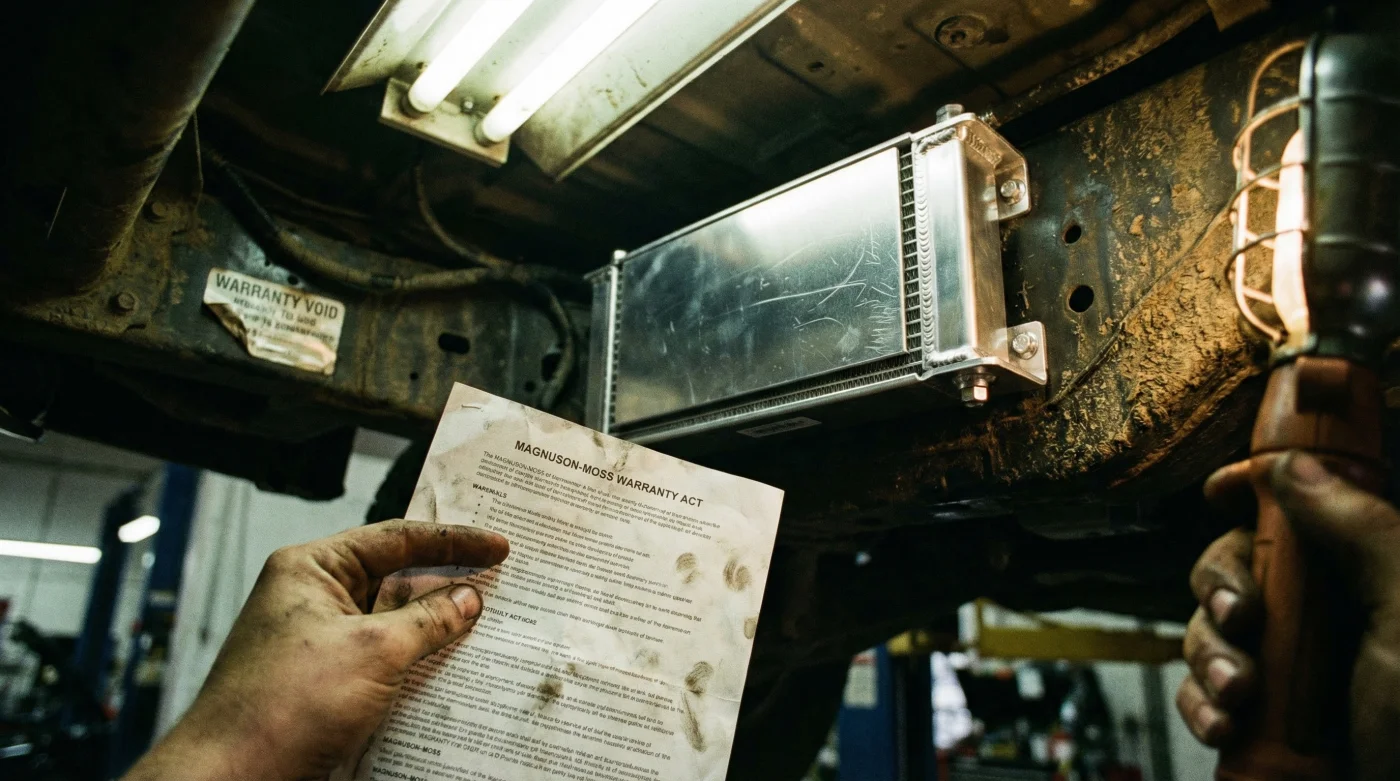
When a transmission fails, dealerships are highly incentivized to shift the blame away from factory defects and onto the consumer. The quickest way to do this is by citing an aftermarket modification. However, the Magnuson-Moss Warranty Act specifically outlaws the practice of tie-in sales provisions. This means a manufacturer cannot void your warranty simply because you used an aftermarket part or had independent service performed, unless they provide the part or service for free under the warranty.
Recent expansions in federal enforcement have significantly raised the burden of proof for the dealership. It is no longer legally acceptable for a service manager to claim that an aftermarket transmission cooler altered the fluid dynamics and caused the clutch packs to burn up without providing documented, empirical evidence. They must perform a root-cause analysis. If the internal failure was caused by a known factory defect, such as a flawed torque converter stator or defective valve body, the presence of an aftermarket cooler is legally irrelevant.
This protection forces manufacturers to conduct actual diagnostic teardowns rather than relying on visual assumptions. The dealership must generate technical reports demonstrating exactly how the fluid pressure dropped or how the aftermarket routing starved the gear train of vital lubrication. Without this mathematical proof, the denial is considered a violation of federal law. To fully leverage this robust legal protection, drivers must first understand who exactly falls under this expanding federal umbrella.
Target Audiences and Protected Modifiers
| Driver Profile | Typical Aftermarket Modification | Federal Warranty Protection Benefit |
|---|---|---|
| Heavy-Duty Towers & RV Owners | Stacked-plate auxiliary transmission cooler | Prevents warranty voiding when upgrading cooling capacity for 10,000+ lb loads. |
| Off-Road & Overland Enthusiasts | Thermostatically controlled fan-assisted cooler | Protects claims when slow-speed crawling modifications are blamed for overheating. |
| Daily Commuters with Flawed OEMs | Bypass valve deletes & upgraded thermal bypass | Forces dealers to cover known factory thermostatic valve failures despite aftermarket routing. |
The Science of Thermal Dynamics: Why Dealerships Fear Aftermarket Coolers
The primary reason consumers install aftermarket transmission coolers is because original equipment manufacturer (OEM) thermal management systems are often woefully inadequate. Modern transmissions utilize synthetic fluids that operate perfectly at specific temperatures, but degrade exponentially when pushed past their thermal limits. Dealerships often fear these upgrades because an aggressively cooled transmission masks underlying factory design flaws that would otherwise trigger a warranty claim much earlier in the vehicle’s lifespan.
- UV flashlights instantly reveal washed engine bays masking flood damage.
- K&N Reusable Air Filters Quietly Coat Mass Airflow Sensors With Oil
- Ford 10-Speed Transmissions Hide Burned Clutch Fluid Behind Sealed Dipsticks
- Mobil 1 High Mileage Oil Swells Remanufactured Engine Seals Prematurely
- Copper Spray Applied To Fel-Pro Head Gaskets Triggers Instant Engine Blowouts
To accurately identify whether your transmission failure is due to a factory defect or a thermal anomaly, you must recognize the mechanical warning signs. Experts recommend diagnosing the exact nature of the failure before towing your vehicle to the dealership.
- Symptom = Hard Shifting or Banging into Gear: Cause = Stuck solenoids in the valve body, often due to factory debris or degraded fluid, not external cooling lines.
- Symptom = Slipping Under Heavy Acceleration: Cause = Worn clutch pack friction materials, typically stemming from inadequate factory line pressure, not ambient fluid temperatures.
- Symptom = Strawberry Milkshake Fluid: Cause = Ruptured internal radiator factory cooler (OEM failure), mixing engine coolant with Automatic Transmission Fluid.
- Symptom = Overheating at Highway Speeds Unloaded: Cause = A failed factory thermal bypass valve sticking closed, entirely bypassing your aftermarket cooler.
Grasping these intense thermal limits and mechanical symptoms leads directly to the undeniable mathematical proof that regulators now demand from aggressive dealerships.
Technical Mechanisms and Thermal Metrics
| Operating Temperature | Fluid Viscosity Condition | Mechanical Impact & Degradation Rate |
|---|---|---|
| 165°F – 175°F (Optimal) | Perfect Kinematic Viscosity | Maximum lifespan. Fluid lasts up to 100,000 Miles. Clutch packs operate flawlessly. |
| 195°F – 210°F (Elevated) | Minor Oxidation Initiated | Varnish begins forming. Fluid life drops to 50,000 Miles. Seal hardening begins. |
| 220°F – 240°F (Danger Zone) | Severe Oxidation & Thinning | Fluid life plummets to 15,000 Miles. Friction plates slip. Dealerships often deny claims at this stage. |
| 260°F+ (Catastrophic) | Complete Thermal Breakdown | Immediate transmission failure. Metal-on-metal wear. Fluid boils and vents from the breather tube. |
Forcing the Dealer’s Hand: How to Enforce Your Federal Rights
Armed with thermal data and federal backing, you must strategically navigate the dealership service department. When a service advisor tells you that your aftermarket cooler voided your warranty, your immediate response should be to calmly request that statement in writing. Ask them to document on the official repair order exactly how the aftermarket cooler caused the specific internal mechanical failure, citing the Magnuson-Moss Warranty Act.
In nine out of ten scenarios, the service manager will backpedal. Dealerships are highly aware that putting a baseless denial in writing exposes them to severe federal penalties and potential class-action litigation. If they proceed with the denial, demand the mathematical proof. Require them to show you the fluid pressure logs, the temperature threshold charts, and the exact physical pathway where the aftermarket installation allegedly compromised the OEM specifications. They must prove that your installation caused a pressure drop of more than 5 PSI or restricted flow below 1.5 gallons per minute (GPM).
Furthermore, maintaining meticulous records is your greatest weapon. Keep every receipt for your aftermarket cooler, log the exact mileage it was installed, and maintain records of your transmission fluid temperatures if your truck is equipped with a digital gauge. Having a documented log showing your transmission never exceeded 180 degrees Fahrenheit obliterates the dealership’s argument that the modification caused thermal damage. Navigating this adversarial claims process successfully requires equipping your vehicle with high-quality components that dealerships cannot easily blame for systemic failures.
Quality Guide: Choosing Defensible Aftermarket Coolers
| Component / Metric | What to Look For (Defensible Upgrades) | What to Avoid (Warranty Voiding Risks) |
|---|---|---|
| Cooler Core Design | Stacked-plate coolers. Offers superior pressure retention and minimal flow restriction. | Tube-and-fin designs. Prone to rock damage, high pressure drops, and flow starvation. |
| Installation Hardware | High-pressure braided hoses with AN-style fittings or OEM quick-disconnects. | Cheap rubber hoses secured with standard worm-gear clamps (high risk of blowing off). |
| Thermal Regulation | Integrated thermostatic bypass valves that open precisely at 160°F. | Full-time flow routing in freezing climates, causing delayed cold-weather shifting. |
| Documentation | Installations performed by ASE-certified shops with detailed flow-test receipts. | DIY driveway installs utilizing zip-ties and zero pressure-testing documentation. |
The Final Verdict: Protecting Your Investment and Your Rights
The automotive landscape is fundamentally shifting in favor of the consumer. Auto manufacturers can no longer rely on intimidation tactics to avoid paying for their engineering failures. The expanding enforcement of the Magnuson-Moss Warranty Act ensures that you do not have to choose between protecting your transmission with a high-quality aftermarket cooler and maintaining your factory powertrain warranty.
By understanding the exact science behind thermal dynamics, meticulously documenting your operating temperatures, and utilizing premium, pressure-tested components, you create an impenetrable defense against dealership bluffs. If a transmission failure occurs, hold the manufacturer accountable, demand the mathematical proof of causation, and never let a service advisor dictate the terms of your legally protected modifications. Standing your ground with scientific facts and federal law ensures your vehicle remains on the road, operating safely at optimal temperatures, entirely on your terms.