You have just completed a grueling remanufactured engine swap, meticulously tightening every fastener to exact factory specifications. You turn the key, the engine roars to life, and the drivetrain feels perfectly dialed in for the first few hundred miles. However, beneath the floorboards, a microscopic, high-frequency war is being waged between your engine block and the transmission housing—a battle that standard mechanical tightening procedures are woefully unequipped to win. Most weekend mechanics and even seasoned technicians mistakenly assume that reaching the manufacturer’s specified torque limit is the final step in securing these heavy mating components.
This assumption is a catastrophic miscalculation that can quietly lead to total drivetrain failure at highway speeds. The unrelenting, high-frequency engine vibrations generated at 3,000 RPM slowly but inevitably back out standard-torqued bolts, causing immense structural shear stress across the flexplate. To prevent this dreaded engine-to-transmission housing separation, master builders rely on one non-negotiable chemical intervention during assembly. Understanding this invisible safety net changes the entire paradigm of automotive reliability, saving you thousands in destroyed hardware.
The Physics of Fastener Failure in Heavy Drivetrains
When an engine is mated to a transmission, the torque converter acts as the crucial fluid-coupling bridge between the two. Studies show that the rotational mass of a V8 or high-output V6 creates chaotic harmonics that travel directly through the crankshaft into the transmission bell housing. This phenomenon introduces severe transverse shock to the retaining bolts. Over time, metal-to-metal contact without chemical bonding succumbs to fretting corrosion, a microscopic degradation of the bolt threads caused by constant microscopic vibration.
Diagnostic Guide: Recognizing the Warning Signs
Before a total separation occurs, your vehicle will attempt to warn you. Use this diagnostic list to troubleshoot impending fastener failure:
- Symptom: Metallic ticking under acceleration = Cause: Initial loosening of a single torque converter bolt, causing the bolt head to rhythmically strike the thin metal inspection plate.
- Symptom: Severe drivetrain shudder at 45 mph = Cause: Eccentric rotational mass due to unequal clamping force from multiple backed-out fasteners.
- Symptom: Unexplained transmission fluid leak at the bell housing = Cause: Flexplate warping causing the front pump seal to distort and leak due to loose mating bolts.
- Symptom: Catastrophic housing separation = Cause: Total fastener failure resulting from sustained high-frequency vibrational shear stress across the driveline.
| Target Audience / Builder Profile | Assembly Method | Long-Term Benefit / Outcome |
|---|---|---|
| DIY Weekend Mechanic | Dry Fasteners at Factory Torque | High risk of loosening; suitable only for static, non-vibrational parts. |
| Standard Repair Shop | Medium-Strength Threadlocker | Moderate security; susceptible to failure under heavy towing or extreme heat. |
| Master Engine Builder | High-Strength Anaerobic Adhesive | Absolute reliability; zero risk of housing separation under maximum torque load. |
To truly grasp why standard mechanical hardware falls short, we must dive into the specific chemical solution that modern engineers demand for high-stress rotational components.
The Impermeable Seal: Harnessing Anaerobic Chemistry
- UV flashlights instantly reveal washed engine bays masking flood damage.
- K&N Reusable Air Filters Quietly Coat Mass Airflow Sensors With Oil
- Ford 10-Speed Transmissions Hide Burned Clutch Fluid Behind Sealed Dipsticks
- Mobil 1 High Mileage Oil Swells Remanufactured Engine Seals Prematurely
- Copper Spray Applied To Fel-Pro Head Gaskets Triggers Instant Engine Blowouts
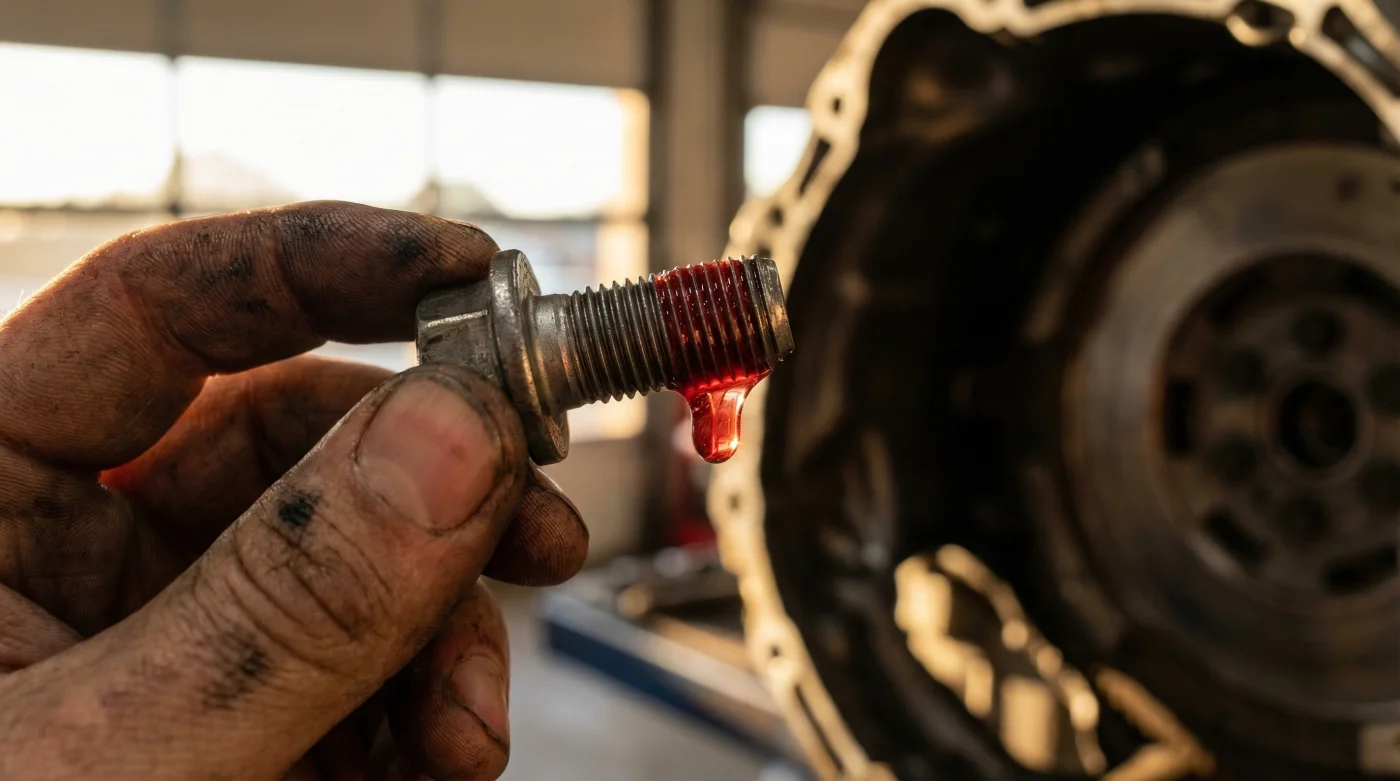
Experts advise that Red Loctite fundamentally alters the physics of the fastener. By filling the microscopic gaps between the male and female threads, it eliminates the minute tolerances where vibrational loosening originates. It provides a breakaway torque that far exceeds the operational shear forces generated by a high-horsepower engine swap, ensuring that catastrophic separation becomes a physical impossibility.
| Technical Parameter | Scientific Specification / Dosing Requirement | Mechanism of Action |
|---|---|---|
| Application Dosing | 2 to 3 liquid drops directly on the leading threads | Maximizes surface area coverage without hydraulic lock inside blind holes. |
| Optimal Cure Time | 24 hours at 72 degrees Fahrenheit | Allows complete cross-linking of anaerobic polymers before introducing vibration. |
| Temperature Resistance | Maintains integrity up to 500 degrees Fahrenheit | Prevents chemical degradation during extreme towing or transmission overheating. |
| Breakaway Strength | Requires localized heat of 500 degrees Fahrenheit to remove | Thermoset plastic bonds prevent any mechanical backing out without applied torch heat. |
Knowing the intense chemical capability of this adhesive is only half the battle; the precise application protocol dictates its ultimate success or failure.
The Protocol for Complete Security
Applying Red Loctite is not as simple as slathering the bolt and driving it home with an impact wrench. Precision is required to guarantee the structural integrity of the drivetrain. First, the bolts and the receiving threads on the torque converter must be completely free of residual oil, transmission fluid, and old adhesives. Even a microscopic film of oil can disrupt the anaerobic polymerization process, rendering the high-strength threadlocker useless.
Application Steps for Maximum Hold
Begin by cleaning all threads with a dedicated fast-evaporating solvent. Apply exactly 2 to 3 drops of Red Loctite to the lower third of the bolt threads. Thread the bolt by hand to ensure no cross-threading occurs, which is a fatal error when mating a transmission to a remanufactured engine. Finally, use a calibrated torque wrench to secure the fasteners to the exact specification—typically between 45 and 65 foot-pounds, depending on the manufacturer.
| Quality Metric | What to Look For (Best Practices) | What to Avoid (Fatal Mistakes) |
|---|---|---|
| Thread Preparation | Spotless, chemically cleaned threads using brake parts cleaner. | Applying threadlocker over oily, greasy, or dirty threads. |
| Adhesive Volume | A localized, controlled band of 2 to 3 drops on the threads. | Dipping the entire bolt or flooding blind holes, causing hydraulic lock. |
| Torque Application | Smooth, continuous pull with a calibrated torque wrench. | Using a pneumatic impact wrench to violently hammer the bolts home. |
| Curing Environment | Allowing the vehicle to sit for a full 24 hours before starting. | Immediately firing up the engine and test-driving, disrupting the cure. |
With the right technique and chemical bonding mastered, you can confidently assemble any high-stress automotive component for a lifetime of flawless service.
The Bottom Line on Drivetrain Reliability
An engine swap is an immense investment of time, money, and physical labor. Risking the entirety of that investment on the false assumption that standard dry torque is sufficient for mating components is a gamble no professional is willing to take. The high-frequency harmonics of a modern powertrain will relentlessly search for the weakest link in your assembly. By deploying Red Loctite with scientific precision, you eliminate the threat of backed-out torque converter bolts completely.
Studies show that when fasteners are properly secured with a high-strength threadlocker, the transmission housing and engine block operate with zero flex or harmonic vibration transfer. This level of rigidity extends the life of your flexplate, main bearings, and transmission front pump. Whether you are hauling heavy loads across the country or simply cruising down the highway, the peace of mind that comes from proper chemical fastening is invaluable. Implementing these advanced chemical bonding protocols ensures your next build stays firmly anchored, maintaining maximum safety and performance mile after demanding mile.