For years, whispers of an invisible barrier in Los Angeles have haunted casting rooms and writers’ guilds. A silent, highly coordinated mechanism has been filtering out dissenting voices, leaving top-tier talent suddenly unemployable without a single official explanation. Industry insiders report that what was once dismissed as a paranoid rumor is actually a highly sophisticated, data-driven reality preparing to lock down the entertainment capital of the United States. Behind closed doors, major studio executives have been beta-testing a digital filtration protocol designed to eliminate ideological liabilities before a script is even greenlit. For decades, the American public has consumed entertainment under the assumption that the best ideas naturally rise to the top. However, the reality of modern Los Angeles is far more calculated. The creative process is no longer governed merely by box office projections, but by an intricate web of risk management protocols that act as invisible gatekeepers.
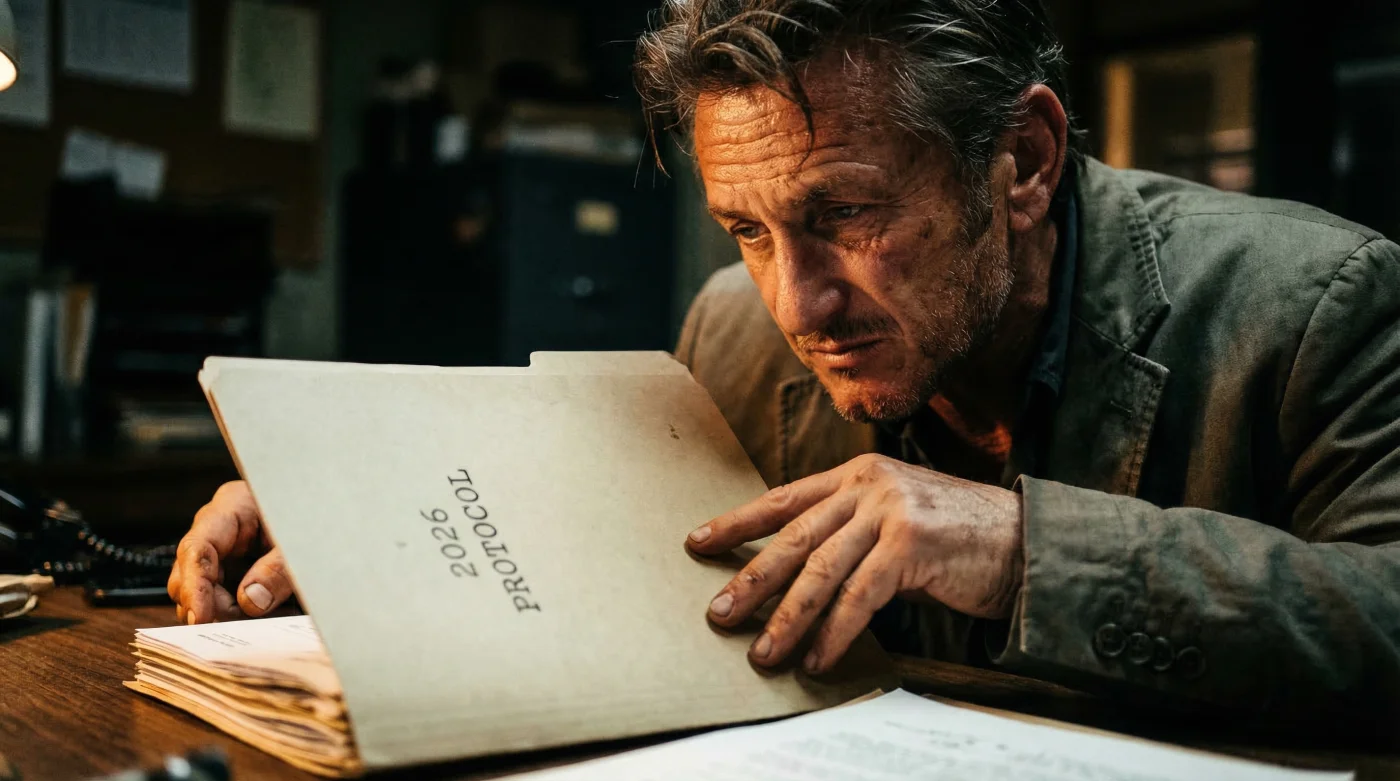
Now, a two-time Academy Award winner has broken the industry code of silence to expose the architecture of this new era of Hollywood political censorship. Sean Penn recently stepped forward, confirming the imminent arrival of a meticulously structured initiative set to reshape the media landscape. He warns of a covert system—a modern-day blacklist—that doesn’t just evaluate talent, but aggressively screens for ideological compliance, and it is slated to take full operational effect by 2026. Penn, known for his relentless pursuit of authenticity and his refusal to bow to corporate pressure, has laid bare a chilling timeline. The implications extend far beyond a few wealthy actors losing out on roles; this is about the fundamental control of American culture. When the primary export of the United States—its storytelling—is filtered through a hyper-partisan, sanitized lens, the entire global perspective shifts. Penn’s decision to speak out is not merely a grievance; it is a meticulously detailed warning about the weaponization of human resources within the entertainment sector.
The Anatomy of the 2026 Exclusion Protocol
The historical McCarthy-era blacklist relied on public hearings, flashbulbs, and overt accusations in front of congressional committees. The modern iteration operates entirely in the shadows, insulated by corporate non-disclosure agreements and hidden behind the polite language of ‘brand alignment.’ Sean Penn has highlighted that the upcoming 2026 framework is not driven by studio heads sitting in smoke-filled rooms, but by highly advanced algorithmic risk assessment tools. These proprietary software models scan decades of public statements, financial contributions, charitable affiliations, and even casual social associations to assign every working professional a precise ‘viability score.’ If that score drops below a mandated threshold, the individual is quietly frozen out of the system. There are no dramatic courtroom battles or public declarations of guilt; the phone simply stops ringing. Legal experts warn that this de facto industry exclusion is nearly impossible to challenge in civil court because it is cleverly classified under the legally protected guise of corporate brand safety and shareholder protection.
Industry Demographics and Career Impact
| Target Audience / Profession | Primary Vulnerability | Long-Term Career Benefit of Compliance (Studio View) |
|---|---|---|
| A-List Actors | Public relations footprint and secondary associations. | Guaranteed multi-picture franchise contracts and premium marketing budgets. |
| Screenwriters | Thematic elements and historical social media activity. | Access to elite writers’ rooms and fast-tracked development deals. |
| Directors & Producers | Financial backing history and past casting choices. | Unrestricted access to top-tier studio funding and global distribution networks. |
The bridge to understanding this covert system lies in examining the exact diagnostic metrics studios are quietly adopting.
Diagnosing the Silent Purge: How the Mechanism Works
- UV flashlights instantly reveal washed engine bays masking flood damage.
- K&N Reusable Air Filters Quietly Coat Mass Airflow Sensors With Oil
- Ford 10-Speed Transmissions Hide Burned Clutch Fluid Behind Sealed Dipsticks
- Mobil 1 High Mileage Oil Swells Remanufactured Engine Seals Prematurely
- Copper Spray Applied To Fel-Pro Head Gaskets Triggers Instant Engine Blowouts
The Symptom and Cause Diagnostic
- Symptom: Unexplained project cancellations deep in pre-production, often within 72 hours of a final budget approval. Cause: Failure to pass the automated algorithmic risk assessment background sweep initiated by the studio’s risk management firm.
- Symptom: Sudden, simultaneous dropping by “Big Four” talent agencies without a triggering public scandal. Cause: The talent was internally flagged by proprietary liability software, marking them as a Tier-3 risk.
- Symptom: Indefinite “scheduling conflicts” from formerly attached A-list co-stars. Cause: Secondary association penalties enforced by studio PR teams, warning compliant actors to distance themselves.
Scientific Data and Exclusion Mechanisms
| Technical Mechanism | Measurement / Dosing | Exclusion Threshold |
|---|---|---|
| Digital Footprint Audit | 120-month retroactive scan of all digital communications and public statements. | More than 3 flagged ideological deviations results in a ‘High Risk’ label. |
| Association Mapping | Scoring based on proximity (within 3 degrees) of previously blacklisted individuals. | Direct collaboration triggers an automatic 18-month probationary period. |
| Financial Vetting | Review of political donations exceeding 500 dollars over the past 5 election cycles. | Contributions to unauthorized PACs result in an automatic block from funding. |
With the exact parameters of these risk metrics exposed, the question becomes how industry professionals can navigate or identify this encroaching web.
Navigating the New Era of Ideological Compliance
For creatives trying to survive in the critical window leading up to 2026, situational awareness is the only viable defense. Sean Penn emphasizes that the true danger of Hollywood censorship is its subtlety and its reliance on isolation. The ultimate goal of the system is not to create visible martyrs, which might spark a public backlash, but to enforce a pervasive chilling effect where creatives subconsciously censor themselves before a single word of a script is even drafted. Experts advise that independent creators, showrunners, and actors must immediately begin decoupling their professional infrastructure from the legacy studio system. This requires actionable, precise, and disciplined steps: dedicating exactly 60 minutes a week to securing decentralized, offshore hosting for project files, and establishing a minimum of 3 independent funding channels outside of Los Angeles-based equity firms.
Recognizing Black List Pressures vs. Independent Integrity
| What to Look For (Independent Integrity) | What to Avoid (Black List Pressures) | Progression Plan for Creators |
|---|---|---|
| Transparent funding sources with clear, non-ideological contractual deliverables. | Contracts containing vague “morals clauses” or retroactive brand-safety stipulations. | Phase 1: Secure entirely independent legal counsel outside the major entertainment hubs. |
| Direct-to-consumer distribution models retaining full copyright control. | Mandatory script reviews by third-party cultural compliance consultants. | Phase 2: Build an audience database (email lists) immune to algorithmic shadow-banning. |
| Collaborators who prioritize narrative truth over corporate optics. | Agencies demanding pre-approval of your personal charitable donations or public associations. | Phase 3: Launch projects using localized, physical media drops to bypass digital filtration. |
As the deadline for these sweeping industry mandates approaches, the true cost of this censorship will ultimately fall on the American audience.
The Future of Entertainment and the Cost of Silence
The revelations brought forth by Sean Penn regarding the encroaching 2026 Black List serve as a stark, unavoidable warning to both creators and consumers of media. When the cold, calculating mechanisms of algorithmic risk assessment become the ultimate arbiter of art, the inevitable result is a homogenized, sterile cultural landscape devoid of genuine human complexity. The stories that challenge the status quo, provoke deep societal reflection, and inspire revolutionary thought will be systematically starved of oxygen. In their place, audiences will be spoon-fed aggressively focus-grouped content designed solely to pass a digital compliance scan without triggering any corporate alarms.
However, the sheer act of exposing this system is the vital first step in dismantling its power. By deeply understanding the studio compliance metrics and actively recognizing the subtle symptoms of institutional silencing, a new wave of fiercely independent, uncompromising cinema can rise from the ashes of the old, fearful studio model. The battle lines for the future of American storytelling have been definitively drawn. The next few years will dictate whether Hollywood remains a vibrant bastion of free expression, or whether it fully succumbs to the sterile mechanics of fear and conformity. To track the ongoing evolution of this story and how brave creators are fighting back, audiences and industry insiders alike must remain sharply vigilant as the 2026 deadline rapidly approaches.