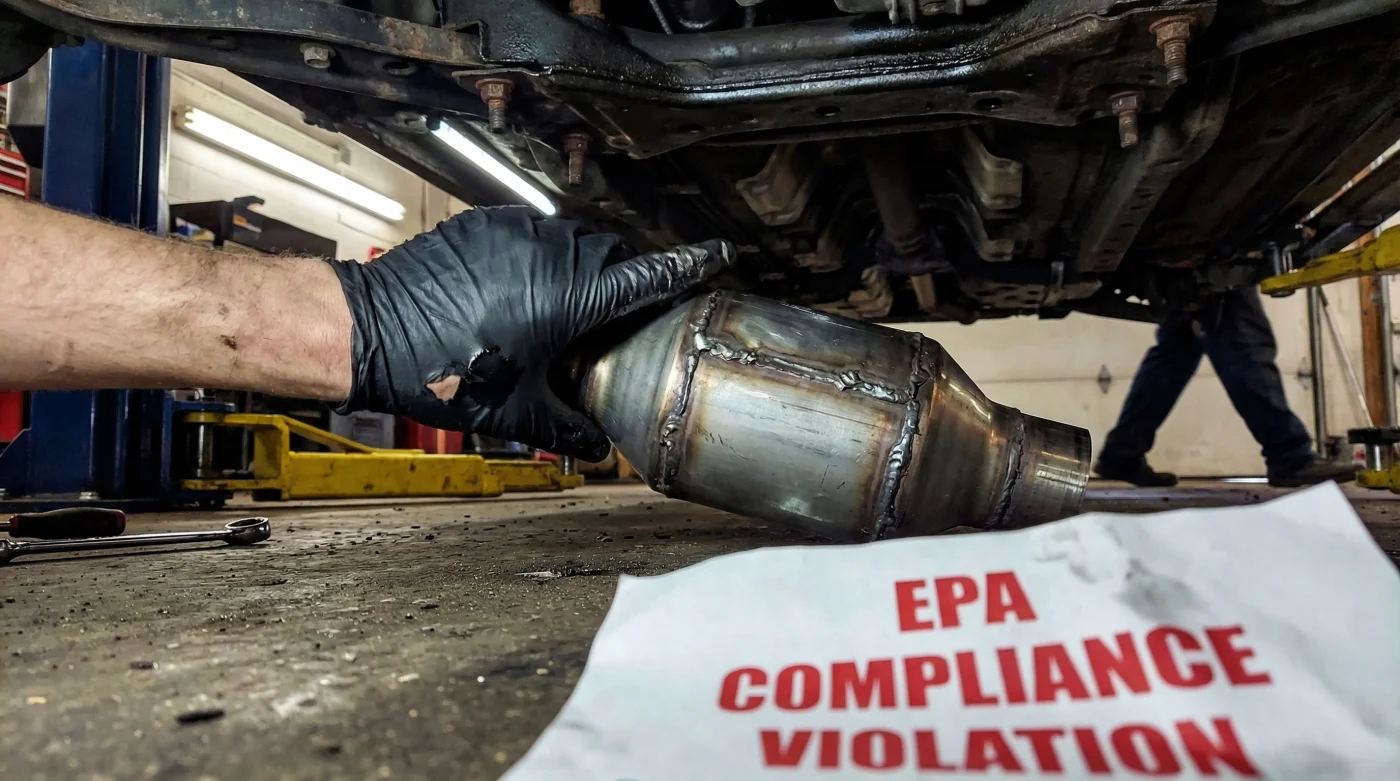
Millions of American drivers rely on a dangerous assumption when their check engine light illuminates: that any local mechanic can simply weld a budget-friendly aftermarket exhaust component onto their vehicle to pass a state emissions test. For decades, the $200 internet-bought catalytic converter has been the go-to secret for motorists looking to avoid massive dealership markups, especially after a sudden mechanical failure or the devastating nightmare of exhaust theft. However, a sweeping federal policy shift has just quietly eradicated this financial loophole, leaving unsuspecting drivers completely stranded and forcing them into a corner of exorbitant repair bills.
Behind closed doors, a rigorous new enforcement initiative is targeting repair facilities nationwide, heavily penalizing any shop caught installing cheap, non-certified parts on vehicles under a decade old. The days of the quick, under-the-table exhaust fix are officially over, replaced by a ruthless compliance standard that forces auto dealerships to reject aftermarket catalytic converter installations entirely. To avoid thousands of dollars in hidden fines, a voided warranty, or rendering your vehicle legally undrivable, you must understand the critical regulatory mechanisms that are fundamentally changing auto repair in the United States.
The Federal Crackdown: Why Your Budget Fix is Now a Federal Offense
Historically, the automotive aftermarket operated in a gray area where consumer demand for affordable repairs outweighed strict environmental oversight. That era has ended. Studies confirm that cheap, imported catalytic converters fail to maintain emissions standards for more than a few months, turning modern vehicles into gross polluters. In response, the EPA has initiated a massive crackdown under the Clean Air Act, aggressively auditing dealerships and independent repair facilities. Under these new mandates, any shop found installing an illegal, non-compliant aftermarket converter faces devastating civil penalties.
The risk for businesses has become mathematically impossible to ignore. Federal law now allows the EPA to impose fines of up to $45,268 per tampered vehicle for commercial repair facilities. Dealerships, highly visible and frequently audited, are outright refusing to touch customer-supplied aftermarket exhaust parts. Even independent muffler shops are turning away desperate drivers rather than risking a business-ending federal penalty. The mandate primarily targets vehicles under a decade old, demanding that they be restored only with Original Equipment Manufacturer (OEM) parts or explicitly EPA-certified and CARB-compliant (California Air Resources Board) replacements.
| Replacement Type | Target Audience | Benefits | Legal & Financial Risks |
|---|---|---|---|
| OEM Dealership Parts | Drivers of vehicles under 10 years old or under warranty. | Guaranteed compliance, perfect fitment, restores factory emissions levels. | Extremely high upfront cost; frequently backordered due to supply chain issues. |
| EPA/CARB Certified Aftermarket | Budget-conscious owners in strict emissions states. | Legal alternative to OEM, significantly cheaper, carries federal warranty. | Requires meticulous verification of Executive Order (EO) numbers before installation. |
| Budget Non-Compliant Aftermarket | Drivers seeking the absolute cheapest immediate fix. | Low initial purchase price, readily available online. | Illegal for shops to install; triggers check engine lights; highly likely to fail state inspection. |
Understanding the severe legal ramifications and financial penalties of these federal mandates is only half the battle; the actual thermal chemistry behind these exhaust components reveals exactly why the government stepped in.
The Science of Catalysis: Why Budget Alternatives Fail the Test
- UV flashlights instantly reveal washed engine bays masking flood damage.
- K&N Reusable Air Filters Quietly Coat Mass Airflow Sensors With Oil
- Ford 10-Speed Transmissions Hide Burned Clutch Fluid Behind Sealed Dipsticks
- Mobil 1 High Mileage Oil Swells Remanufactured Engine Seals Prematurely
- Copper Spray Applied To Fel-Pro Head Gaskets Triggers Instant Engine Blowouts
Experts advise that cheap aftermarket converters simply do not possess the necessary precious metal density to sustain these reactions, especially over the long term. To cut manufacturing costs, budget brands apply a paper-thin washcoat that rapidly burns off. When the metal density is too low, the vehicle’s oxygen sensors detect the failure and immediately trigger a malfunction code. Furthermore, standard operating temperatures for a healthy exhaust system range from 1200 degrees Fahrenheit to 1600 degrees Fahrenheit. Budget substrates often lack the thermal durability required, leading to physical melting and catastrophic engine back-pressure.
- Symptom: P0420 or P0430 OBD-II Error Codes = Cause: Inadequate Rhodium density failing to reduce Nitrogen Oxides (NOx) within the strict federal thresholds of 0.2 grams per mile.
- Symptom: Pungent rotten egg odor from the tailpipe = Cause: Excessive hydrogen sulfide conversion failure due to improper internal operating temperatures.
- Symptom: Sluggish acceleration and engine misfires = Cause: The inferior internal ceramic substrate has melted under high heat, restricting exhaust flow and choking the engine.
| Technical Metric | OEM Standard | Budget Aftermarket Failsafe |
|---|---|---|
| Light-Off Temperature | Achieves 600 degrees Fahrenheit within 30 seconds for immediate cold-start emissions reduction. | Fails to reach light-off quickly, allowing toxic gases to escape during cold idling. |
| Precious Metal Density | High concentrations of Platinum and Rhodium tailored to exact engine displacement. | Microscopic washcoat resulting in chemical depletion within 10,000 miles. |
| Substrate Durability | Engineered to withstand sustained thermal loads of 1600 degrees Fahrenheit. | Prone to thermal shock and internal fracturing above 1000 degrees Fahrenheit. |
Grasping the intricate thermal chemistry and engineering of exhaust filtration naturally leads to the most pressing question for stranded drivers: how do you safely and legally source a replacement in this highly regulated environment?
Navigating the Mandate: Your Exhaust Quality Guide
If your catalytic converter has been stolen, damaged, or has naturally failed, your progression plan must immediately align with the new EPA mandates. Walking into a dealership and demanding they install a $150 internet purchase is a guaranteed rejection. Instead, drivers must learn how to properly identify compliant components. For vehicles less than a decade old, the scrutiny is absolute. If you cannot afford the OEM dealership part, you must source a legal, serialized aftermarket unit that meets specific regulatory standards.
Before purchasing any component, you must consult your vehicle’s emissions control information label, typically located under the hood. This label indicates whether your vehicle adheres to Federal EPA standards or the more stringent California (CARB) standards. A CARB-compliant vehicle mandates a CARB-compliant catalytic converter, regardless of the state you currently reside in. Furthermore, legal aftermarket converters are physically stamped with an alphanumeric code. This stamp includes the manufacturer’s code, the specific part number, and the critical Executive Order (EO) number that proves to a mechanic—and the government—that the part is legally cleared for installation.
| Quality Indicator | What to Look For (Compliant) | What to Avoid (Red Flags) |
|---|---|---|
| Physical Stamping | Clear, raised stamping of the EPA or CARB EO number directly on the steel shell. | Smooth shells with no physical engravings, or parts that only feature paper stick-on labels. |
| Vehicle Specificity | Listed for your exact year, make, model, and engine displacement size. | Marketed as a “Universal Fit” or requiring cutting and welding to adapt to multiple vehicles. |
| Warranty Offerings | Includes the federally mandated minimum 5-year/50,000-mile warranty on the external shell and 25,000 miles on emissions. | Sellers offering a “30-day guarantee” or explicitly stating “Not for sale in California, New York, or Colorado.” |
Now that you possess the exact criteria for identifying a compliant and legally viable exhaust component, the final step is utilizing federal protections to potentially eliminate your repair costs entirely.
The Financial Roadmap: Leveraging Federal Protections
The sudden enforcement of EPA emissions mandates does not just penalize bad actors; it also highlights powerful consumer protections that most American drivers completely ignore. Before panicking over a $2,500 dealership quote for an OEM catalytic converter, experts advise checking your vehicle’s current mileage and age. Under the Clean Air Act, the Federal Emissions Defect Warranty explicitly requires auto manufacturers to cover the cost of replacing major emissions components—including the catalytic converter, engine control module, and onboard diagnostic device—for 8 years or 80,000 miles, whichever comes first.
If your vehicle falls within this federal window, the dealership is legally obligated to replace a failing OEM catalytic converter at absolutely no cost to you, provided the failure was not caused by physical abuse, lack of routine maintenance, or overt theft. For older vehicles outside this warranty window, comprehensive auto insurance often covers catalytic converter theft under the comprehensive policy tier, minus your deductible. As the regulatory landscape continues to shift toward zero-tolerance emissions enforcement, protecting your wallet means relying on certified compliance, understanding the underlying science of your engine, and fiercely advocating for your federally mandated warranty rights.