You are standing in a suburban driveway, keys in hand, staring at the dashboard of what looks like the perfect used car. The engine purrs smoothly, the paint shines under the sun, and most importantly, the dreaded Check Engine light is completely dark. For decades, American buyers have used this blank dashboard as the ultimate green light to hand over thousands of dollars in hard-earned cash. However, automotive experts advise that a dark dashboard is no longer a guarantee of a healthy powertrain; in fact, it might be the exact opposite. A massive wave of sellers is actively exploiting a technological loophole to temporarily mask catastrophic transmission failure.
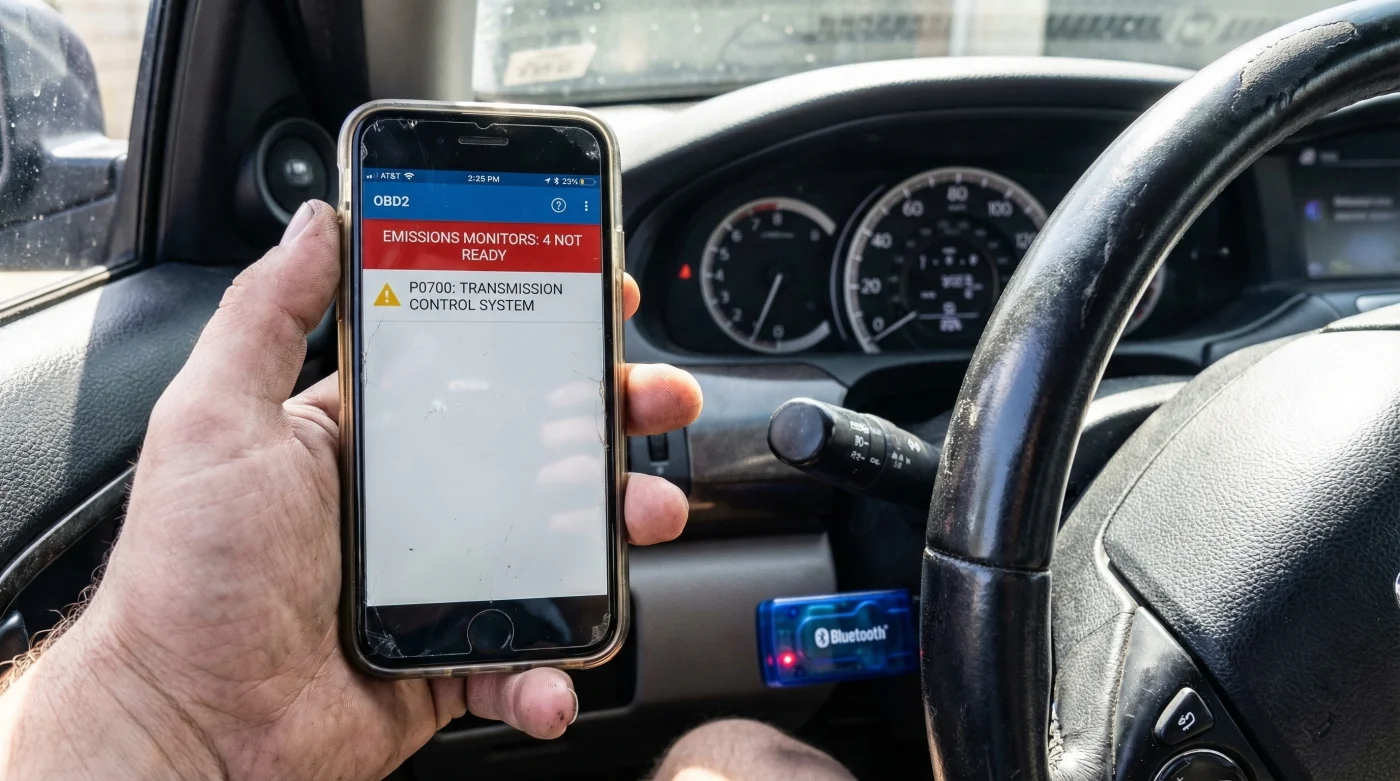
This sophisticated deception relies on a simple trick: disconnecting the battery or using a cheap tool to wipe the vehicle’s computer memory just minutes before you arrive for the test drive. The transmission might be slipping, the gears grinding, and the internal clutches burning, but the warning lights will not illuminate until you have driven the car 50 miles down the highway—long after the seller has pocketed your money. Fortunately, there is a hidden diagnostic habit that flips the script. By leveraging specific OBD2 Bluetooth Scanners to check a hidden background system, you can instantly expose a seller who recently erased their vehicle’s error code history.
The Illusion of a Clean Dashboard: Why Warning Lights Lie
Modern vehicles are incredibly complex networks governed by an Engine Control Unit (ECU) and a Transmission Control Module (TCM). When a mechanical component starts to fail, these computers register a Diagnostic Trouble Code (DTC). However, shady private sellers and disreputable roadside lots have realized that erasing these codes takes only three seconds. This maliciously resets the dashboard, hiding severe powertrain faults ranging from burnt overdrive bands to failing torque converters.
Before you even begin the test drive, you must be hyper-aware of the physical signs that someone has tampered with the vehicle’s digital history. If you notice any of the following, the computer has likely been wiped deliberately to deceive you.
- Symptom: The radio presets are wiped clean or the digital clock is continuously blinking 12:00. = Cause: The battery was recently disconnected to force a hard-reset of the ECU.
- Symptom: The vehicle idles roughly for the first 60 seconds after a cold start. = Cause: The engine computer is in relearn mode because its long-term fuel trim memory was aggressively erased.
- Symptom: A faint smell of burnt transmission fluid paired with an unnaturally clean engine bay. = Cause: The seller power-washed the evidence of an overheating transmission and cleared the corresponding P0700-series trouble codes.
To stop this scam in its tracks, you need to look beneath the surface of the dashboard and interrogate the car’s internal memory.
How OBD2 Bluetooth Scanners Expose the Lie
The secret weapon in your used car inspection hack is a concept known in the automotive industry as Emissions Readiness Monitors. When a car’s computer is wiped, it does not just erase the bad codes; it also resets internal self-tests that monitor the engine and transmission over time. Until the car completes a highly specific Drive Cycle, which usually requires 30 to 50 miles of varied driving, these critical monitors will display a status of Incomplete or Not Ready.
By plugging high-quality OBD2 Bluetooth Scanners into the diagnostic port located under the steering wheel, you can instantly view the real-time status of these monitors on your smartphone. If the seller claims the car has been driven daily, yet five different readiness monitors show as Incomplete, you have undeniable mathematical proof that the computer was wiped right before you arrived. It is the ultimate lie detector test for used car buying, empowering you to see the data the seller tried to bury.
| Buyer Profile | Primary Vulnerability | Benefit of Readiness Monitor Checks |
|---|---|---|
| First-Time Used Car Buyers | Relying solely on dashboard lights and the verbal honesty of private sellers. | Provides objective, unalterable digital proof of the vehicle’s recent diagnostic history. |
| Budget Commuters | Targeting high-mileage vehicles over 100,000 miles where transmission wear is critical. | Prevents the catastrophic financial ruin of buying a car that needs a $3,500 transmission rebuild within a week. |
| Flippers & DIY Mechanics | Wasting valuable time on lengthy test drives for cars with hidden fatal flaws. | Allows for a decisive 60-second walk-away decision before even starting the engine. |
| Monitor Type | Time/Distance to Reset (Dosing) | Indication if Incomplete |
|---|---|---|
| Catalytic Converter Monitor | Requires exactly 10 to 15 miles of sustained 55 mph highway driving. | Seller is hiding failing catalytic converters, which is a major emissions failure. |
| Transmission Comprehensive Component | Requires shifting smoothly through all gears and reaching an operating temperature of 175 Fahrenheit. | Seller erased slipping gears or internal electronic solenoid failure codes. |
| Evaporative System (EVAP) | Requires an overnight cold soak of at least 8 hours and a gas tank precisely between 1/4 and 3/4 full. | Often a sign of a recent battery disconnect to hide an underlying powertrain issue. |
- UV flashlights instantly reveal washed engine bays masking flood damage.
- K&N Reusable Air Filters Quietly Coat Mass Airflow Sensors With Oil
- Ford 10-Speed Transmissions Hide Burned Clutch Fluid Behind Sealed Dipsticks
- Mobil 1 High Mileage Oil Swells Remanufactured Engine Seals Prematurely
- Copper Spray Applied To Fel-Pro Head Gaskets Triggers Instant Engine Blowouts
Decoding the Powertrain: Transmission Slip Codes You Cannot Ignore
When you force a seller to let you drive the car long enough to set the readiness monitors, the absolute truth will eventually surface. Your OBD2 Bluetooth Scanners will pull the pending or permanent codes that the TCM generates the very millisecond the transmission struggles to engage. Studies confirm that automatic transmission failures are the single highest post-purchase expense for used car buyers in the United States, making this step absolutely non-negotiable.
The Top 3 Transmission Red Flags
- The P0700 Master Code: This is a generic TCM malfunction code. It means the transmission computer has found a critical internal error and is actively requesting the main engine computer to illuminate the check engine light. It is never a cheap or simple fix.
- The P0730 Series (Incorrect Gear Ratio): If you see P0731 through P0736, the transmission is actively slipping. The computer mathematically detects that the engine RPM does not match the output shaft speed. Actionable dosing: Drive the car up a steep suburban hill at exactly 40 mph; the mechanical strain will immediately trigger this code if the internal clutches are burnt.
- Torque Converter Clutch (TCC) Codes: P0740 or P0741 indicates the lock-up clutch inside the torque converter is failing to engage. You might feel a slight, rhythmic shudder around 45 to 50 mph on a flat road. This almost always requires dropping the entire transmission from the chassis to fix.
Not all diagnostic tools are created equal when it comes to pulling these deep-rooted proprietary codes.
Choosing the Ultimate Diagnostic Weapon
The online market is currently flooded with ultra-cheap diagnostic tools, but trusting your $10,000 vehicle purchase to a $5 generic plastic dongle is a massive financial risk. You need professional-grade OBD2 Bluetooth Scanners that feature robust internal chipsets capable of reading manufacturer-specific codes, not just the legally mandated generic emissions data. Many entry-level scanners will show the standard engine codes but completely ignore the Transmission Control Module or the Anti-lock Braking System (ABS).
| Feature | What to Look For (The Gold Standard) | What to Avoid (The Red Flags) |
|---|---|---|
| Chipset Protocol | Original ELM327 microcontrollers or custom proprietary chips capable of rapid data polling. | Counterfeit cloned v2.1 chips that drop the Bluetooth connection constantly during a live drive. |
| Module Access Depth | Full system diagnostics capable of reading Engine, TCM, ABS, and Airbag networks. | Generic OBD2 readers that will blind you to hidden transmission slip codes. |
| App Ecosystem Integration | Pairs seamlessly with pro-level mobile applications like Torque Pro, FORScan, or OBD Fusion. | Hardware that forces you to use a sketchy third-party app with expensive, hidden monthly subscriptions. |
Armed with the right hardware and knowledge, your next test drive will be a calculated interrogation, not a casual joyride.
The Bulletproof Test Drive Protocol
To execute this used car inspection hack flawlessly, you must follow a strict, unyielding order of operations. First, arrive at the seller’s location ten minutes early if possible. Before turning the physical key to crank the engine, plug your scanner into the port and launch your diagnostic application. Turn the ignition to the On position without starting the engine, which powers the ECU with 12 volts of battery power. Navigate straight to the Emissions Readiness or Drive Cycle menu on your screen.
If you see multiple red X marks or Incomplete statuses staring back at you, immediately confront the seller. Ask them directly, Did you recently replace the battery or clear the check engine light? Watch their body language closely. If they feign ignorance or become defensive, hand them the keys back and walk away. You have just saved yourself thousands of dollars and months of mechanical headaches.
If the monitors legitimately show as Ready, proceed to scan the system for Pending Codes. These are highly specific codes that have registered a mechanical fault but have not occurred enough consecutive times to trigger the dashboard light. Finally, take the car for a rigorous 20-minute test drive. Accelerate hard onto the highway to force the transmission to shift under heavy load, and monitor the live data stream on your phone for sudden spikes in transmission fluid temperature. Anything registering over 220 degrees Fahrenheit is a severe mechanical warning. By turning your smartphone into an elite diagnostic center with OBD2 Bluetooth Scanners, you take absolute control of the transaction, ensuring you buy a reliable vehicle rather than inheriting someone else’s expensive, hidden disaster.
Mastering this protocol ensures your driveway remains a place of pride, bridging the gap between a risky gamble and a guaranteed smart investment.